

AI Economics™ wasn’t a prediction. It was a warning. The 2026 ‘State of’ Reports prove it. In October, we made six prominent predictions about AI Economics and how it would transform the tech services industry. We argued that SaaS complacency was nearing its end, but instead of disappearing, services would refactor. There would be a shift in value from deployment to break/fix, consolidating around orchestration, advisory, integration, and optimization.
Now that the 2026 State of Reports have dropped, the question is, were our predictions directional or definitive? The data is clear: the industry understands the shift, but execution is still a work in progress.
Key Takeaways
- TSIA’s AI Economics predictions were right. The 2026 State of Reports confirm that value is shifting away from seat-based SaaS toward orchestration, advisory, optimization, and outcome ownership across every major service line.
- AI adoption is accelerating, but operational maturity is lagging. Organizations are investing in AI and automating core functions, yet pricing models, ROI measurement, governance, and unified data strategies haven’t caught up.
- The competitive advantage now belongs to execution. The companies that redesign pricing, formalize ROI discipline, and operationalize AI-native service portfolios will outperform those still protecting legacy SaaS economics.
Professional Services is Moving Up the Value Stack, but Maturity Is Still Low
Our prediction
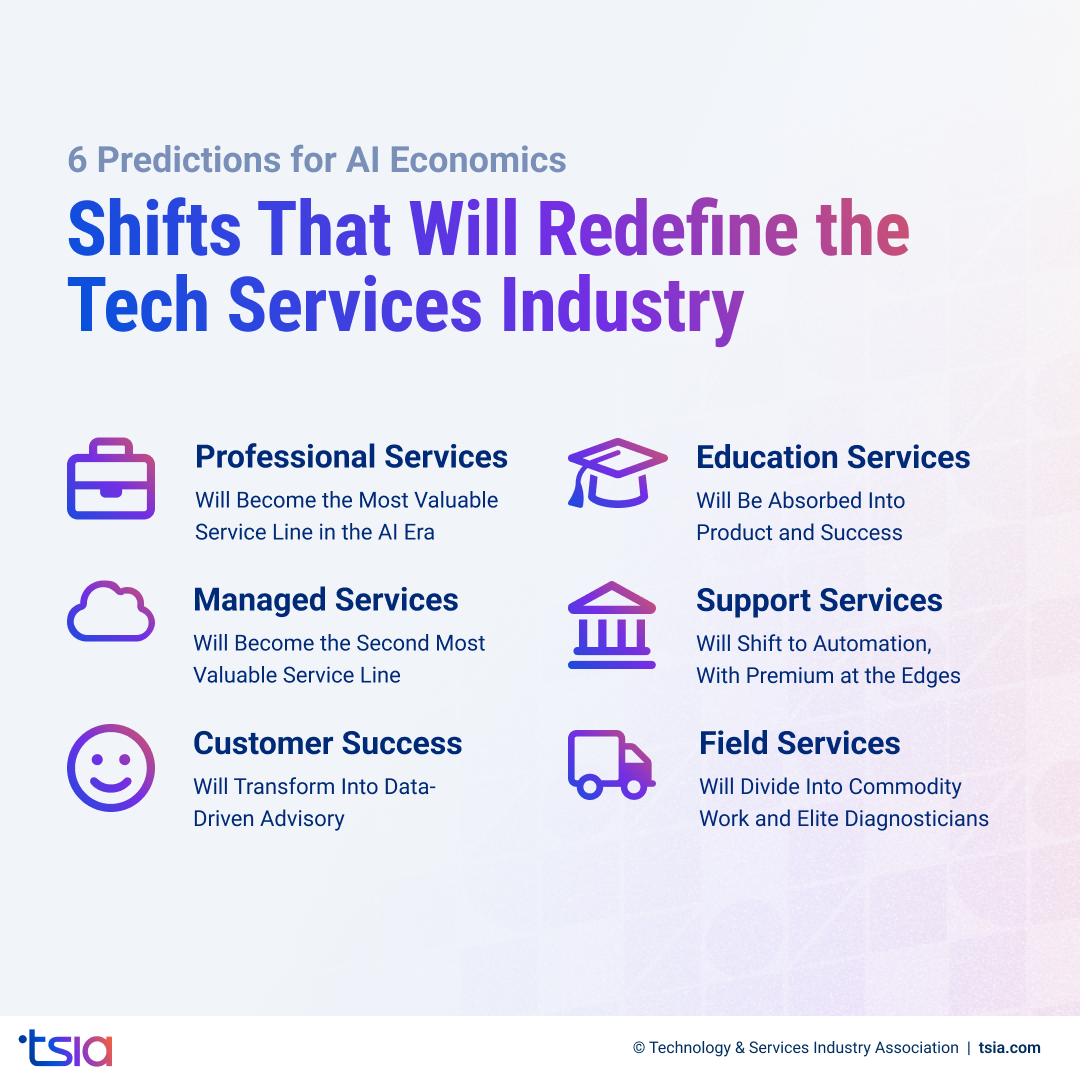
We predicted that professional services (PS) would become the most valued and integral service line in the AI era. Implementation would commoditize, while strategy, design, and continual optimization would become premium.
What does the data show?
Client delivery optimization has doubled. AI solutions consulting has tripled over the past year and a half, and the Forward-Deployed Engineer (FDE) model has validated the move from deployment to embedded, strategic design. Even in the partner ecosystem, the message is clear: services are king, not resale.
Where execution lags
- Only 3% of professional services organizations claim high AI maturity.
- 65% of brands lack a formal AI roadmap.
- Outcome-based pricing remains a minority practice, accounting for just under 3% of total deals.
It’s clear that the industry understands the shift but cannot operationalize it.
Who’s breaking through?
Accenture has partnered with the Software Engineering Institute (SEI) to launch the AI Adoption Maturity Model, which provides a structured path from early-stage inception and experimentation to a fully scalable AI framework. Their “AI Achievers” report states that almost 30% of total revenue is attributable to AI-enabled services.
Related: The PS 2.0 Transformation Paradox
Managed Services Is Ascending, but ROI Discipline Is Weak
What we predicted
We predicted that managed services would wind up as the second most important service line, edging closer to AI-native orchestration and full lifecycle ownership.
What does the data show?
According to the data, organizations with a formal AI strategy achieve stronger revenue growth and improved margins. Providers assume full operational ownership of AI solution lifecycles.
According to IBM, over 90% of serviceable events related to infrastructure products can be resolved through automation. Autonomous operations are no longer theoretical; they are operational.
Where execution lags
- Most participants don’t measure ROI for AI tools.
- Transactional, cost-plus pricing remains dominant.
- Companies are investing in AI-native managed services, but pricing and measurement have not yet caught up.
Who’s breaking through?
TTEC Digital implements AI observability to help them measure performance and ROI. Once the client reduced transfer rates by around 49%, it resulted in approximately $3 million in annual savings.
Darwinbox implemented an Agentic AI ROI framework that measured “Workforce Value” rather than merely cost. This shift to AI-native orchestration is happening in real time, and pricing discipline needs to keep pace with it.
Related: State of Managed Services 2026: Why Service Is Now the Engine of AI Economics™
Customer Success Is Becoming Data-Driven, but the Data Is Fragmented
What we predicted
We predicted customer success (CS) would transform into data-driven advisory. We also believed AI would automate things like check-ins and renewals, predicting that strategic CSMs would evolve into analytics-literate consultants.
What does the data show?
The data revealed that variable pay for CSMs now ranges between 20–30%, and is tied to Net Renewal Rate (NRR) and lead generation. Organizations with formal value realization capabilities are shown to achieve a 7-point higher NRR. What’s more, best-in-class firms utilizing guided digital journeys report a 30% increase in NRR.
Where execution lags
- 80% cannot quantify the savings generated by CS technology.
- 57% of CS professionals don’t measure ROI for generative AI.
- 69% are lacking a unified customer view.
- 1% of businesses rate their manual health scores as being incredibly accurate at predicting churn.
Ambition is already present, but the data foundation is not yet in place.
Who’s breaking through?
Salesforce Data Cloud enables unified customer profiles across silos. EverAfter uses AI-powered dynamic health scoring to predict churn with high accuracy (around 85%). Customer success is about refactoring, but maturity gaps remain huge.
Education Services Is Refactoring, but Attainment Rates Tell a Different Story
What we predicted
At TSIA, we predicted that education services (ES) would be absorbed into product and success, with AI slashing content costs and embedding learning into software experiences.
What does the data show?
According to the data, over 85% of organizations benefit the most from automation in content creation. Adopters show a 147% efficiency boost. Databricks replaced instructor-led training with AI-driven enablement, resulting in 94% completion rates. AI has completely altered the cost structure of education services.
Where execution lags
- The average attach rate is close to 10%.
- 42% of enterprises admit that poor LMS-CRM integration is a prominent scaling barrier.
- Nearly 64% report questionable job-role data.
Who’s breaking through?
isEazy is reducing course development time by up to 98% by enabling training to map to real-time roles. Neontri promotes metadata-driven LMS-CRM integration, reducing data friction costs. This is a validated shift, but the commercial operating model needs to be rebuilt.
Support Is Automating at the Core, but Governance Risks Are Emerging
Our prediction
We predicted that support would automate foundational delivery and monetize at the edges.
What does the data show?
Generative AI chatbots are estimated to resolve over 80% of client questions autonomously. Palo Alto Networks resolves almost 60% of internal IT tickets through AI. Automation is also rapidly displacing L1/L2 volume.
Where execution lags
- “Integration tax” involved in cleaning data for AI remains high.
- “Agent spread” is emerging (where siloed teams build disconnected bots).
- Automation without orchestration results in fragmentation.
Who’s breaking through?
PwC uses “Orchestrator” agents to coordinate specialized AI agents across ecosystems. Wolters Kluwer connects accounting and audit workflows via enterprise-level orchestration.
Field Services Is Bifurcating, but ROI Discipline Is Thin
What we predicted
We predicted that field services would evolve into commodity execution and elite diagnosticians augmented by AI.
What does the data show?
The data supports our estimations, with 90% of IBM infrastructure events being resolved via automation. Strategic investment is a core component of AI-guided troubleshooting. Augmentation is the high-end of the process.
Where execution lags
Only around 10.5% of enterprises measure AI ROI via reduced onboarding or training time. Most incumbents remain defensive and seek to protect their legacy metrics, rather than redesign their value models.
Who’s breaking through?
CVS Health is reducing live-agent chats by 50% over 30 days through AI agents. Klarna’s AI Assistant can handle two-thirds of service chats, driving $40 million in profit improvements. The bifurcation is underway, but most modern enterprises continue to operate on outdated metrics.
The Pattern Is Clear
It’s evident that, across all six predictions, the same patterns emerge:
- Clear early adoption.
- Strong conceptual alignment.
- Significant lag when it comes to execution.
Organizations understand the importance of AI Economics at a strategic level. They understand that SaaS alone is not going to cut it, and they’re wise to the fact that value is shifting toward orchestration, advisory, and optimization. This is confirmation of the prediction, because AI Economics is not theoretical, but structural. Even as the industry evolves, the vast majority of enterprises are trying to identify the best way to embrace AI adoption and achieve maturity.
Related: The AI Economics™, Experts React to What Enterprise Tech Isn’t Saying Out Loud
The Gap Between Intent and Operations Explained
The gap between strategy and operational reality is the defining friction point that businesses in the AI Economics era must address. Roles evolve, and headcounts change, but it’s important to understand that pricing, governance, and data discipline can lag behind the transformation rhetoric. At the end of the day, the companies that win out won’t be those that understand AI, but those that can adopt and operationalize it most effectively.
AI Economics increases the need for services, but these services will be very different from the ones in the SaaS era. The result is going to be:
- Professional services evolve into a strategy-first approach.
- Managed services become autonomous orchestration.
- Customer success turns into data-driven advisory.
- Education refactors into product and success.
- Support automates at the core.
- Field services are split into commodity and elite.
TSIA called this in October, and now the data confirms what we predicted. The only real question that remains at this stage is whether organizations can close the execution gap in time to capture the upside. AI Economics isn’t arriving; it’s already here, and it’s here to stay.
FAQs
What is AI Economics?
AI Economics is the shift from seat-based SaaS revenue models to outcome-based, service-intensive business models powered by AI. As automation reduces labor, traditional pricing models break down. AI Economics defines how technology providers must redesign pricing, governance, and service portfolios to remain profitable in the Services Era.
How do the 2026 State of Reports validate AI Economics?
The 2026 data shows consistent patterns across every major service line: automation is increasing, advisory services are expanding, lifecycle ownership is consolidating, and AI-enabled offerings are growing revenue contribution. At the same time, pricing discipline and ROI measurement lag, confirming the structural shift TSIA predicted.
Why is execution lagging behind AI adoption?
Most organizations are experimenting with AI, but fewer have redesigned their pricing models, service portfolios, governance structures, and data foundations. Without ROI measurement, unified customer data, and outcome-based monetization strategies, AI adoption remains tactical rather than transformational.
Smart Tip: Embrace Data-Driven Decision Making
Making smart, informed decisions is more crucial than ever. Leveraging TSIA’s in-depth insights and data-driven frameworks can help you navigate industry shifts confidently. Remember, in a world driven by artificial intelligence and digital transformation, the key to sustained success lies in making strategic decisions informed by reliable data, ensuring your role as a leader in your industry.

.png)