


You are not living through a typical technology shift. This moment is bigger than the cloud. Bigger than SaaS. AI is not simply making your products smarter. It’s quietly dismantling the economic logic that’s powered technology growth for the last two decades.
That’s the heart of AI Economics™: a new financial and operating reality where value is no longer tied to access. It’s tied to work performed and outcomes delivered, and that creates an uncomfortable tension. Autonomous AI agents reduce the need for human labor. If you still price per seat, every improvement in automation becomes a revenue leak. The better your AI performs, the fewer users your customer needs, and the less predictable your renewals become.
This is the Cannibalization Dilemma, and why so many technology services organizations are reaching an inflection point. The winners won’t be the ones who bolt AI onto yesterday’s business model. They’ll be the ones who redesign how value is discovered, delivered, measured, and monetized—and who build a service engine that can consistently deliver real-world outcomes.
Key Takeaways
- Seat-based SaaS economics are breaking. AI agents reduce the need for human users, making per-seat pricing unstable and accelerating the shift to value-based and outcome-based models.
- Services are now your value delivery engine. The “Last Mile” of AI integration requires expertise, making professional services, managed services, and customer success essential to turning AI potential into real results.
- Outcome delivery requires structural change. To compete, you need new operating models such as Value Engineering Offices, cross-functional delivery pods, and AI-native offerings designed around measurable value.
The Collapse of SaaS Physics
For most of the SaaS era, the growth equation was straightforward: your customer grew headcount, and you grew revenue. More sales reps meant more CRM seats. More developers meant more licenses. Revenue scaled with access, and access scaled with people. That’s what made the model so predictable and why it became the standard.
AI breaks that correlation. Autonomous agents don’t just support human users. They perform tasks directly. They resolve tickets, configure infrastructure, generate content, and reconcile workflows without needing a person to sit behind the keyboard. So if one AI agent can do the work of five employees, a model that charges per employee starts to collapse under its own logic.
That’s the Cannibalization Dilemma in practice: if you price per seat, innovation becomes self-defeating. Every time your AI helps a customer reduce labor, you risk reducing your own renewal revenue right alongside it.
This is why the market is splitting into two paths. On one side are companies trying to protect seat-based pricing and hoping AI becomes a premium feature that customers pay extra for. On the other side are companies leaning into AI Economics and designing their offers around outcomes, tying revenue to measurable value rather than headcount.
TSIA research frames this shift through three key financial cohorts in the industry:
- Established incumbents.
- SaaS-era growth leaders.
- AI-native challengers.
What separates the AI-native cohort is not the sophistication of their models. It’s the structure of their monetization. They aren’t selling access. They’re selling results: fraud prevented, costs reduced, throughput increased, risk avoided. That’s why seat-based companies are vulnerable. In a world where customers can buy “work performed” rather than “users enabled,” the old model becomes easy to displace.
The Revenue Acquisition Crisis
You can see the shift in another metric: Revenue Acquisition Cost (RAC). As AI offerings become more complex and customers demand proof of value before renewals feel safe, the traditional “sell it and expand it later” motion becomes much harder and more expensive. For many SaaS leaders, the cost to generate incremental growth is rising because it now takes real delivery effort—deployment, integration, proof of value—to secure adoption and retention.
In other words, you’re paying an “activation tax.” Not because your sales team isn’t working hard, but because the product alone can’t deliver outcomes without real operational lift. The implication is clear: the solution isn’t simply increasing sales investment. It’s reducing the cost of growth by changing what you sell and how you deliver it, so value is engineered into the experience and provable through data.
From LAER to DARE: Redesigning Customer Engagement
In the SaaS era, LAER (Land, Adopt, Expand, Renew) worked because adoption was the best available proxy for value. In the AI era, adoption is no longer enough.
A customer can log into an AI tool, experiment, or even build a pilot, and still fail to achieve a meaningful business result. And if results aren’t delivered, renewals become shaky, expansions stall, and pricing becomes harder to justify.
That’s why engagement shifts to DARE:
- Design: You define outcomes before the deal is closed, including readiness requirements and success metrics.
- Activate: You deploy quickly with a focus on Time-to-Value, not just “go live.”
- Realize: You prove ROI through outcome telemetry, not usage reporting. QBRs become Value Realization Reviews.
- Evolve: You expand based on what you’ve already proven, turning renewals and growth into the natural next step.

This is also why the customer success role changes. You’re not just managing relationships anymore. You’re managing measurable value. And with customer success budgets compressing, you have to use AI to automate the low-value tail while reserving human expertise for the accounts where outcomes and revenue are most at stake.
Related: From LAER to DARE: Why the AI Era Demands a New Customer Engagement Model
The Last Mile: Why Services Are Now Central to AI Growth
Early AI hype assumed product-led growth would scale enterprise adoption. Customers would integrate powerful models through APIs and unlock results quickly. In reality, most enterprises aren’t plug-and-play environments. They are messy ecosystems of legacy systems, fragmented data, security requirements, and governance complexity. A raw model can’t overcome those constraints without expert help.
That’s the “Last Mile” challenge, and it’s why the Services Era is accelerating. To deliver AI outcomes, you need professional services (PS) for integration and deployment, managed services for continuous model performance and cost control, and customer success to tie value delivery to renewal and expansion. Services are no longer an add-on. They are the engine that translates AI potential into business reality.
Fixing the Foundation: You Cannot Automate Chaos
Of course, there’s a catch. Many organizations want AI-powered delivery, but they’re still operating on Services 1.0 foundations with inconsistent processes, messy project data, siloed systems, and a culture that relies on heroics rather than repeatable execution.
TSIA describes this as the PS 2.0 Transformation Paradox: you cannot build scalable AI services on top of operational debt. If you can’t reliably track margins, utilization, and delivery outcomes today, AI won’t fix that. It will amplify the mess. No service is exempt from the 2.0 transformation.
This is why data hygiene and operational discipline aren’t back-office priorities anymore. They’re commercial prerequisites. If you want to scale AI delivery, you must first standardize how work is delivered and how performance is measured.
The Value Engineering Office: Making Value Measurable
To manage outcome delivery at scale, leading companies are building Value Engineering Offices (VEOs). The VEO becomes the internal authority that turns “value” into something you can define, instrument, and defend.
That means:
- Defining specific value anchors tied to business outcomes.
- Designing telemetry to prove those outcomes mathematically.
- Aligning product, sales, and services around the same targets.
- Protecting the economics of the account by monitoring value performance.
In mature organizations, Value Engineers act as the account's CFO, ensuring the contract remains viable because the value can be proven.
Industrializing Delivery: From Snowflakes to Repeatable Offers
AI delivery can easily become unscalable if every engagement is one-off. That’s why Services Offer Engineering matters. You still need elite delivery talent, like Forward-Deployed Engineers (FDEs), to solve bespoke, last mile integration challenges. But you also need the discipline to capture what works and turn it into reusable delivery blueprints.
Over time, the pattern becomes: Build → Capture → Standardize → Scale. This is how services become product-like. Without it, your margins compress as demand increases.
Managed Services: Becoming the Guardian of AI ROI
AI outcomes aren’t something you deliver once. Models drift. Data changes. Costs spike. Risk accumulates. That’s why managed services are evolving from infrastructure monitoring to AI performance orchestration.
In practice, this means bundling the operational work of AI into recurring services that protect value over time, including:
- Managed MLOps.
- Drift and bias monitoring.
- Inference cost optimization.
- Governance enforcement.
In AI Economics, your promise is not “the system is up.” Your promise is “the outcome stays true.”
The AI Pricing Ladder: Shifting Monetization Toward Value
As your services evolve, your pricing has to evolve with them.
The AI Pricing Ladder shows the path:
- Per-seat pricing (legacy and unstable).
- Cost-based consumption (protects margin but misses value).
- Value-based consumption (pricing tied to valuable units, such as tickets resolved).
- Outcome-based pricing (pricing tied directly to results).
The higher you climb, the more your revenue aligns with what customers actually care about. But it also requires stronger measurement and delivery maturity. That’s why pricing transformation and operating transformation have to move together.
The Service Portfolio You Need To Win AI Economics
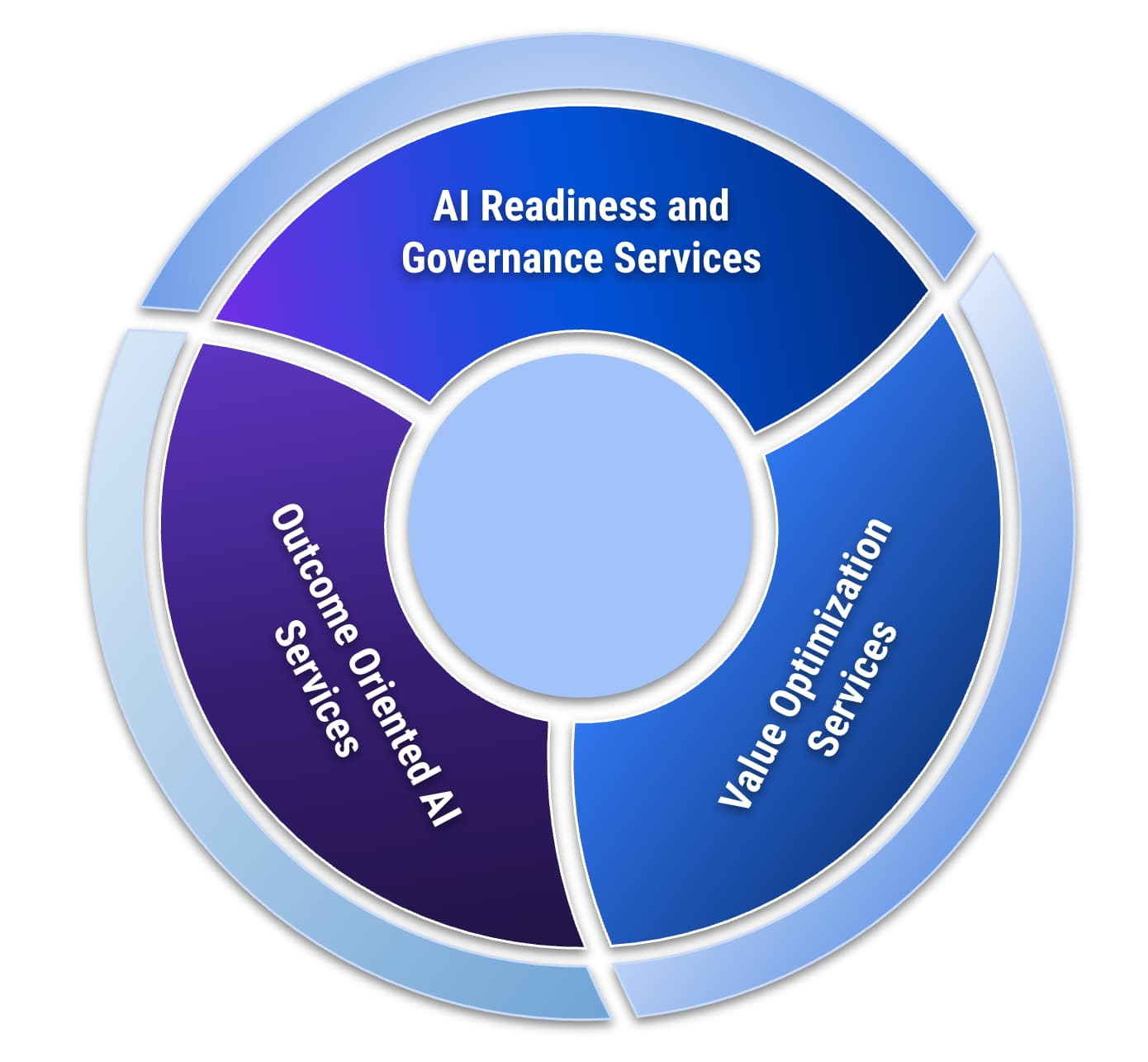
TSIA highlights three AI-native service categories that belong in your portfolio:
- AI Readiness & Governance Services (ARGS): You help customers prepare for data, processes, security, and responsible AI frameworks.
- Value Optimization Services (VOS): You keep AI systems performing in production while managing drift, costs, and operational debt.
- Outcome-Oriented AI Services (OOAS): You guarantee business results and build commercial models around shared value.
If you want to monetize AI outcomes, these are the building blocks.
Related: Retooling Your Services Portfolio for the Era of AI Economics™
Compete or Concede
The market is splitting, and the dividing line is clear. If you want to compete in AI Economics, you have to be willing to redesign the fundamentals: pricing, delivery, operating models, and how value is proven.
If you don’t, the default path is concession. Seat-based pricing becomes unstable. Services remain underinvested. The last mile becomes the customer’s burden. And AI becomes a feature that never turns into durable revenue.
AI doesn’t eliminate services. It makes them mandatory. The companies that win in 2026 will be the ones that combine AI scale with outcome ownership and build an economic model that rewards results.
Related: AI Economics.™ TSIA’s Perspective on Profitable AI Business Models
FAQs
What is AI Economics in technology services?
AI Economics is a shift away from seat-based SaaS pricing, toward models where revenue is tied to the work AI performs and the outcomes you can prove, not the number of users who have access.
Why is seat-based pricing risky in the AI era?
Because AI agents reduce human labor, if your customer needs fewer people, they need fewer seats, and your renewal revenue shrinks right when your AI is delivering more value.
What services matter most for AI transformation?
AI Readiness & Governance Services to prepare customers, Value Optimization Services to keep models performing, and Outcome-Oriented AI Services to deliver and guarantee measurable business results.
Smart Tip: Embrace Data-Driven Decision Making
Making smart, informed decisions is more crucial than ever. Leveraging TSIA’s in-depth insights and data-driven frameworks can help you navigate industry shifts confidently. Remember, in a world driven by artificial intelligence and digital transformation, the key to sustained success lies in making strategic decisions informed by reliable data, ensuring your role as a leader in your industry.

.png)


.png)

.png)
.png)
