

.png)


For years, technology leaders treated pricing as a downstream decision—something to fine-tune after products shipped and go-to-market plans were set. That mindset worked in a world of static software and predictable usage. AI breaks that model entirely.
When AI systems don’t just inform decisions, but take actions that directly affect your customer’s revenue, costs, and margins, pricing stops being a tactical choice. It becomes the starting point for transformation.
This is the core idea behind pricing-led transformation. Under AI Economics™, how you price offerings determines how you recognize revenue, operate, organize teams, and ultimately, how you deliver and monetize services. If you try to modernize AI offerings without modernized pricing, every other transformation effort stalls. In the AI era, pricing doesn’t follow transformation, it drives it.
Key Takeaways
- Your pricing model is the trigger for every significant change in your business model. With AI, shifts toward consumption and outcome-based pricing are reshaping financial metrics, operating models, and services, whether you plan for them or not.
- AI makes user-based pricing economically unsustainable. When AI performs work instead of users, seat or license-based pricing becomes less relevant, prompting you to move toward value-aligned models.
- Services become the profit engine, not the cost center. Modern pricing models inherently require continuous services that drive adoption, retention, and value realization.
Why AI Makes Pricing the First Decision You Must Get Right
The SaaS era already taught you one hard lesson: pricing changes everything. When companies moved from perpetual licenses to subscriptions, it didn’t just alter invoices. It forced changes in revenue recognition, compensation plans, forecasting models, and organizational design. Entire functions, like customer success, emerged because recurring revenue demanded ongoing value delivery.
AI represents an even bigger break from the past. AI-powered offerings don’t simply enable workflows. They execute them. That means customers don’t measure value by access or features; they measure it by business outcomes. And once outcomes are measurable, customers expect pricing to reflect that value.
This is why historically controversial models, consumption-based and outcome-based pricing, are moving from edge cases to the mainstream. AI makes them unavoidable.
Related: Outcome-Oriented AI Services
Why Pricing Is the First Domino in AI Transformation
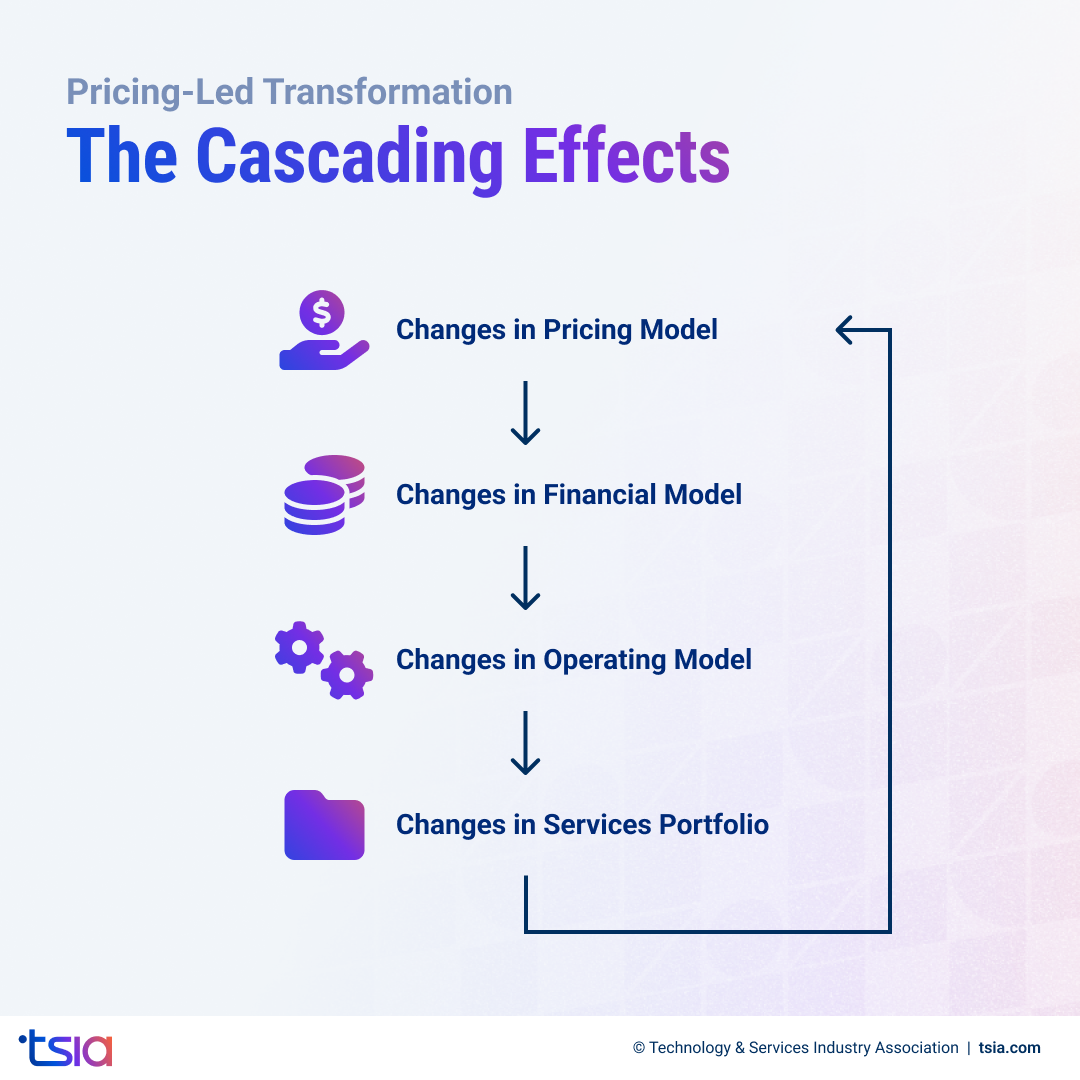
Pricing-led transformation follows a predictable sequence. When you change pricing, the rest of the organization has to change with it.
1. A Shift in Pricing Model
Transformation begins when you move away from legacy models, such as:
- One-time licenses.
- Seat-based subscriptions.
- Hourly, time-and-materials billing.
In their place come pricing models aligned to value:
- Consumption-based pricing (pay for usage, transactions, or compute).
- Subscription models tied to ongoing value.
- Outcome-based pricing (pricing linked to business results achieved).
This shift isn’t cosmetic. It changes what customers expect from you and how they measure success.
2. A New Financial Model Follows
Once pricing changes, your financial model must be updated accordingly. Recurring and consumption-based revenue behaves very differently from transactional revenue. You can no longer optimize around quarterly bookings alone.
Instead, you must manage metrics like:
- Annual recurring revenue (ARR).
- Expansion and contraction.
- Churn and retention.
- Lifetime value (LTV).
- Revenue predictability and volatility.
Forecasting, budgeting, and performance management all need to evolve. AI Economics™ makes this unavoidable because AI usage and value rarely scale linearly.
3. Your Operating Model Must Evolve
When revenue depends on retention and expansion, selling and implementing once is no longer enough.
- Your current operating model: Sell → Implement → Exit
- Should shift to: Onboard → Adopt → Expand
That change forces new priorities:
- Adoption matters as much as acquisition.
- Retention becomes a core growth lever.
- Value delivery is continuous, not episodic.
This is why roles like customer success managers, value engineers, and adoption specialists emerge. They aren’t organizational “nice-to-haves.” They’re structural necessities created by the pricing model.
4. Your Services Portfolio Becomes Strategic
The final and most misunderstood stage of pricing-led transformation is the services portfolio.
Under legacy pricing, services were often treated as:
- One-off implementation projects.
- Cost centers to be minimized.
- Necessary but non-strategic.
Modern pricing flips that logic. To support adoption, retention, and measurable outcomes, you need continuous services, including:
- Managed services.
- Advisory and optimization services.
- Value realization and enablement services.
- Ongoing support aligned to usage and outcomes.
At this point, the loop closes. Your services portfolio doesn’t just support the pricing model—it reinforces and monetizes it.
Related: Pricing-Led Transformation Under AI Economics™
What Other Industries Can Teach You About Pricing-Led Change
Pricing-led transformation isn’t theoretical. It has already reshaped multiple industries.
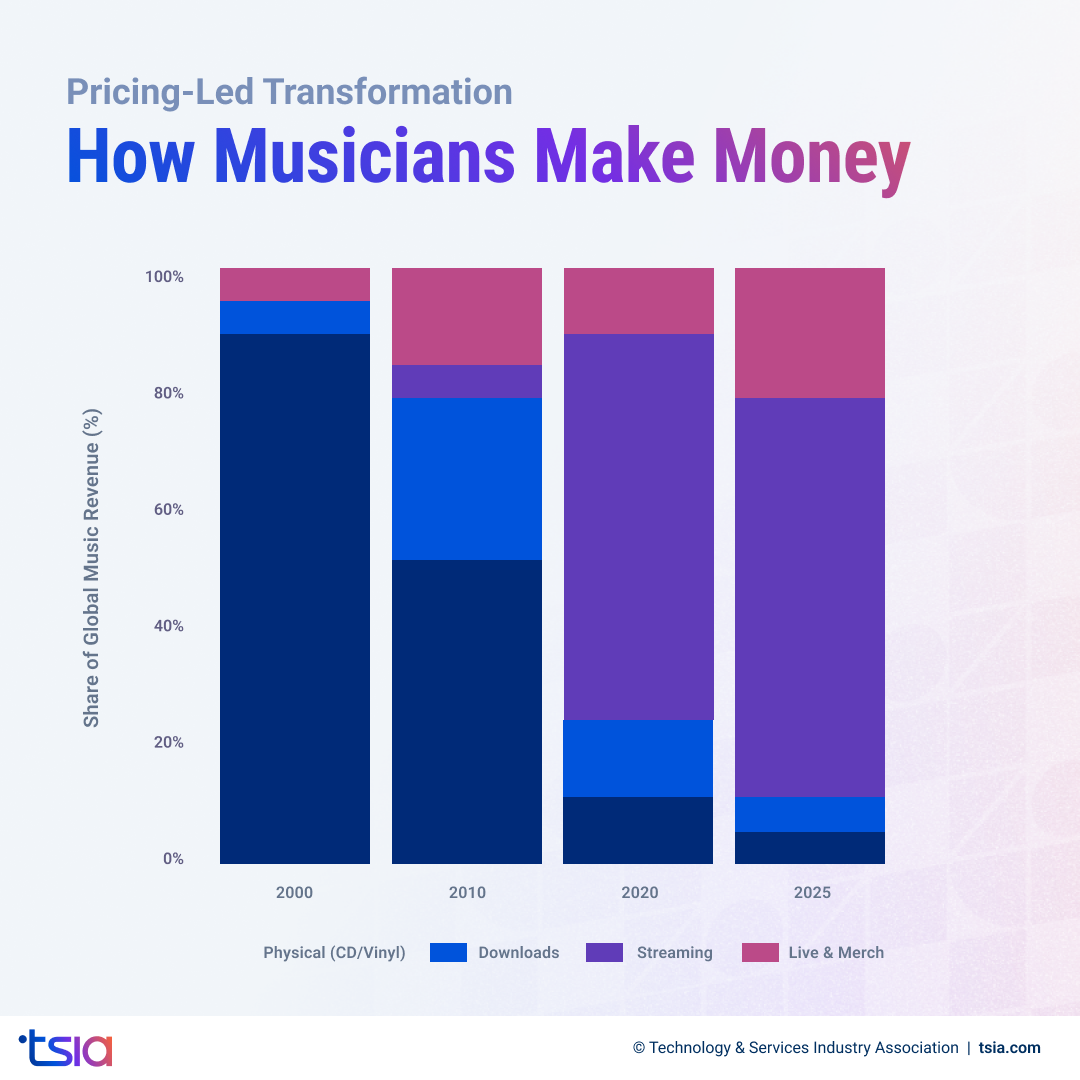
Music: From Albums to Streams
When consumers stopped buying full albums and started paying per song or stream, the revenue engine for artists collapsed—then rebuilt itself.
Artists responded by creating new “services”:
- Live performances.
- Fan subscriptions.
- Exclusive digital access.
Pricing forced the reinvention of monetization.
Software: From Licenses to SaaS
Legacy software companies once relied on upfront licenses plus annual maintenance. Subscription pricing eliminated maintenance revenue and compressed margins.
In response:
- Customer success became mission-critical.
- Pricing teams gained executive visibility.
- Services shifted from reactive support to proactive adoption.
The business model changed because pricing changed.
Professional Services: Tokens Instead of Hours
In consulting and IT services, token-based and subscription models are replacing hourly billing. Clients pay for access to AI-powered capacity, not labor time.
This requires:
- New organizational structures.
- Cross-functional delivery teams.
- Services bundled around continuous value, not projects.
Again, pricing forced transformation—not the other way around.
What Pricing-Led Transformation Means for You
AI accelerates and intensifies every lesson learned in the SaaS transition. Under AI Economics™, user-based pricing fails because AI doesn’t scale with headcount. Consumption and outcome-based models become inevitable and disruptive.
You should expect:
- Short-term financial pain during transition.
- New volatility in usage and revenue.
- Pressure to redesign metrics, incentives, and teams.
But leaders who embrace pricing-led transformation gain something far more valuable: a scalable path to AI profitability. Pricing becomes a strategic lever, not a lagging indicator.
How Leadership Teams Should Approach Pricing-Led Transformation
To succeed, you need to treat pricing as a catalyst—not a constraint.
Pricing Is a Strategic Lever
Pricing decisions now shape:
- Financial structure.
- Organizational design.
- Service strategy.
- Customer relationships.
This is a board-level conversation, not a packaging exercise.
Services Are Not Optional
Under modern pricing, you are running a services-led business—whether you label it that way or not. Adoption, retention, and expansion depend on services that help customers realize value continuously. Serviceless AI is a myth.
Turn Services Into a Profit Engine
Your services portfolio is no longer just about solving problems. It is the mechanism through which value is delivered, measured, and monetized.
When done right, services drive:
- Adoption.
- Retention.
- Expansion.
- Predictable growth.
Pricing Is the Decision That Shapes Everything Else
The most powerful insight of pricing-led transformation is also the simplest: how you price determines how you operate. AI forces pricing decisions that can’t be deferred.
When you embrace pricing as the first move, not the last, you unlock a structured, causal path to transformation. Not through mission statements. Not through reorgs. But through the economics that govern how value is created and captured.
Related: AI Pricing Models Supercharge the Drive to Value Realization
Frequently Asked Questions
1. Why does AI make user-based pricing unsustainable?
AI continues to perform work regardless of the number of users. When value scales without adding users, seat-based pricing disconnects price from value and caps growth.
2. Does pricing-led transformation always hurt margins initially?
Often, yes. Transitions can introduce short-term volatility. But companies that persist unlock more durable, scalable profitability aligned with customer value.
3. Why do services become more critical under AI pricing models?
Because consumption and outcome-based pricing require continuous adoption and optimization, services are essential to ensure customers achieve value—without them, recurring revenue fails.
Smart Tip: Embrace Data-Driven Decision Making
Making smart, informed decisions is more crucial than ever. Leveraging TSIA’s in-depth insights and data-driven frameworks can help you navigate industry shifts confidently. Remember, in a world driven by artificial intelligence and digital transformation, the key to sustained success lies in making strategic decisions informed by reliable data, ensuring your role as a leader in your industry.

.png)




.png)

.png)
.png)
