AI isn’t just transforming technology; it’s rewriting the economics of the entire industry. For decades, growth engines followed a familiar formula: add more users, ship more licenses, expand usage, and layer in services for implementation and support.
Artificial intelligence breaks that formula. Customers can now generate more output with fewer people. Automation reduces seats. Intelligent systems reduce transactions, and increasing customer efficiency exposes more fragile pricing models. At the same time, AI also increases complexity, risk, and accountability. When your system makes decisions, you share responsibility for the outcome.
That tension is precisely what led us to launch AI Economics™, a framework and body of research for understanding how services, profitability, pricing, and value are being rewritten in real time. In this blog, we answer some of the most frequently asked questions about AI Economics, including what it means, why it matters now, and how technology providers can adapt to the new rules of value creation and capture.
Key Takeaways
- AI is breaking traditional growth models. For decades, technology revenue scaled with user growth, transaction volume, and labor. AI disrupts that equation by increasing output while reducing headcount, flattening consumption, and exposing pricing models that depend on volume.
- Profitability in the AI era depends on pricing and evolution. As AI generates greater customer value with less measurable usage, companies must move up the AI Pricing Ladder toward value and outcome-based pricing while building services that drive adoption, optimize performance, and deliver measurable results.
- Incumbents can win if they redesign how value is captured. Established providers already have domain expertise, customer trust, and service infrastructure. The challenge is not competing with AI startups—it’s evolving pricing models, service portfolios, and operating structures quickly enough to capture value in the AI era.
Frequently Asked Questions About AI Economics™
As AI reshapes pricing models, service portfolios, and profitability, many technology leaders are asking the same questions. Below are answers to some of the most frequently asked questions about AI Economics and how it is changing the future of the technology services industry.
What Is AI Economics?
AI Economics is TSIA’s research-based framework that explains how artificial intelligence is reshaping value creation, pricing models, service portfolios, and profitability in the technology industry.
Historically, revenue scaled alongside labor and usage. The equation was simple: more users meant more seats, more machines meant more units, and more transactions meant greater consumption. Growth and headcount were closely linked.
AI breaks that relationship. Organizations can now increase output while reducing headcount. Automation increases throughput, which can erode per-unit pricing and flatten consumption-based revenue models.
At the same time, AI generates significant, measurable business value. Companies see cost savings, productivity gains, revenue growth, and reduced risk. However, many technology providers capture only a small portion of that value in revenue. This gap is known as value leakage.
AI Economics focuses on closing that gap through two structural changes:
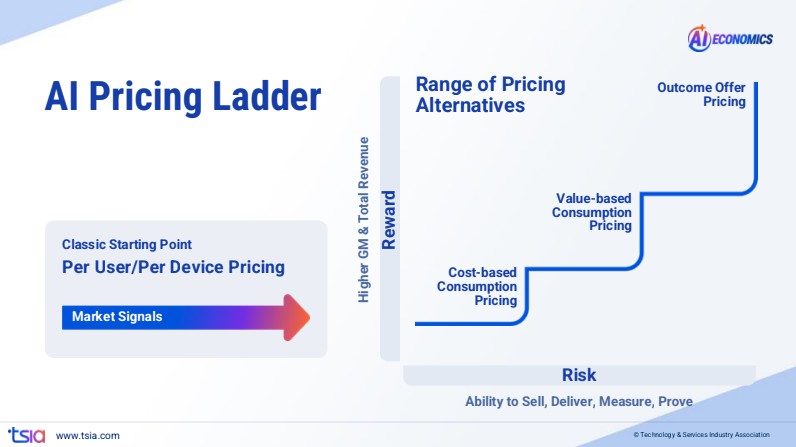
- Moving up the AI Pricing Ladder toward value-based and outcome-based pricing.
- Building service capabilities that ensure measurable value realization.
Related: AI Economics™ Explained: What It Means for the Technology Industry
Is AI Replacing Services in the Technology Industry?
The short answer is both yes and no. AI is eliminating many low-value, repetitive service tasks. Activities such as basic support, manual configuration, and labor-intensive implementation work are becoming increasingly automated.
However, AI does not eliminate the need for services. In fact, it increases the need for higher-value service capabilities. As organizations deploy AI systems, they face new challenges around data readiness, governance, integration, compliance, and performance optimization. These areas require expertise, oversight, and continuous improvement. Rather than eliminating services, AI is reshaping the service portfolio. The focus shifts from labor-based delivery to services that ensure AI systems deliver measurable outcomes.
What Is the AI Pricing Ladder?
The AI Pricing Ladder describes the evolution of pricing models as technology shifts from activity-based value to outcome-driven value. Historically, companies priced software based on inputs such as users or usage. As digital platforms matured, many organizations moved toward consumption pricing tied to transactions or infrastructure usage.
In the AI era, pricing is evolving further toward value-based and outcome-based models, where revenue reflects the measurable business impact a solution delivers rather than the volume of activity it generates.
Why Is Outcome-Based Pricing Important in the AI Era?
Outcome-based pricing allows technology providers to capture a portion of the value their solutions create. AI systems often deliver significant improvements in efficiency, productivity, and business performance. However, when pricing is tied only to usage or transactions, companies may generate enormous customer value while capturing limited revenue.
When pricing reflects outcomes, providers are rewarded for the real value their technology delivers. However, moving toward outcome-based pricing requires new capabilities. Organizations must be able to measure, validate, and continuously optimize customer outcomes.
What New Services Are Needed to Support AI Adoption?
As AI adoption grows, several service categories are emerging as critical for enterprise success.
Three foundational service areas include:
- AI Readiness and Governance Services (ARGS): These services help organizations prepare their data, governance frameworks, and infrastructure for AI deployment.
- Value Optimization Services (VOS): These services ensure that AI systems deliver measurable business impact through ongoing tuning, monitoring, and improvement.
- Outcome-Oriented AI Services (OOAS): These services focus on delivering and validating specific business results enabled by AI solutions.
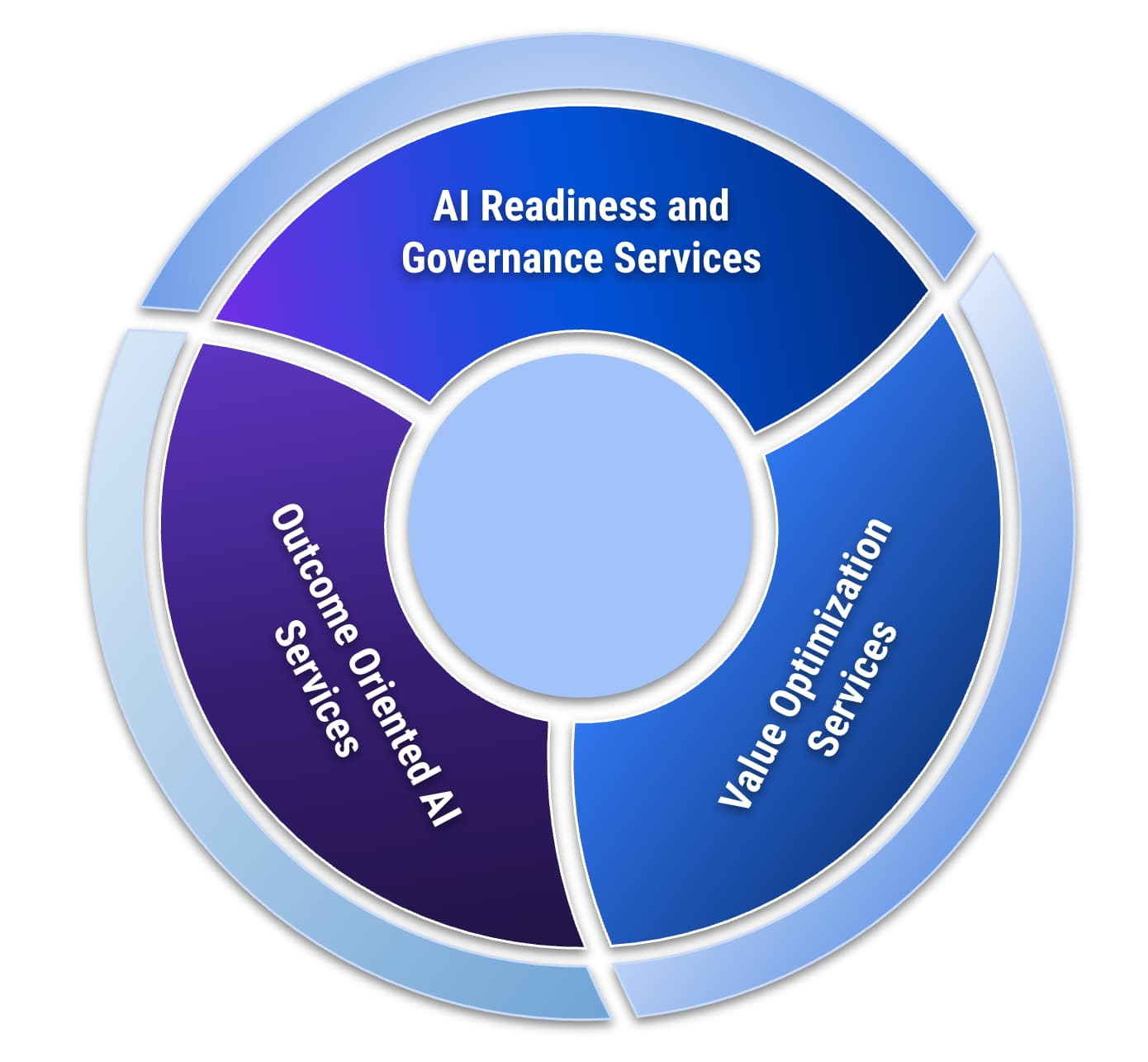
Together, these services help close the gap between AI adoption and realized value.
Is AI Eliminating Services or Creating New Ones?
AI is eliminating many commoditized service activities, but it is also creating entirely new service categories. Automation will reduce the need for traditional, tier-one support, simplify many implementation activities, and compress labor-intensive delivery models.
At the same time, AI introduces new requirements around governance, data preparation, system orchestration, and outcome validation. These areas require expertise and continuous oversight.
In practice, the service portfolio does not disappear—it evolves. The emphasis moves away from repetitive, operational work toward services that ensure AI systems perform reliably and deliver measurable results.
Why Are Traditional Pricing Models Breaking in the AI Era?
Traditional pricing models assume that value scales with activity. More users, more transactions, or more infrastructure consumption typically meant greater revenue. AI breaks that assumption.
When organizations deploy AI, they can often generate the same or greater output with fewer employees and fewer transactions. If pricing is tied to these declining inputs, revenue growth can stall even as customers gain more value.
Even consumption-based pricing models face limitations when AI improves efficiency and reduces activity levels. To address this challenge, pricing must evolve toward models that align revenue with business outcomes rather than operational volume.
Related: Pricing-Led Transformation: Why AI Forces You To Rethink Pricing First
Why Are Many AI Companies Struggling To Become Profitable?
Despite rapid growth and investment, many AI companies are still struggling to achieve sustainable profitability. One reason is that many providers are focused heavily on technology development while placing less emphasis on value capture.
Profitability in the AI era requires more than powerful models. It requires an integrated approach that includes:
- Pricing models tied to measurable outcomes.
- Services that ensure adoption and optimization.
- Value engineering capabilities that demonstrate return on investment.
Without these elements, organizations risk generating enormous customer value while capturing limited revenue.
Can Incumbent Tech Companies Still Win in the AI Era?
Yes. In many cases, incumbents may actually have an advantage. Established technology providers already possess several critical assets, including deep domain expertise, trusted customer relationships, global service infrastructure, and operational scale. These capabilities position incumbents well to deliver the services and outcome validation required in the AI era.
The real risk is not competition from startups, but internal resistance to change. Legacy pricing models, product-centric thinking, and outdated compensation structures can slow the transition to AI Economics. Organizations that adapt quickly can leverage their existing strengths to capture significant value in the AI era.
How Should Technology Leaders Adapt to AI Economics?
Understanding AI Economics is only the first step. Leaders must also translate these insights into operational change. A good starting point is to evaluate your pricing portfolio and identify areas where revenue is still tied to outdated growth models. Organizations should also review their service portfolio to determine where automation will reduce traditional delivery work and where new capabilities must emerge.
Finally, leaders must bring together product, service, and sales teams to design offerings that align with measurable customer outcomes. AI Economics is not simply about responding to disruption. It is about redesigning how your organization captures value before margins begin to erode.
Related: The AI Economics™, Experts React to What Enterprise Tech Isn’t Saying Out Loud
The Organizations That Adapt Will Define the AI Economy
AI is not just another wave of technology innovation. It is restructuring how value is created, delivered, and captured across the entire technology industry.
For decades, growth depended on expanding the user base, increasing transaction volume, and scaling labor-intensive services. AI breaks that model. Customers can now generate more output with fewer people and fewer transactions. When that happens, traditional pricing engines stall, and service portfolios built around labor begin to erode.
That’s the central challenge of AI Economics. The organizations that thrive will not simply deploy AI. They will redesign how they price, package, and deliver value.
This requires moving beyond legacy growth models and building the capabilities that allow companies to capture value in the AI era:
- Pricing models aligned with business outcomes.
- Services that ensure AI adoption and optimization.
- Value engineering that proves measurable impact.
Companies that make these shifts early will turn AI into a durable engine of profitable growth. Those who delay risk watching value creation grow while revenue capture declines.
The question facing every technology leader now is simple: Will your organization adapt its economics before the market forces you to?
Smart Tip: Embrace Data-Driven Decision Making
Making smart, informed decisions is more crucial than ever. Leveraging TSIA’s in-depth insights and data-driven frameworks can help you navigate industry shifts confidently. Remember, in a world driven by artificial intelligence and digital transformation, the key to sustained success lies in making strategic decisions informed by reliable data, ensuring your role as a leader in your industry.

.png)

.png)