

At TSIA, predicting the future isn’t hype—it’s history.
For over a decade, TSIA has not only documented the shifts defining the technology industry but also forecasted them. While others chased trends, TSIA defined them. We saw the Complexity Avalanche before AI made complexity its brand. We mapped the Fish Model before Wall Street discovered the concept of recurring revenue. We codified LAER long before customer success became a department.
Now, we’re repeating it: AI Economics isn’t a theory; it’s the next inevitable transformation.
When TSIA makes predictions, they aren’t speculative. They’re pattern-based, data-backed, and time-tested. Every major shift in technology business models, from products to outcomes, was already in our research before it became common sense. The question isn’t if AI Economics is coming. It’s whether you’ll be ready when it does.
Key Takeaways:
- TSIA has a track record of getting it right. From Complexity Avalanche to B4B to Digital Hesitation, TSIA didn’t just predict industry shifts; it defined the frameworks that made them actionable. That same foresight now underpins AI Economics.
- AI Economics is the next evolution of TSIA’s proven models. Every prior transformation, consumption pricing, outcome-based contracts, LAER, and DOCX has led to this moment, where AI finally connects value creation to measurable outcomes.
- The winners of the AI Economy will be those who deliver value and operationalize outcomes, not algorithms. The pattern is clear: services over products, profitability over hype, outcomes over ownership. Companies that ignore it will repeat the same collapse cycles TSIA predicted years ago, only faster.
Seeing Around the Corner Has Always Been the Point
When TSIA researchers first described the Complexity Avalanche back in 2009, they argued that technology was becoming too complex for customers to consume without help. That prediction didn’t just hold; it became the foundation for the modern services economy.
“Customers don’t buy products, they buy outcomes,” says George Humphrey, TSIA’s VP of Research. “They’re not buying a drill; they’re buying the hole. That idea has guided every major change in our industry since 2009.”
AI is now the most complex technology ever introduced into customer environments, layered onto messy data, legacy systems, unclear governance, and siloed operations. Companies are bolting AI features onto products at breathtaking speed, often without the customer readiness needed to absorb them.
The result is a new phenomenon: the AI Complexity Avalanche. It isn’t just that customers struggle to consume AI; they’re not structurally prepared to do so.
This is precisely why TSIA frameworks emphasized digital readiness, standardized data, and value realization long before AI made those requirements non-negotiable. It was a simple truth that foreshadowed everything to come: as technology gets more complex, services become indispensable.
The Record of Prediction
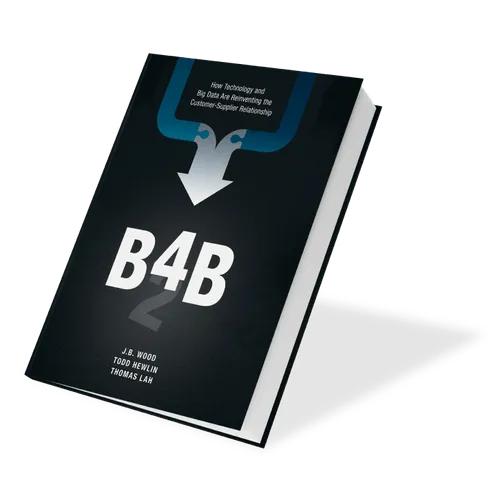
B4B (2013): Outcomes Replace Ownership
In B4B, TSIA predicted that customers would stop paying for technology itself and start paying only for the results it delivered. Outcome Engineers. Recurring revenue. The Fish Model. These weren’t trends, they were forecasts. And every one came true. TSIA is now predicting the “pay-for-outcomes” model will become the standard contract for enterprise technology.
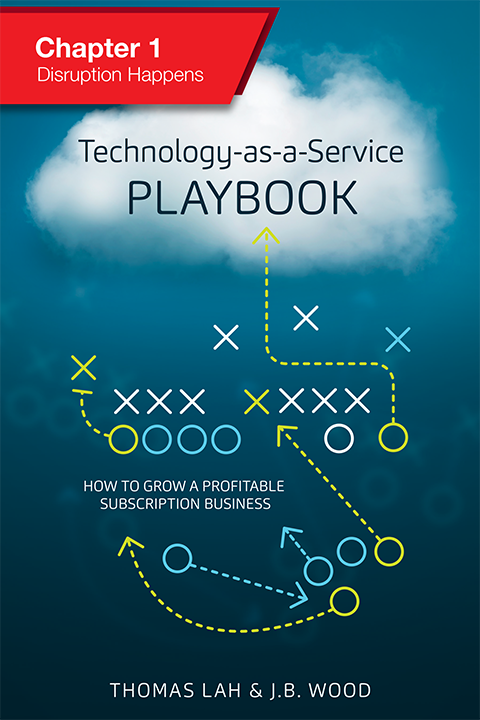
The XaaS Playbook (2016): Profitability Returns to Growth
TSIA saw what the SaaS market refused to admit: growth without profit is a dead end.
We declared that investors would soon demand stronger unit economics, and we were right. The LAER model (Land, Adopt, Expand, Renew) became the global playbook for driving profitable recurring revenue.
Related blog: The Four Phases to Becoming LAER Efficient
Digital Hesitation (2022): The Foundation for AI
TSIA warned that organizations relying on “brute labor” instead of digital systems would fall behind. Our prescription was clear: standardize, digitize, then AI-enable.
The DOCX framework (Digital Operations and Customer Experience) defined the exact path companies now follow to scale AI responsibly.
“Without a DOCX-style foundation,” Humphrey notes, “you can’t AI-enable your enterprise. You’ll be stuck with isolated capabilities that never connect. We predicted this environment long before anyone called it AI.”
DOCX: The Operating System of the AI Era
While AI Economics defines the business model of the future, the DOCX framework defines the operating system needed to make that model a reality.
DOCX was never simply a digital-transformation blueprint. It was TSIA’s prescription for unifying a company’s offer portfolio, systems, data ontology, workflows, and customer experience into one coherent architecture. In the era of AI, that architecture becomes a hard prerequisite.
- AI models cannot deliver accurate decisions without unified data.
- Outcome-based services cannot scale without integrated systems.
- AI-driven value cannot be realized without cross-functional telemetry.
DOCX provides the “how,” the structural foundation. AI Economics provides the “what” and “why,” the monetization model.
Together, they form the only viable path for companies that intend to own outcomes in the AI Economy.
Related report: The Digital Operations and Customer Experience Platform
Proof in the Present
The same market dynamics TSIA mapped a decade ago are now playing out in real time, only faster and more extreme.
Consider the AI 20, the world’s most visible, most over-capitalized, publicly traded AI firms.
Collectively, they post an average operating income of -129%, burning billions to chase scale without structure. OpenAI has committed to $1.4 trillion in infrastructure while generating only roughly $13 billion in annual revenue.
History has seen this movie before. The names change, but the pattern is the same: technological disruption outpaces economic discipline, until services, standards, and consumption-based models rebalance the system.
The collapse of AI-native economics isn’t just the result of aggressive investment; it’s structural. TSIA calls this the Value Paradox: AI simultaneously makes products exponentially more valuable, while destroying the revenue models meant to monetize that value.
Traditional per-user or per-seat pricing, the engine of SaaS growth for 20 years, collapses when AI’s primary function is to reduce the number of users required to run the business. More automation means fewer seats, which means the better the AI performs, the less revenue the vendor earns.
In other words, AI increases value while reducing revenue.
This is why consumption economics is no longer enough. AI forces a shift from “pay for use” to “pay for value” and ultimately, to “pay for outcomes.” And TSIA predicted this shift long before AI exposed the cracks.
That’s the moment TSIA was built for.
Why Credibility Matters Now
The AI Economy isn’t a fresh start; it’s a continuation of every transformation TSIA has already predicted and documented.
- Complexity Avalanche became AI Avalanche.
- Consumption Economics evolved into AI Economics.
And now B4B’s outcomes-first mindset powers AI-aligned pricing and outcome-oriented AI services.
“We didn’t just anticipate the AI Economy,” Humphrey says. “We built the insights and frameworks that make it possible.”
Companies that ignore those insights are repeating the same mistakes that crippled hardware giants in the 2000s and unprofitable cloud players in the 2010s.
Companies that follow them are creating the playbooks for the 2030s.
Who Owns the Outcome?
In the SaaS era, vendors could argue that customers owned the outcomes. The technology provided insights, but humans made the decisions.
AI shatters that model.
When AI makes the decision and takes the action—not the user—the responsibility for the outcome shifts to the vendor. If AI produces the wrong forecast, misclassifies a risk, or drives the wrong workflow, it is the supplier’s model that failed.
This is the foundational logic of AI Economics: If your AI drives the decision, you own the outcome.
This shift is not theoretical; it is already reshaping customer expectations, contract structures, and the financial accountability model for the entire tech industry.
Related blog: How AI Economics™ Is Disrupting the Biggest Names in Tech
The Next Era of Foresight: AI Economics
AI Economics isn’t an abstract theory. It’s the logical next phase of TSIA’s frameworks, where value creation, service delivery, and financial performance converge. It doesn’t just measure what technology does, but what it returns.
It rewards those who connect AI investments to measurable business outcomes and exposes those who can’t. The early indicators are already visible:
- Services are the industry's growth engine, now accounting for two-thirds of total tech revenue.
- The market is moving from “AI products” to Outcomes-as-a-Service, where contracts align around results rather than capacity.
- Profitability, not hype, is becoming the ultimate differentiator.
AI isn’t just transforming products, it’s transforming pricing. And pricing changes everything.
TSIA’s Pricing-Led Transformation framework highlights that when offers are priced differently, financial models, operating models, and service portfolios must change. AI accelerates this shift.
The monetization path TSIA defined years ago is now unfolding in real time:
Per-User → Consumption → Value-Based Consumption → Outcome-Based Pricing
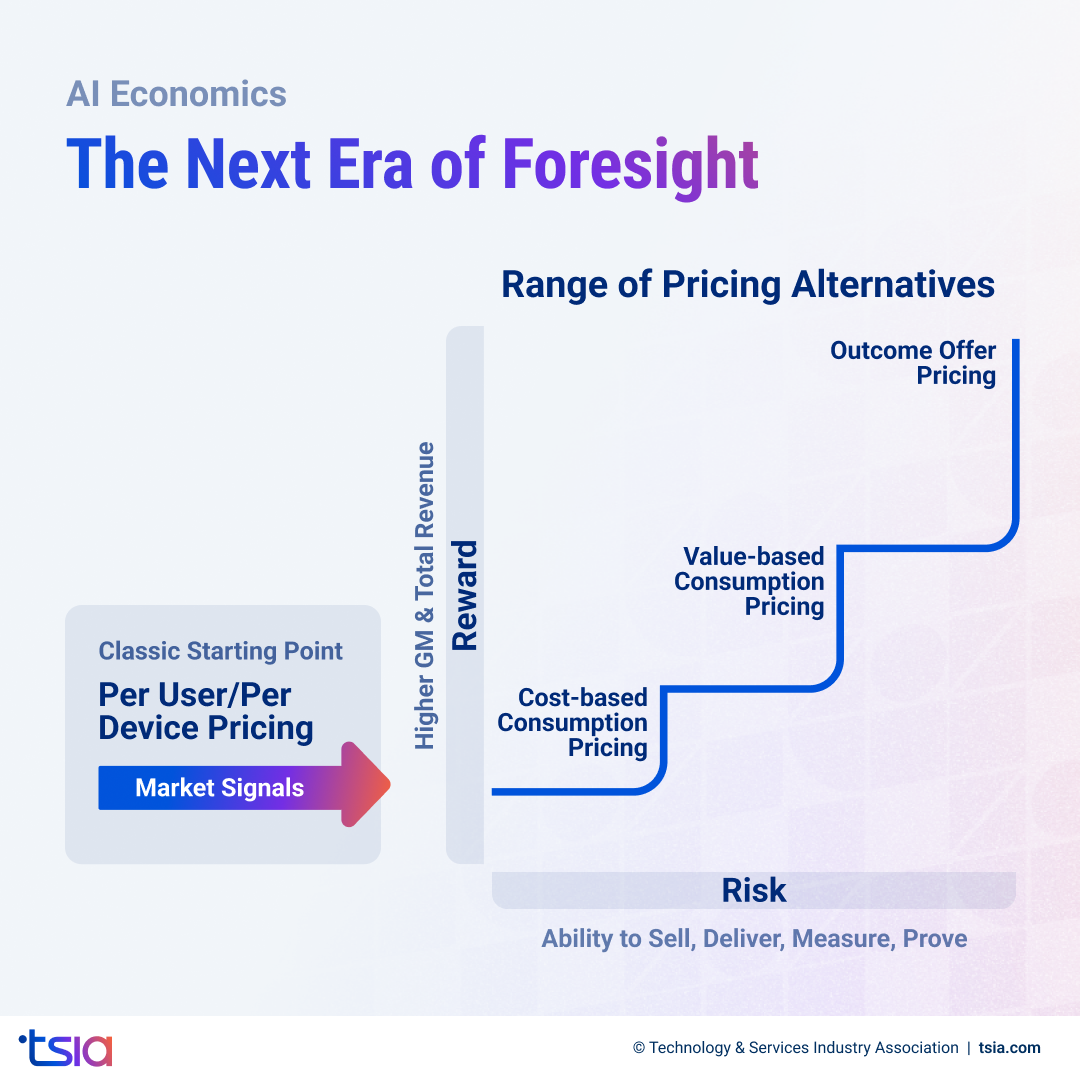
AI exposes the inadequacy of cost-plus and usage-based models. Companies can no longer charge for tokens, calls, seats, or features. They must charge for the business results AI delivers and architect their organizations to consistently prove those outcomes.
The economic pressure is clear: If you don’t evolve your pricing model, it will fail you.
Related: AI Economics.™ TSIA’s Perspective on Profitable AI Business Models
History Says: Trust the Data, Not the Drama
For fifteen years, TSIA has been right about every central inflection point that has reshaped the technology landscape. We called the move from ownership to subscription, from growth to profitability, and from digitization to intelligence.
Now we’re calling the next one. AI Economics will distinguish the companies that can deliver outcomes, and those that can only deliver algorithms.
Related blog: 6 Predictions for AI Economics™: Shifts That Will Redefine the Tech Services Industry
What This Means for You
The implications of TSIA’s track record and the realities of AI Economics land differently depending on where you sit. But the mandate is the same: outcomes must become your operating system.
Here’s what that means in practice:
If you run a Services P&L
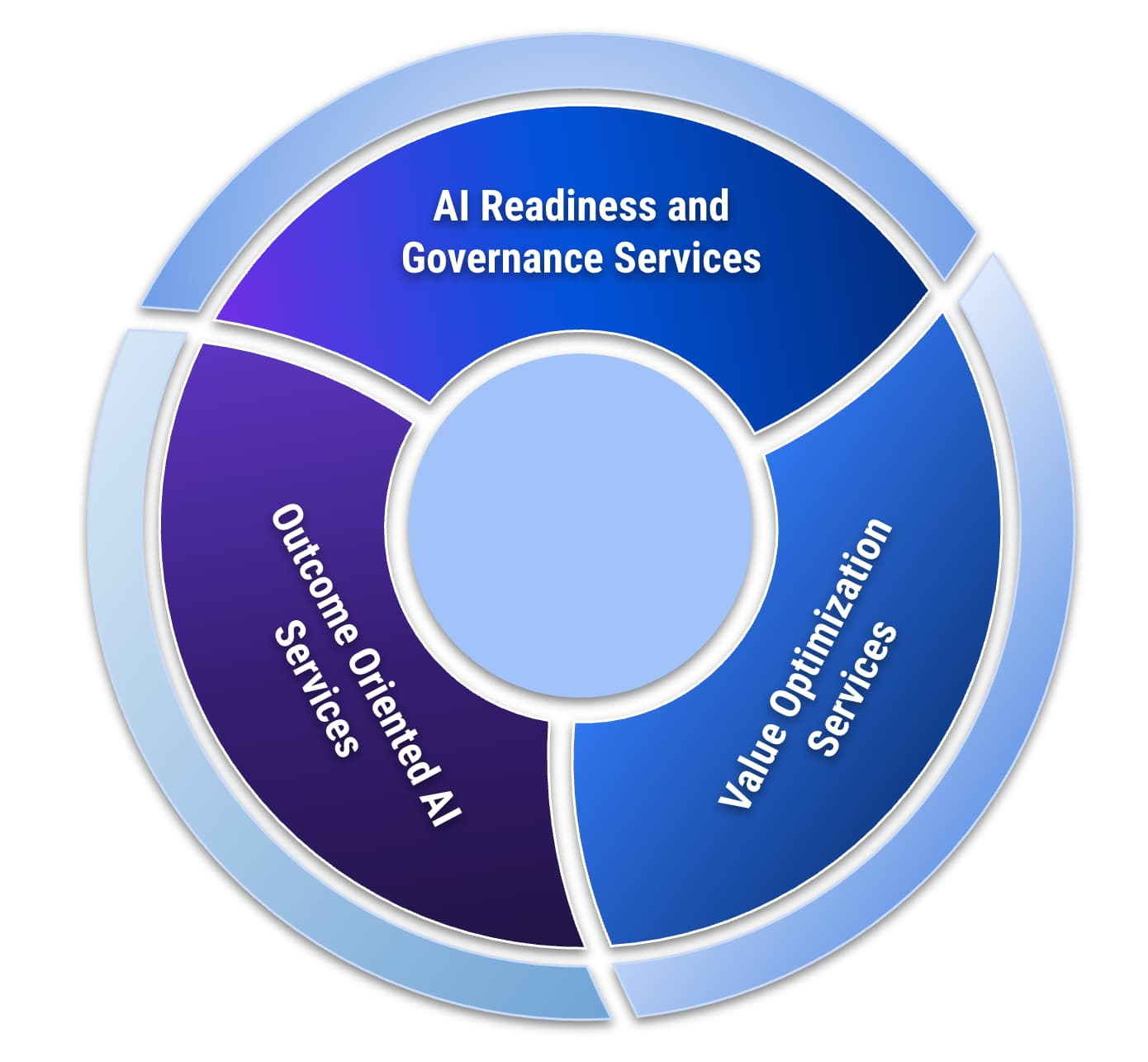
Your profitability strategy is about to be rewritten. AI won’t magically remove cost; it will reallocate it. Traditional services will become more efficient, yes. But the savings must be reinvested into the next generation of services. To compete in the AI Economy, services organizations must build three new categories of capability:
- AI Readiness & Governance Services
Preparing customers’ data, systems, infrastructure, and risk frameworks to enable AI to be safely deployed and governed. - Value Optimization Services
Continuously tuning models, expanding use cases, and ensuring AI delivers increasing value over time, because AI is never “one and done.” - Outcome-Oriented AI Services
Structuring engagements where the vendor contractually owns a measurable business result, productivity gains, cost reductions, throughput increases, risk mitigation, and more.
If you don’t own the outcomes, you won’t own the revenue.
If you’re in the C-suite
AI Economics is no longer a technology conversation. It’s a business model conversation.
It will determine:
- Which revenue models scale
- Which pricing strategies collapse
- Which companies can take ownership of customer outcomes
And it comes with a choice: Lean into services-led value, or watch competitors win the outcomes game while you’re still optimizing features.
Your investors will ask for the same thing markets have always demanded during disruption: credible transformation backed by data, pricing, and outcomes.
The Era of Excuses Is Over
AI will not wait for executives to get comfortable. Customers will not wait for vendors to figure out outcomes. Markets will not wait for business models to catch up.
Every major shift TSIA predicted from consumption, outcomes, subscription, digital, to value realization has already arrived. Those who listened built the modern tech economy. Those who ignored it spent a decade trying to recover.
AI Economics is no different. It is the most consequential rewrite of technology business models since the cloud, in fact, maybe ever, and it is happening faster than any transformation before it.
The choice is brutally simple: Engineer value, embrace outcomes, modernize your services, re-architect your pricing, rebuild your operating system, or get left behind by those who do.
History is repeating.
TSIA is repeating its warning.
The only question is whether leaders will repeat the same mistakes, or finally act before the disruption hits.
FAQ
1. What exactly is “AI Economics”?
AI Economics is TSIA’s framework for understanding how artificial intelligence transforms the economy of technology services. It measures how AI impacts cost structures, customer value, and profitability—shifting the model from selling capabilities to selling measurable, business outcomes.
2. How is this different from previous TSIA frameworks like Consumption Economics or B4B?
Consumption Economics explained how customers began paying only for what they used.
B4B defined the move from selling technology to delivering business outcomes. AI Economics is the synthesis; it quantifies those outcomes using AI-driven data, automation, and predictive insight. It’s not a replacement; it’s the culmination of everything TSIA has already proven.
3. Why should executives trust TSIA’s predictions about AI?
Because we’ve been right before, repeatedly. TSIA foresaw the shift to services, the rise of subscription models, the demand for profitability, and the digitization imperative that made AI possible.
Our frameworks aren’t theory. They’re verified history.
Smart Tip: Embrace Data-Driven Decision Making
Making smart, informed decisions is more crucial than ever. Leveraging TSIA’s in-depth insights and data-driven frameworks can help you navigate industry shifts confidently. Remember, in a world driven by artificial intelligence and digital transformation, the key to sustained success lies in making strategic decisions informed by reliable data, ensuring your role as a leader in your industry.

.png)