If your professional services (PS) organization is still managing staffing decisions with spreadsheets, static skills lists, and last-minute fire drills, you’re not alone. For years, professional services resource management has been treated as an operational function focused on filling open roles and tracking utilization. But in the PS 2.0 era, that approach is no longer enough.
Today, your resource pool is far more complex. You’re balancing internal consultants, subcontractors, strategic partners, and increasingly, AI tools that can automate portions of delivery work. At the same time, customers expect faster implementations, better outcomes, and more predictable value realization.
That means resource management has become a strategic capability. The organizations that excel in the AI era will be the ones that can match the right resources to the right work at the right time—while optimizing margins, utilization, and customer outcomes.
Key Takeaways
- Professional services resource management is now a strategic discipline that directly impacts profitability and customer success.
- AI can improve staffing decisions, but only if you first build a strong data foundation.
- Leading professional services organizations are evolving toward a hybrid workforce model that includes consultants, partners, subcontractors, and AI agents.
What Is Professional Services Resource Management?
Professional services resource management is the process of planning, allocating, and optimizing the people and capabilities needed to deliver customer engagements.
At its core, it helps you answer questions like:
- Who has the right skills for this project?
- Who is available when the project starts?
- Which resources are most likely to deliver a successful outcome?
- How do you balance utilization, employee development, and customer needs?
Done well, resource management helps you:
- Increase billable utilization.
- Reduce bench time.
- Speed up project staffing.
- Improve customer outcomes.
- Protect margins.
- Support employee growth.
In other words, resource management is where delivery strategy becomes operational reality.
Why Traditional Resource Management No Longer Works
Many professional services organizations still rely on outdated methods to assign consultants to projects.
These methods often include:
- Spreadsheet-based scheduling.
- Self-reported skills profiles.
- Limited visibility into future demand.
- Separate processes for contractors and partners.
- Manual decision-making based on tribal knowledge.
This approach creates several problems.
Skills Data Becomes Outdated
A consultant’s profile may say they know Salesforce or SAP, but it rarely tells you:
- How recently they used that skill.
- The complexity of the work they completed.
- The size and industry of the clients they served.
- Their proficiency level.
Without this level of detail, staffing decisions are based on assumptions rather than facts.
Staffing Decisions Become Reactive
If you don’t have visibility into pipeline demand, resource managers are forced to scramble when projects close.
This leads to:
- Delayed project starts.
- Overbooked top performers.
- Underutilized team members.
- Increased subcontractor costs.
Resource Pools Are Fragmented
Many organizations manage employees, partners, and contractors in different systems. As AI agents begin to take on repeatable tasks, this fragmentation becomes even more problematic.
Related: What Is Professional Services 2.0?
The PS 2.0 Transformation Paradox
One of the biggest lessons from TSIA’s research is that AI does not fix broken operational processes. It amplifies them. Organizations are eager to use AI to improve staffing and allocation, but if the underlying data is incomplete or inaccurate, the recommendations AI generates will also be unreliable.

The gap between measurement and AI adoption shows that most organizations have the metrics they need; they just haven’t built the integrated data foundation required to act on them intelligently. TSIA refers to this as the PS 2.0 Transformation Paradox: You cannot scale AI-driven professional services without first building strong operational discipline. That means your success with AI depends on the quality of your foundational systems, processes, and data.
Related: Professional Services 2.0: The Playbook for Winning in the AI Economics Era
Why Resource Management Matters More Than Ever
Resource management directly impacts nearly every key PS metric.
When you consistently place the right resources on the right projects, you can:
- Improve billable utilization.
- Increase revenue per consultant.
- Reduce time to staff new engagements.
- Improve project margins.
- Lower employee burnout.
- Enhance customer satisfaction.
TSIA benchmark data shows that organizations with a formal resource management organization (RMO) outperform those without one in utilization and staffing speed. That makes resource management one of the highest-leverage areas for PS improvement.
From Resource Management Office to Hybrid Workforce Command Center
In the PS 2.0 era, the traditional RMO evolves into what TSIA calls the hybrid workforce command center. This is not simply a centralized scheduling team. It operates across two components that must be built in sequence.
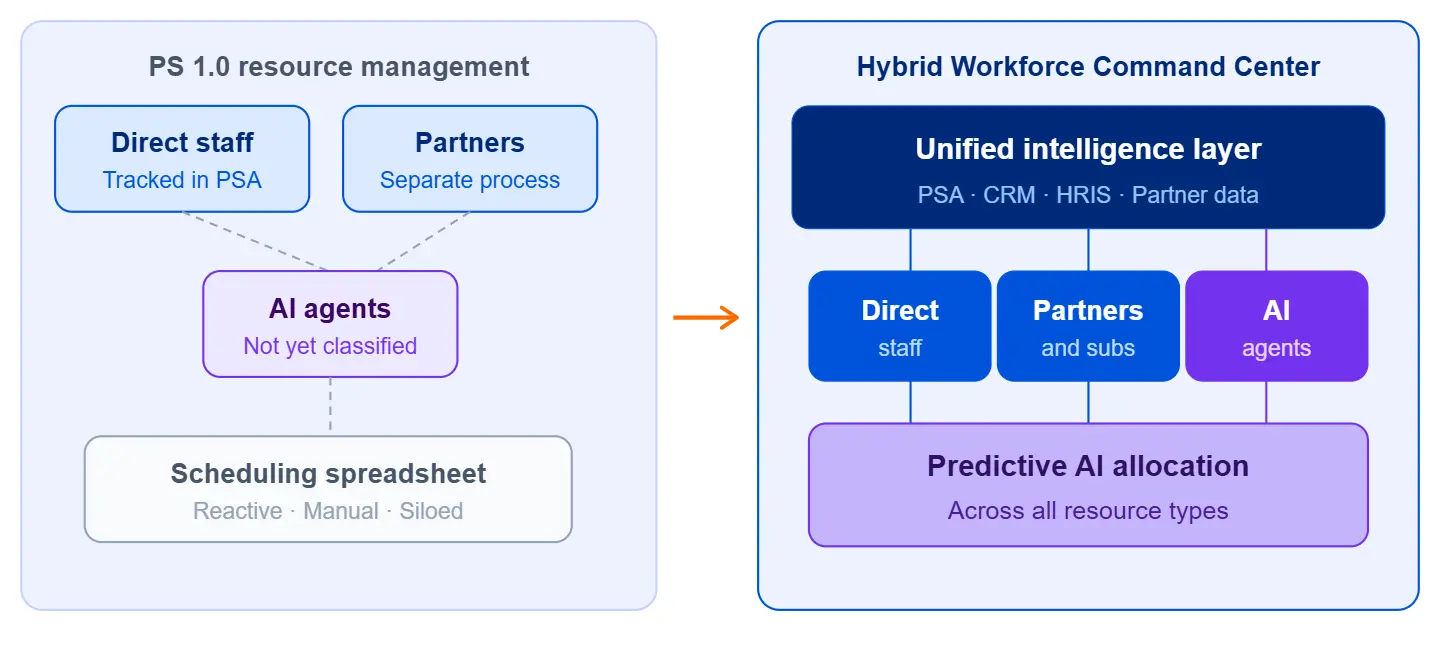
It is an intelligence-driven function that manages all available capacity across:
- Internal consultants.
- Strategic partners.
- Subcontractors.
- AI agents.
Its goal is to optimize the entire delivery ecosystem rather than just assigning available employees.
Build the Skills Genome
The foundation of modern professional services resource management is a structured and continuously updated skills database, which TSIA refers to as the skills genome.
What the Skills Genome Includes
For each resource, you capture:
- Skill proficiency level.
- Industry expertise.
- Project experience.
- Recency of use.
- Certifications.
- Performance history.
For AI tools, you document:
- Specific capabilities.
- Reliability levels.
- Known limitations.
- Required oversight.
For partners and subcontractors, you maintain the same level of rigor you use for internal staff. This creates a trusted source of truth for allocation decisions.
Create a Unified Resource Intelligence Layer
Once you establish the skills genome, you need to connect your systems into a unified data environment.
This includes integrating:
- Professional services automation (PSA).
- Customer relationship management (CRM).
- Human resources information systems (HRIS).
- Partner management systems.
Together, these systems provide three essential signals:
- Demand signal: Sales pipeline and forecast data help you anticipate future staffing needs.
- Supply signal: Current availability and capacity show what resources you have.
- Performance signal: Historical delivery data reveals which staffing combinations produce the best outcomes.
With this intelligence layer in place, you can move from reactive staffing to predictive resource planning.
How AI Improves Professional Services Resource Management
AI capabilities in resource management typically evolve across three maturity levels.

- Level 1: Skills Intelligence: AI continuously updates consultant profiles by analyzing project data, certifications, and delivery artifacts.
- Level 2: Allocation Optimization: AI recommends staffing options based on skills match, availability, utilization, and project history.
- Level 3: Hybrid Workforce Orchestration: AI optimizes work across consultants, subcontractors, partners, and AI agents in a unified model.
Most organizations are still in the early stages, but the opportunity is significant for those who build the right foundation first.
Related: Boost Professional Services Impact With AI
The Strategic Impact of Better Resource Management
When professional services resource management is done well, the benefits extend far beyond scheduling.
You gain the ability to:
- Deliver projects faster.
- Improve margins.
- Scale without adding headcount at the same rate.
- Develop your people more effectively.
- Increase customer confidence.
- Compete more effectively in the AI era.
In short, resource management becomes a strategic advantage.
Build the Infrastructure for PS 2.0
Professional services organizations are entering a new era. Your workforce is no longer made up solely of consultants. It now includes partners, subcontractors, and AI agents, all working together to deliver outcomes. Managing this complexity requires more than spreadsheets and tribal knowledge.
It requires a data-driven command center that gives you real-time visibility into your skills, capacity, and delivery performance. The sooner you build this foundation, the better positioned you’ll be to improve profitability, accelerate delivery, and scale your organization with confidence.
Frequently Asked Questions
What is professional services resource management?
Professional services resource management is the process of assigning the right people and capabilities to projects based on skills, availability, and business priorities.
Why is resource management important in professional services?
It directly affects utilization, margins, staffing speed, employee satisfaction, and customer outcomes.
How does AI improve resource management?
AI helps maintain skills data, recommend staffing options, and optimize work across human and digital resources.
Smart Tip: Embrace Data-Driven Decision Making
Making smart, informed decisions is more crucial than ever. Leveraging TSIA’s in-depth insights and data-driven frameworks can help you navigate industry shifts confidently. Remember, in a world driven by artificial intelligence and digital transformation, the key to sustained success lies in making strategic decisions informed by reliable data, ensuring your role as a leader in your industry.