




AI has become the rallying cry for professional services (PS) leaders. You’re being asked to scale faster, deliver measurable outcomes, reduce delivery costs, and prove value sooner—all while customer expectations continue to rise.
At the same time, many professional services organizations are struggling with inconsistent data, manual processes, and fragmented delivery models. That creates a frustrating tension: you’re expected to modernize with AI, but your operational foundation isn’t built to support it.
This is the PS 2.0 transformation paradox. The reality is uncomfortable but straightforward: you cannot scale AI-driven professional services without mastering the fundamentals first. AI doesn’t fix broken processes. It amplifies them. And without operational rigor—clean data, repeatable delivery, and aligned metrics—AI initiatives will stall before they ever create value.
PS 2.0 is the evolution of professional services toward scalable, outcome-driven delivery powered by automation and AI. It emphasizes repeatability, measurable value, and long-term customer impact rather than billable hours.
The future of professional services is absolutely outcome-driven, automated, and scalable. But getting there requires addressing what’s holding you back today.
Key Takeaways
- The PS 2.0 transformation depends on mastery of many aspects of PS 1.0. AI-powered scaling is impossible without standardized services, clean data, and repeatable processes.
- Foundational gaps, not technology, are the biggest blockers to AI adoption. Most professional services organizations struggle with productization, data integrity, and operational alignment.
- The winning approach is parallel progress. You don’t “fix everything first.” You strengthen fundamentals while deliberately designing for an AI-driven future.
Understanding the Shift From PS 1.0 to PS 2.0
Before addressing what’s broken, it’s essential to clarify what’s changing.
What PS 1.0 Looks Like Today
Many professional services organizations still operate primarily under the PS 1.0 model. That model is defined by:
- Labor-intensive, project-based delivery.
- Heavy reliance on specialized consultants.
- Manual execution and fragmented tools.
- Success is measured by utilization, billable hours, and project margin.
This approach works—until scale and hyper-efficiency become the goals. PS 1.0 delivery is often bespoke, difficult to standardize, and produces inconsistent data. That makes automation and AI adoption extremely difficult.
What PS 2.0 Requires
PS 2.0 represents a fundamental evolution in how services are designed, delivered, and measured. In this model, you move toward:
- Productized, repeatable service offers.
- Outcome or adoption-based delivery models.
- Embedded automation and AI.
- Success is measured by ARR, customer lifetime value (CLTV), and time-to-value.
AI is the engine behind PS 2.0. But AI only works when it has structured data and repeatable processes to learn from. That’s where the paradox emerges.
Related: The PS 2.0 Transformation Paradox
The PS 1.0 Gaps Blocking PS 2.0 Transformation
Across the industry, the same operational gaps recur. These gaps don’t just slow you down—they actively prevent scalable transformation.
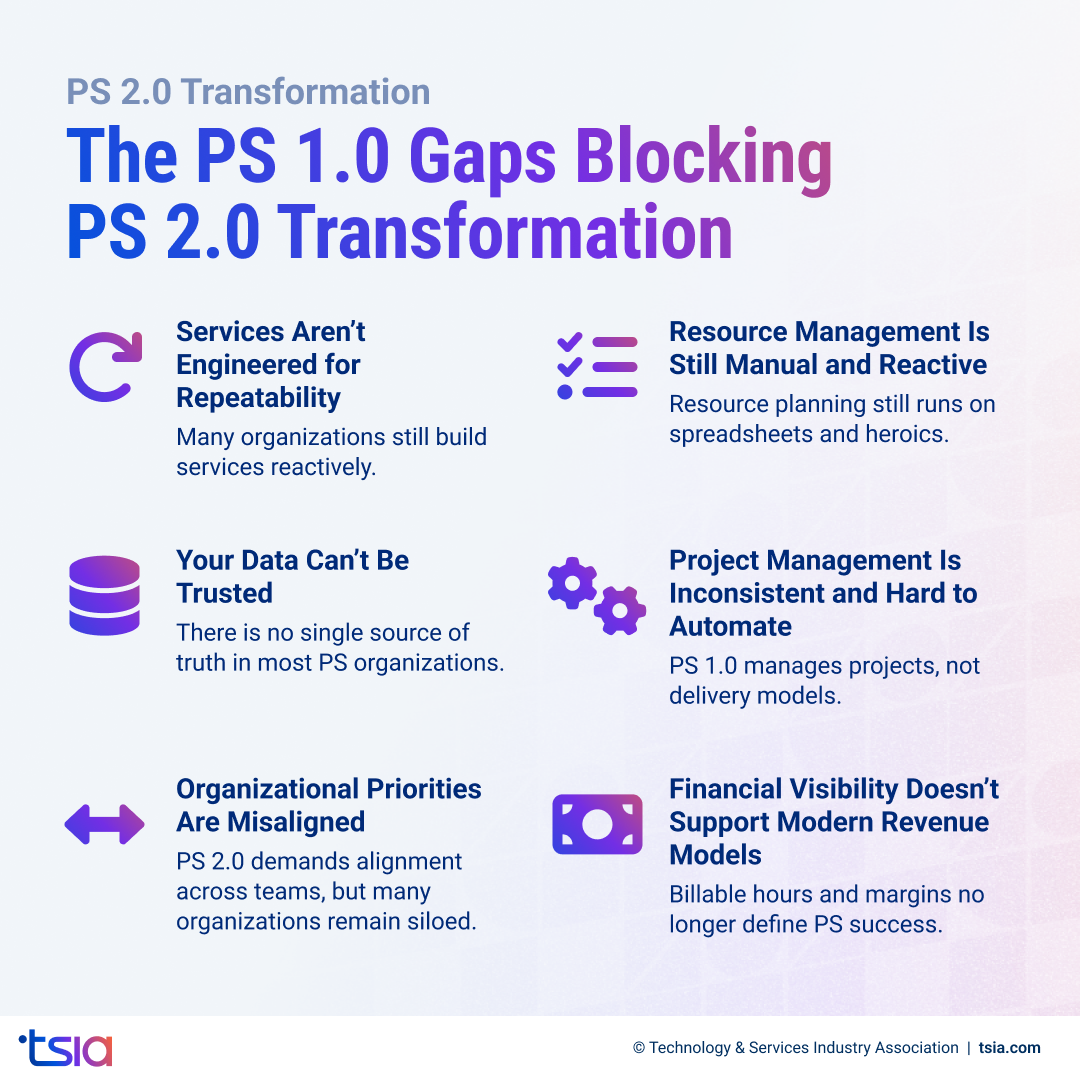
1. Services Aren’t Engineered for Repeatability
In many organizations, services are still created reactively—defined in response to sales requests rather than designed intentionally.
Why this matters to you: If every engagement is custom, you never generate consistent data, and without consistency, AI has nothing reliable to optimize.
PS 2.0 depends on services that are engineered with:
- Clear outcomes.
- Standardized steps.
- Defined success metrics.
- Lifecycle management.
Without formal service development and productization, outcome-based and subscription services remain out of reach.
2. Your Data Can’t Be Trusted
AI is only as good as the data it consumes. In professional services, this data includes:
- Project plans and milestones.
- Resource assignments and actuals.
- Offer definitions.
- Adoption and value metrics.
Most professional services organizations can’t point to a trustworthy single source of truth. Data is scattered across PSA tools, CRM systems, finance platforms, and spreadsheets—often telling different stories.
Why this matters to you: Without clean, connected data, forecasting breaks down, reporting becomes unreliable, and AI models fail before they deliver value.
PS 2.0 requires data integrity across the full lifecycle—from sale to delivery to realized outcomes.
3. Organizational Priorities Are Misaligned
PS 2.0 requires tight alignment across sales, professional services, customer success, product, and support. Yet many organizations remain stuck in functional silos.
You see it when:
- Professional services prioritize utilization.
- Customer success prioritizes adoption.
- Sales prioritizes bookings.
- No one owns the end-to-end outcomes.
Why this matters to you: Misalignment creates friction, inconsistent execution, and fragmented data. AI-driven delivery cannot succeed if the underlying organization is pulling in different directions.
Clear operational and organizational alignment isn’t optional—it’s foundational.
4. Resource Management Is Still Manual and Reactive
Despite being a core professional services capability, resource planning in many organizations still relies on spreadsheets, gut instinct, and individual heroics.
This approach:
- Introduces bias and inefficiency.
- Limits forecasting accuracy.
- Fails to account for future skill needs.
- Ignores AI agents as part of the delivery model.
Why this matters to you: PS 2.0 depends on scalable capacity planning. Without data-driven resource management, you can’t predict demand, close skill gaps, or optimize delivery at scale.
5. Project Management Is Inconsistent and Hard to Automate
Traditional project management in PS 1.0 focuses on individual projects rather than standardized delivery models.
Common challenges include:
- Manual project setup.
- Intuition-based assignments.
- Reactive risk management.
- Little reuse of lessons learned.
Why this matters to you: AI thrives on patterns. Without documented, repeatable delivery methods, AI cannot automate scheduling, predict risk, or improve outcomes over time. Every project becomes a one-off, and scaling becomes impossible.
6. Financial Visibility Doesn’t Support Modern Revenue Models
Many professional services financial models are still optimized for billable hours and project margins. While those metrics still matter, they don’t tell the whole story in a subscription and outcome-driven world.
PS 2.0 requires visibility into:
- Cost efficiency driven by automation.
- Contribution to ARR and CLTV.
- Long-term value creation.
Why this matters to you: Without modern financial visibility and AI-enabled insights, financial decisions remain reactive rather than strategic.
Related: Professional Services Pricing in the AI Era
How To Bridge PS 1.0 and PS 2.0 Without Stalling Progress
The biggest mistake leaders make is treating transformation as a sequence: fix everything first, then adopt AI. That approach rarely works. Instead, successful organizations pursue parallel progress, strengthening foundational rigor while explicitly designing for the future.
“PS 2.0 transformation is not a quantum leap but a carefully constructed bridge.” – Bo DiMuccio, Distinguished Vice President of Professional Services Research, TSIA.
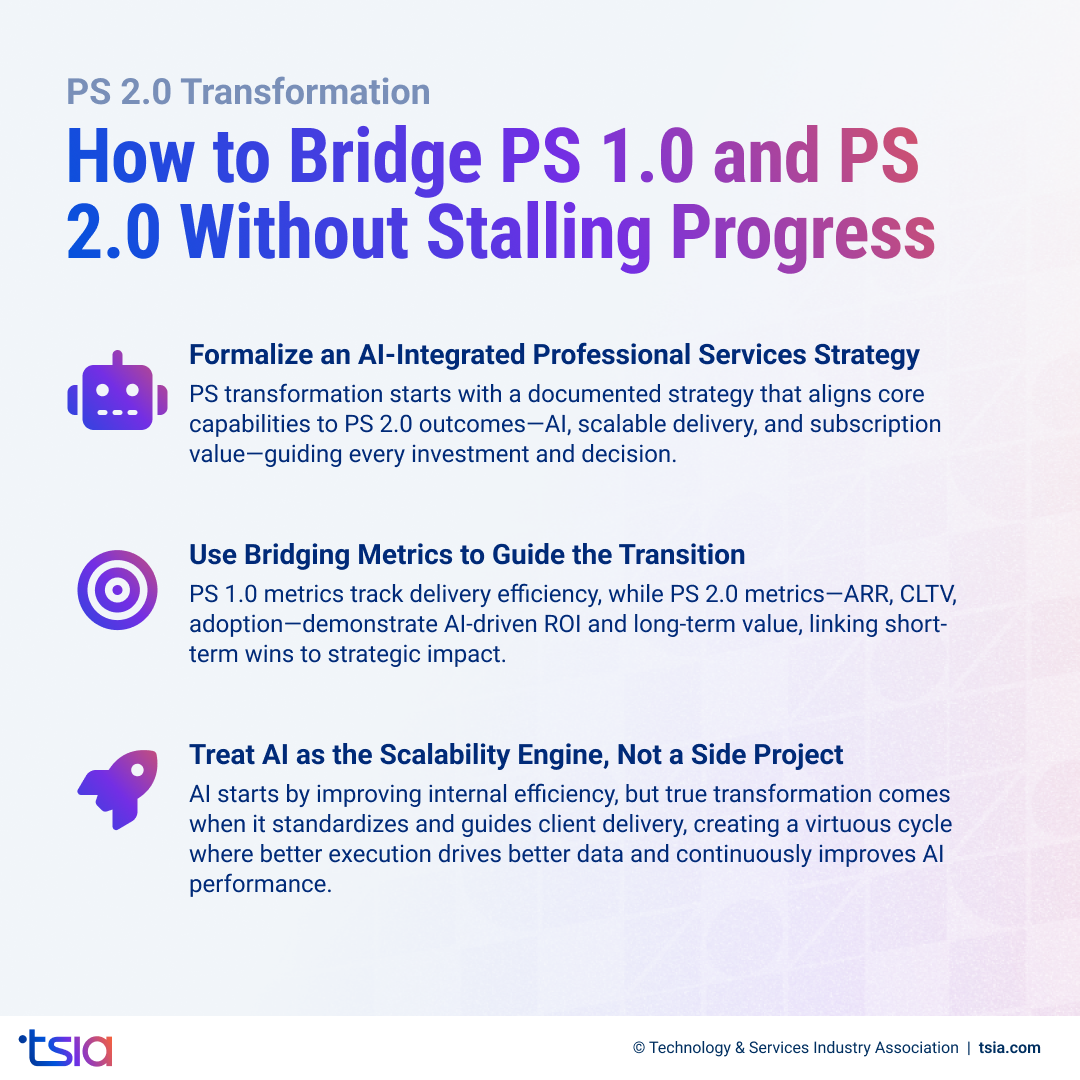
Strategy 1: Formalize an AI-Integrated Professional Services Strategy
Transformation starts with a documented mandate. You need a formal professional services strategy that explicitly addresses:
- AI integration.
- Scalable delivery design.
- Subscription and outcome-based enablement.
This strategy should clearly link investments in PS 1.0 foundations, such as services engineering or data architecture, to PS 2.0 outcomes, including reduced time-to-value and increased recurring revenue. Your professional services strategy becomes the filter for every decision: if it doesn’t support PS 2.0, it doesn’t get funded.
Strategy 2: Use Bridging Metrics to Guide the Transition
You don’t abandon PS 1.0 metrics—but you don’t stop there either. PS 1.0 rigor metrics still matter, including utilization and project margin. They help you understand the efficiency of your delivery engine.
At the same time, PS 2.0 value metrics must come into focus, such as ARR, CLTV, and adoption rates. AI often delivers its first value through cost efficiency. By tracking both sets of metrics, you can show immediate ROI while proving long-term impact.
Strategy 3: Treat AI as the Scalability Engine, Not a Side Project
Early AI use cases often focus on internal efficiency, and that’s a good starting point. Examples include:
- Optimized scheduling.
- Automated SOW creation.
- Smarter reporting.
But the fundamental transformation happens when AI becomes part of the client delivery model itself. That includes:
- Enforcing service standardization during project setup.
- Guiding consultants through repeatable delivery steps.
- Predicting risk and enabling proactive intervention.
When AI is used to productize and standardize delivery, it creates a virtuous cycle: better execution produces better data, which improves AI performance over time.
Related: What Is Professional Services 2.0?
The Future of Professional Services Depends on Foundational Excellence
PS 2.0 is not a clean break from the past. It’s a carefully constructed bridge. Your ability to scale AI-driven professional services depends on how well you master and adapt the fundamentals of PS 1.0. That means resisting the urge to chase instant transformation and instead committing to disciplined, intentional progress.
"The structural integrity of this bridge depends upon mastering and then adapting many of the core fundamentals of PS 1.0." – Bo DiMuccio, Distinguished Vice President of Professional Services Research, TSIA.
When you invest in operational rigor with a clear PS 2.0 mandate, you unlock momentum. You move faster. You deliver consistent outcomes. And you position professional services as an actual growth engine in an AI-driven future.
Frequently Asked Questions
What is PS 2.0 in simple terms?
PS 2.0 is the evolution of professional services toward scalable, outcome-driven delivery powered by automation and AI. It emphasizes repeatability, measurable value, and long-term customer impact—rather than billable hours.
Why can’t AI fix broken professional services processes?
AI depends on structured data and repeatable workflows. If your services are inconsistent, undocumented, or fragmented, AI will amplify those issues rather than resolve them.
Do professional services organizations need to fully master PS 1.0 before adopting AI?
No. The most successful organizations improve foundational capabilities while designing for PS 2.0. The key is ensuring foundational investments are driven by future-state goals.
Smart Tip: Embrace Data-Driven Decision Making
Making smart, informed decisions is more crucial than ever. Leveraging TSIA’s in-depth insights and data-driven frameworks can help you navigate industry shifts confidently. Remember, in a world driven by artificial intelligence and digital transformation, the key to sustained success lies in making strategic decisions informed by reliable data, ensuring your role as a leader in your industry.




.png)

.png)
.png)
