For years, professional services ran on a simple equation: more hours meant more revenue. The more people you staff, the more you can bill. It was predictable, scalable, and deeply ingrained in how your organization operated. That model is now breaking.
AI isn’t just improving efficiency—it’s rewriting the economics behind your business. When AI can complete work faster, more cheaply, and at scale, the traditional link between effort and revenue begins to collapse. What once drove growth now puts pressure on it. This is the reality of AI Economics™.
If you’re still operating under a Professional Services 1.0 mindset, you’re likely already feeling it. Margins are tightening. Pricing models are under scrutiny. And the value of human effort is being questioned in ways it never has before. The shift to Professional Services 2.0 (PS 2.0) isn’t optional—it’s how you protect relevance, revenue, and long-term growth. This playbook gives you a clear path forward.
Key Takeaways
- AI is breaking the effort-based model: If your revenue still depends on hours or headcount, AI will continue to erode your margins.
- Your value now lives in outcomes, not effort: The real differentiation happens in how you deliver and prove business impact—not how much work you do.
- Transformation starts with your foundation: You can’t scale AI on top of fragmented data, inconsistent processes, or misaligned metrics.
Why AI Economics Is Forcing a Reset in Professional Services
The biggest shift happening right now isn’t about technology—it’s about how value is created and captured.
In the PS 1.0 world, your business likely relied on:
- Time-and-materials (T&M) pricing.
- Billable utilization as a core KPI.
- A pyramid-shaped workforce model.
- Services designed around people, not outcomes.
That model worked when human effort was the primary driver of delivery. But AI changes that equation. If AI can complete the work of multiple consultants in a fraction of the time, your pricing model starts working against you. The more efficient you become, the more revenue you risk losing. This is the Cannibalization Dilemma. Instead of resisting it, you need to redesign your model around it.
To understand what this transformation really requires, it helps to look at the core foundations of Professional Services 2.0.
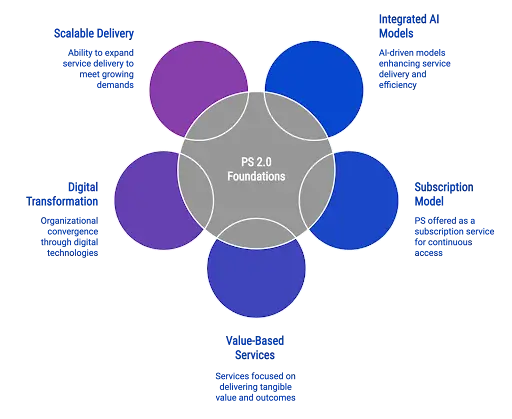
These five pillars—AI, delivery scalability, digital transformation, subscription models, and value-based services—work together to redefine how you create and capture value in the AI Economics era.
In PS 2.0, success comes from:
- Delivering measurable outcomes.
- Capturing the value created by AI-driven efficiency.
- Positioning services as the engine of customer value, not a support function.
Related: Professional Services 2.0 Subscription Models in the Era of AI
The Real Shift: From Effort to Outcomes
The transition to PS 2.0 requires you to rethink what you’re actually selling.
You’re no longer selling:
- Hours.
- Headcount.
- Activities.
You’re selling:
- Time-to-value.
- Business outcomes.
- Measurable impact.
This changes everything from pricing to delivery to how your teams operate.
What this looks like in practice:
- Pricing shifts: From time-based billing to outcome-based or hybrid models.
- Metrics evolve: From utilization to ARR impact and customer value.
- Delivery transforms: From project completion to continuous value realization.
If you don’t make this shift, you risk becoming a commodity provider in a market that is rapidly moving past labor-based value.
To make this shift more concrete, here’s how Professional Services 1.0 compares to Professional Services 2.0.
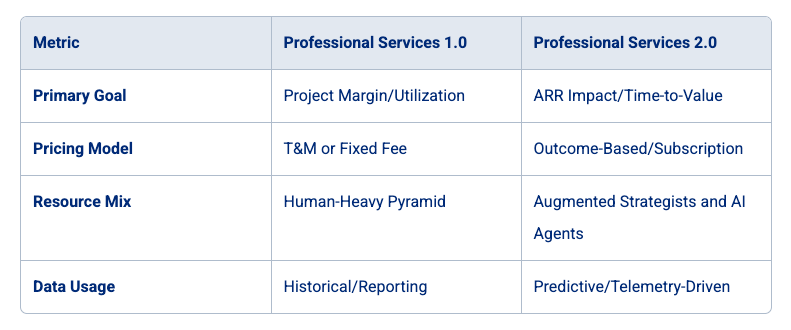
This isn’t just a change in delivery—it’s a complete reset of how you measure success, price your services, and scale value.
Step 1: Fix Your Foundation Before You Scale AI
Before you jump into transformation, you need to address a hard truth: AI doesn’t fix broken systems. It scales them. If your processes are inconsistent, your data is fragmented, or your delivery is overly customized, AI will amplify those problems rather than solve them.
Where to focus first:
- Data integrity: You need a single, reliable source of truth across your systems.
- Process consistency: Standardized delivery is what enables scale.
- System integration: Your CRM, PSA, and customer success platforms must work together.
- Dark time reduction: Identify and eliminate non-billable administrative work.
Many organizations underestimate how much time is lost to “dark time”—manual reporting, status updates, and resource coordination. Reducing this alone can unlock immediate capacity and margin improvement. This step isn’t glamorous, but it’s critical. Without it, everything else stalls.
Step 2: Redefine What Success Looks Like
One of the biggest barriers to PS 2.0 isn’t technology—it’s how success is measured. For years, your managers have been trained to optimize for utilization. A busy team meant a successful team. In PS 2.0, that logic needs to evolve, but it doesn’t disappear.
If AI allows you to deliver the same outcome in less time, lower utilization isn’t failure—it’s a signal that your delivery model is becoming more efficient. At the same time, you still need to ensure your services engine remains productive and financially sound. This is where many organizations get it wrong. They try to abandon legacy metrics too quickly, creating blind spots in performance and profitability.
What needs to change
Instead of replacing old metrics, you need to run both models in parallel:
Continue tracking PS 1.0 metrics:
- Utilization.
- Project margin.
- Delivery efficiency.
Introduce PS 2.0 value metrics alongside them:
- ARR impact.
- Time-to-value (TTV).
- Customer lifetime value (CLTV).
- Customer outcomes and adoption.
This is what TSIA defines as Bridging Metrics—a dual system that allows you to fund the transition while proving the new model's value.
How to apply this in practice:
- Tie manager incentives to a blend of efficiency and outcome metrics.
- Use utilization to ensure delivery discipline, not as the sole measure of success.
- Track how improvements in efficiency translate into greater customer value and recurring revenue.
Over time, value-based metrics will take on a larger role. But during the transition, both sets of metrics are critical. You’re not replacing one system with another; you’re building a bridge between them.
Step 3: Move Toward Outcome-Based Pricing
As AI compresses delivery time, traditional pricing models become unsustainable. If you continue billing for hours, your revenue shrinks as your efficiency improves. To counter this, you need to capture the value AI creates.
How to start:
- Introduce hybrid pricing models (base + outcome-based incentives).
- Align pricing with measurable business impact.
- Build the infrastructure to track and prove outcomes.
This requires what TSIA refers to as a “trust stack”:
- Transparent AI decision-making.
- Reliable performance monitoring.
- Billing systems that support outcome-based models.
Without this foundation, outcome-based pricing is difficult to scale.
Step 4: Productize Your Services With Services Engineering
In PS 1.0, services were often built reactively, customized for each customer. That approach doesn’t scale in an AI-driven world. To move forward, you need to shift from people-as-a-service to knowledge-as-a-service.
What this means for you:
- Create modular, repeatable service assets.
- Standardize delivery frameworks.
- Build accelerators and automation into your offerings.
Think of your services as building blocks, not one-off engagements. This not only improves consistency but also creates the structured data AI needs to optimize delivery over time.
Step 5: Rethink How You Sell Services
In PS 2.0, your sales motion needs to evolve alongside your delivery model. You’re no longer selling effort—you’re selling outcomes.
What changes in your go-to-market approach:
- Discovery becomes diagnostic: You assess business challenges, not just technical requirements.
- Value becomes the anchor: Conversations focus on impact, not scope.
- Pricing aligns with results: Customers pay for outcomes, not hours.
This also extends to your partner ecosystem.
Instead of using partners for capacity, you need to enable them to deliver outcomes at scale:
- Certify partners based on outcomes, not just product knowledge.
- Share service IP and accelerators.
- Track partner performance with real data.
Your ecosystem becomes a force multiplier—if it’s aligned correctly.
Related: Navigating Partner Management in PS 2.0
Step 6: Evolve Your Workforce for an AI-Driven Model
The workforce of PS 2.0 looks very different from PS 1.0. You’re moving from a pyramid model to a more specialized, high-value structure.
The rise of the augmented consultant
Your consultants are no longer just executing tasks. They’re:
- Orchestrating AI-driven delivery.
- Translating business needs into technical outcomes.
- Driving change within the customer organization.
New roles begin to emerge:
- Value translators.
- Forward-deployed engineers (FDEs).
- AI and data governance specialists.
At the same time, AI takes on more of the repetitive, low-value work, freeing your team to focus on strategic impact.
Step 7: Treat Transformation as an Ongoing Strategy
PS 2.0 isn’t a one-time initiative. It’s an ongoing evolution.
The most effective organizations take a parallel-path approach:
- Optimize your current PS 1.0 model for stability.
- Invest in PS 2.0 capabilities for future growth.
How to prioritize your next moves:
- Start with high-impact, low-complexity initiatives.
- Reinvest efficiency gains into transformation efforts.
- Track both short-term and long-term metrics.
This allows you to move forward without disrupting your current business.
Related: The PS 2.0 Transformation Paradox
Why Professional Services Becomes the Growth Engine
Here’s the shift that matters most: In the AI era, your product no longer delivers value on its own. The real value is realized through how that product is implemented, optimized, and continuously improved. That’s where you come in.
Professional services is no longer a support function—it’s the engine that drives:
- Customer outcomes.
- Retention and expansion.
- Long-term profitability.
Organizations that embrace PS 2.0 will lead this transformation. Those that don’t risk becoming commoditized in a fast-moving market.
FAQs
What is Professional Services 2.0 (PS 2.0)?
Professional Services 2.0 is a shift from effort-based delivery models to AI-powered, outcome-driven services. Instead of selling hours or resources, you focus on delivering measurable business results.
Why is AI disrupting traditional professional services models?
AI reduces the time and effort required to deliver services. This breaks traditional pricing models based on hours or headcount, forcing organizations to rethink how they create and capture value.
What is outcome-based pricing in professional services?
Outcome-based pricing ties your revenue to the results you deliver, such as improved efficiency or reduced time-to-value, rather than the amount of work performed.
Smart Tip: Embrace Data-Driven Decision Making
Making smart, informed decisions is more crucial than ever. Leveraging TSIA’s in-depth insights and data-driven frameworks can help you navigate industry shifts confidently. Remember, in a world driven by artificial intelligence and digital transformation, the key to sustained success lies in making strategic decisions informed by reliable data, ensuring your role as a leader in your industry.