If you’re relying on a single customer health score to tell you which accounts are thriving and which are at risk, you’re not alone. For years, customer health scoring has been the backbone of customer success. A simple red-yellow-green indicator promised clarity, alignment, and early warning signals. But today, that model is breaking down.
You’re being asked to scale customer success in a world driven by consumption, digital engagement, and AI. And the reality is this: most traditional health scores aren’t built for that level of complexity. Instead of helping you act early, they’re forcing you into reactive mode—flagging churn risk only after it’s too late.
So the question isn’t whether you should have a customer health score. It’s whether your current model is actually helping you make better decisions.
Key Takeaways
- Traditional customer health scoring models are failing because they rely on lagging indicators and subjective inputs that don’t accurately predict outcomes.
- AI-driven, predictive models are more accurate—but still underutilized, with only 22% of organizations adopting them today.
- The future isn’t one score—it’s a system of predictive signals and agentic workflows that tell you what’s happening and what to do next.
Why Traditional Customer Health Scoring No Longer Works
For over a decade, customer health scoring has been treated as a single source of truth—a way to summarize the state of a customer relationship in one number or color. But that simplicity is exactly what’s causing the problem.
Most traditional models are built by combining a wide range of inputs:
- Product usage data
- Support tickets
- Engagement metrics
- CSM sentiment
All rolled into one weighted score.
At first glance, that sounds comprehensive. In reality, it creates what TSIA describes as a “Swiss Army knife” problem—trying to measure everything, but accurately predicting almost nothing. Your current score is likely telling you what already happened, not what’s about to happen.
That means:
- You’re identifying churn risk after the customer has already disengaged.
- You’re reacting to problems instead of preventing them.
- Your team is stuck in constant firefighting.
If you’ve ever looked at a “red” account and thought, "We should have seen this earlier,” that’s not a process issue. It’s a model issue.
Related: Are Customer Health Scores Still Useful?
The Hidden Cost of Manual and Subjective Scoring
Even if your model seems “good enough,” there’s a deeper problem underneath it: manual effort and human bias. One of the biggest challenges customer success teams face today is the amount of manual work required to maintain health scores.
CSMs are:
- Updating fields.
- Adjusting scores.
- Interpreting conflicting data.
And despite all that effort, the output still lacks confidence. In fact, most organizations using non-AI models don’t consider their scores highly accurate, and even early AI adopters are struggling to eliminate manual work.
The risk of “gut feel” scoring
Many teams still rely on CSM sentiment to round out their scores. On the surface, this feels like a strength—after all, your team knows the customer best. But the data tells a different story.
When subjective inputs like CSM disposition are heavily weighted:
- Retention rates tend to decline.
- Churn rates tend to increase.
This isn’t about capability—it’s about bias. CSMs naturally want to believe they’ve stabilized a risky account after a positive interaction. But that optimism can override the actual data signals—usage trends, support issues, or lack of value realization. The result? A misleading “green” score that hides real risk until it’s too late.
The Actionability Gap: Why Your Score Isn’t Driving Outcomes
Even when your health score is directionally correct, it often fails at the most important step: what happens next. This is what many teams are now calling the actionability gap.
You can see the score, but you don’t know:
- What’s causing the issue.
- Who should take action.
- What the next best step is.
That leaves your team guessing. And when every account requires interpretation, you can’t scale.
What leading organizations are doing differently
Forward-thinking organizations are moving away from static dashboards and toward prescriptive systems.
Instead of just showing a score, they:
- Highlight the specific drivers behind risk or growth.
- Recommend the next action.
- Route the issue to the right role (CSM, technical specialist, sales, etc.).
This is how customer health scoring evolves from reporting into a true growth engine.
From One Score to Many Signals: A Better Way To Measure Customer Health
If the “one score” model doesn’t work, what replaces it? The answer isn’t a better formula—it’s a different approach.
Deconstruct the score
Instead of trying to create one perfect metric, leading organizations are breaking health scoring into multiple focused models.
For example:
- Churn risk model → predicts the likelihood of contraction or loss.
- Expansion model → identifies growth opportunities.
- Outcome model → measures value realization and ROI.
This gives you a more accurate picture of what’s actually happening. Because here’s the reality: a customer can be highly engaged and still at risk if they’re not seeing value. A single score can’t capture that complexity. A system of signals can.
The Shift to Predictive, AI-Driven Customer Health Scoring
This is where AI changes the equation.
Traditional models rely on predefined rules:
- If usage drops below “X,” trigger an alert.
- If support tickets increase, lower the score.
But customer behavior isn’t that simple.
AI-driven models can:
- Analyze patterns across multiple data sources.
- Detect early signals that humans might miss.
- Continuously learn and improve over time.
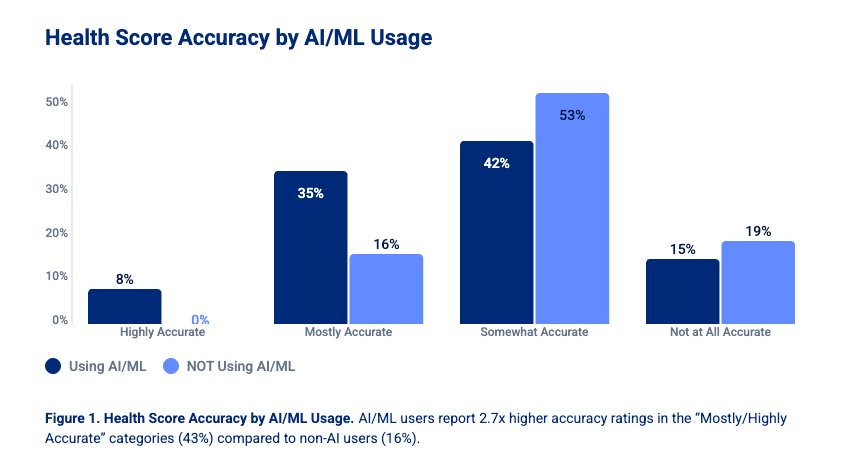
And the impact is real. Organizations using AI/ML for health scoring report significantly higher accuracy compared to those relying on manual models.
Why adoption is still low
Despite the benefits, only 22% of organizations are using AI for health scoring today. That’s not because the value isn’t clear.
It’s because many teams:
- Haven’t restructured their data models.
- Are still dependent on manual processes.
- Treat AI as an add-on instead of a transformation.
To unlock the full value, you need to rethink how your health scoring system is built, not just layer AI on top of it.
Related: How Microsoft’s High-Fidelity Health Scoring Drives Value Realization
What’s Next: Agentic AI and the Future of Customer Health
The next evolution goes beyond prediction. It’s about action. Agentic AI introduces a new model in which systems don’t just identify risk—they help resolve it.
Instead of a simple alert, an agentic workflow can:
- Analyze why a metric changed.
- Pull in data from product, support, and sales systems.
- Determine the root cause.
- Assign the right resource.
- Generate the first draft of outreach or analysis.
That means your CSMs aren’t starting from zero. They’re stepping in at the 80–90% mark, focusing on strategy, relationships, and outcomes instead of manual prep work. This is how you scale customer success without scaling headcount.
How To Improve Your Customer Health Scoring Model Today
You don’t need to overhaul everything at once. But you do need to start shifting your approach. Here’s where to focus first.
1. Audit your inputs for bias
Look at what’s driving your score today. If subjective inputs carry significant weight, you’re introducing risk. Prioritize objective, system-generated data wherever possible.
2. Reduce manual effort
If your team is spending time updating scores, your model isn’t scalable. Focus on automating data collection and reducing reliance on manual fields.
3. Break the “one score” mindset
Start separating risk, growth, and value into distinct models. This gives you clearer insights and more actionable signals.
4. Identify one AI-driven use case
Don’t try to transform everything at once. Start with a high-impact, repeatable workflow, like account summaries or risk analysis, and introduce AI there first.
Related: From Metrics to Machine Learning: Reinventing Customer Health Models
Customer Health Scoring Needs a Reset
Customer health scoring isn’t going away. But the way you approach it has to change. If you continue relying on static, subjective, and manual models, you’ll stay stuck in reactive mode—chasing churn instead of preventing it.
The shift is clear:
- From descriptive to predictive.
- From reactive to proactive.
- From scores to systems.
And the organizations that make this shift early will have a clear advantage—not just in retention, but in growth.
FAQ
What is customer health scoring?
Customer health scoring is a method used by customer success teams to evaluate the overall status of a customer relationship based on data like usage, engagement, support activity, and outcomes.
Why are traditional customer health scores inaccurate?
Traditional models rely heavily on lagging indicators, manual inputs, and subjective judgment, which limits their ability to accurately predict churn or expansion.
How can AI improve customer health scoring?
AI improves customer health scoring by analyzing large datasets, identifying patterns, and predicting future outcomes, allowing teams to act earlier and more effectively.
Smart Tip: Embrace Data-Driven Decision Making
Making smart, informed decisions is more crucial than ever. Leveraging TSIA’s in-depth insights and data-driven frameworks can help you navigate industry shifts confidently. Remember, in a world driven by artificial intelligence and digital transformation, the key to sustained success lies in making strategic decisions informed by reliable data, ensuring your role as a leader in your industry.