If you’re investing in customer success but still struggling with churn, low adoption, or unclear ROI, you’re not alone. Many technology companies build customer success teams, but without a defined playbook, those teams operate reactively. Meetings lack direction, onboarding falls short, and customers never fully realize the value of your product.
A customer success playbook changes that. It gives you a repeatable, scalable way to guide customers from onboarding to expansion, ensuring every interaction drives toward measurable outcomes. In this guide, you’ll learn how to build a customer success playbook step by step, using proven frameworks and best practices to help you improve retention, increase expansion revenue, and deliver consistent customer value.
Key Takeaways
- A customer success playbook turns reactive support into a proactive, outcome-driven strategy that improves retention and growth.
- Aligning your playbook to the customer journey and customer goals is the foundation for driving adoption and long-term value.
- The most effective playbooks combine structured plans, proactive engagement, and clear success metrics to scale customer success.
What Is a Customer Success Playbook?
A customer success playbook is a structured framework that outlines how you guide customers to achieve their desired outcomes with your product.
It defines:
- What actions your team takes at each stage of the customer journey.
- How you engage customers proactively.
- Which metrics you track to measure success.
- How you identify and mitigate risks.
At its core, your playbook ensures that customer success is consistent, measurable, and aligned to business outcomes—not just activity. Without it, customer success becomes fragmented. With it, you create a repeatable system for driving adoption, retention, and expansion.
Related: The Building Blocks of Customer Success
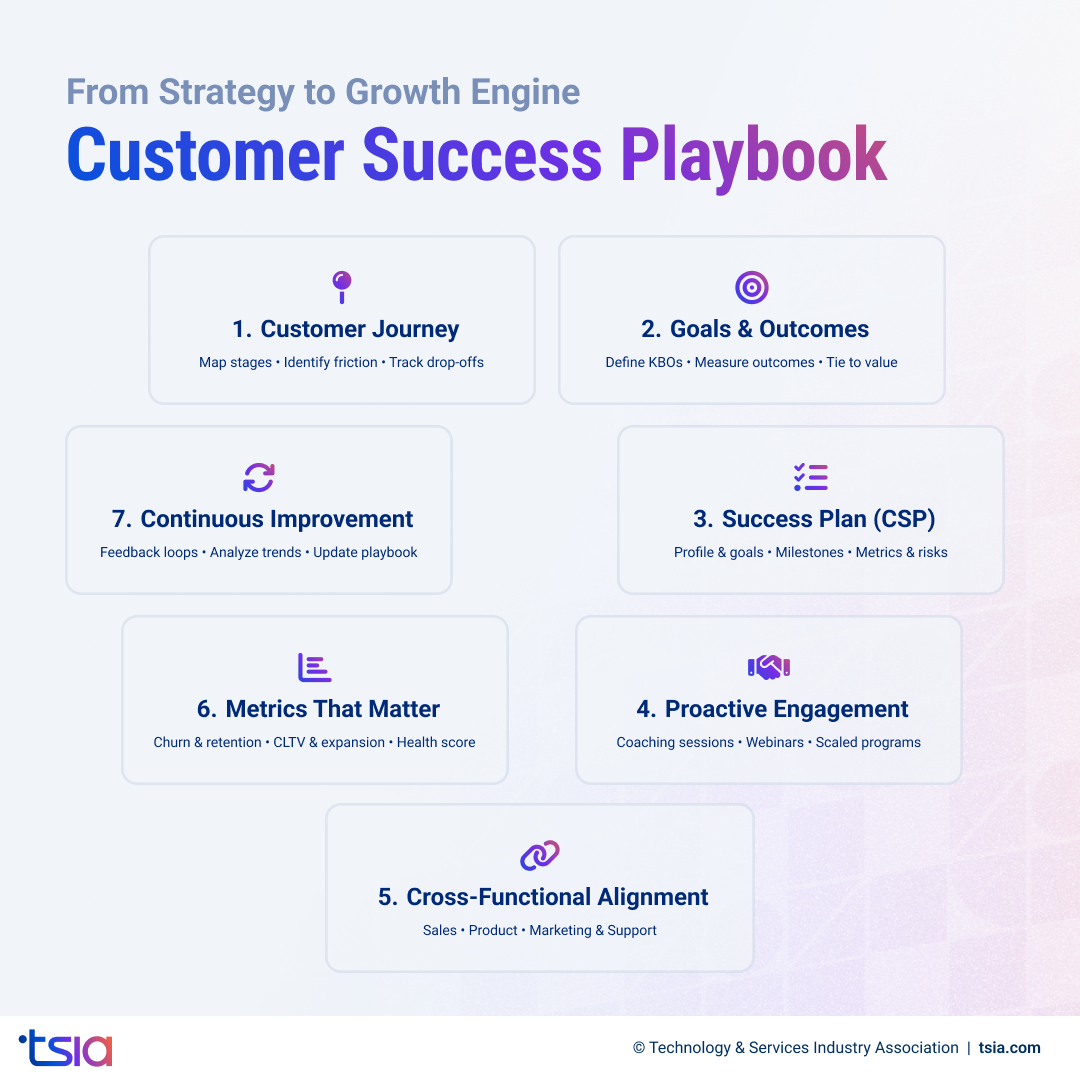
Step 1: Start With the Customer Journey
Your playbook should always begin with one thing: a clear understanding of your customer’s journey.
Why this matters:
- Customers don’t experience your product in silos—they move through stages.
- Each stage has different needs, risks, and opportunities.
- Your engagement strategy should evolve alongside them.
To build this foundation:
- Map out key stages (onboarding, adoption, growth, renewal).
- Identify critical touchpoints and friction points.
- Understand where customers typically struggle or drop off.
When you align your playbook with the journey, you shift from reacting to problems to anticipating them before they arise.
Step 2: Define Customer Goals and Outcomes
A strong customer success playbook is not built around your product—it’s built around your customer’s goals. This is where many organizations fall short. They focus on usage metrics without tying them to real business outcomes.
Instead, you should:
- Work with customers to define key business objectives (KBOs).
- Translate those into measurable outcomes.
- Align your product’s value to those outcomes.
For example:
- Not just “increase feature adoption.”
- But: “reduce onboarding time by 30% using this feature.”
This alignment ensures your customer success strategy is always tied to value realization, not just engagement.
Step 3: Build a Structured Customer Success Plan
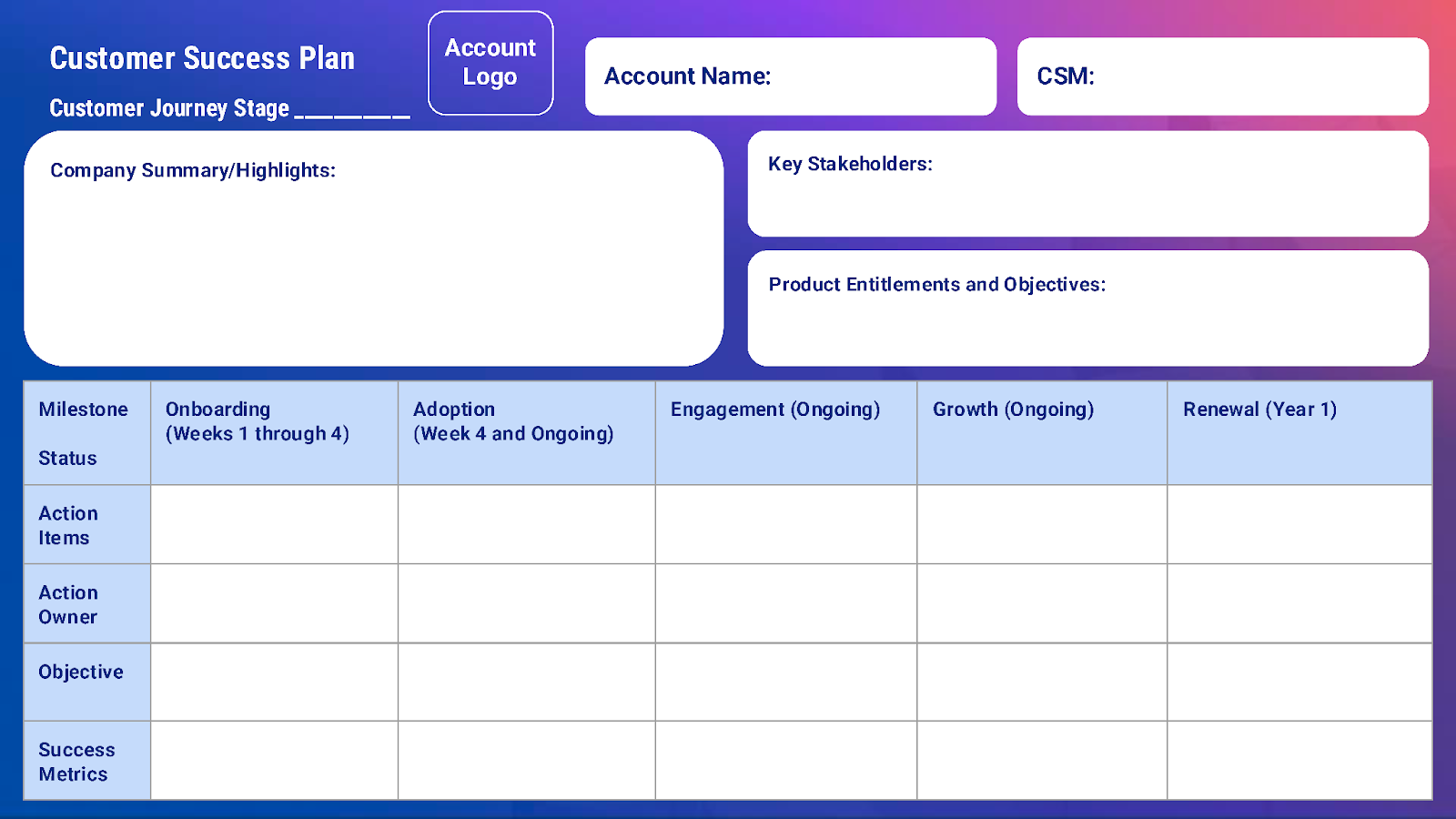
Your playbook comes to life through a Customer Success Plan (CSP), a documented, shared plan that guides execution.
A strong CSP includes:
Customer Profile
- Stakeholders.
- Business goals.
- Key use cases.
Current State Assessment
- Product usage.
- Adoption levels.
- Existing challenges.
Milestones and Timeline
- Key stages in the journey.
- Measurable checkpoints.
Success Metrics
- Adoption metrics (active users, feature usage).
- Onboarding metrics (time-to-value, activation).
- Business impact metrics (ROI, outcomes).
Actions and Responsibilities
- What your team owns.
- What the customer owns.
Risk Management
- Potential blockers.
- Mitigation strategies.
This structure creates alignment and accountability on both sides, turning customer success into a shared effort rather than a one-sided initiative.
Step 4: Operationalize Proactive Engagement
A playbook is only effective if it drives consistent action. This is where proactive engagement becomes critical.
High-performing customer success teams:
- Anticipate customer needs before issues arise.
- Guide customers through key milestones.
- Deliver ongoing education and value.
Some of the most effective ways to do this is through structured engagement models, such as:
Coaching Sessions
- Goal-oriented meetings tied to specific outcomes.
- Regular progress reviews and action planning.
- Clear accountability for next steps.
Webinars and Scaled Programs
- Onboarding and training sessions.
- Feature deep dives.
- Best practice sharing.
- Customer success stories.
These approaches allow you to scale customer success without sacrificing personalization while continuously reinforcing value.
Step 5: Build Strong Cross-Functional Alignment
Customer success does not operate in isolation.
Your playbook should define how customer success collaborates with:
- Sales (handoff and expansion opportunities).
- Product (feedback and roadmap alignment).
- Marketing (education and engagement programs).
- Support (issue resolution and escalation).
Customer success teams act as a bridge between the customer and the business, ensuring that insights flow in both directions.
Without this alignment, you risk:
- Disjointed customer experiences.
- Missed growth opportunities.
- Conflicting priorities across teams.
With it, you create a unified approach to delivering customer value.
Related: Why Your Customer Success Team’s Survival Depends on Demonstrating Value
Step 6: Track the Right Metrics
A customer success playbook must be measurable.
The most important metrics to include are:
- Customer churn rate → Are you retaining customers?
- Customer retention rate → Are they staying long term?
- Customer lifetime value (CLTV) → Are you driving meaningful revenue?
- Expansion revenue → Are customers growing with you?
- Customer health score → Are relationships strong or at risk?
- NPS and CSAT → Are customers satisfied and willing to advocate?
Tracking these metrics allows you to:
- Identify at-risk customers early.
- Prove the value of customer success.
- Continuously improve your playbook.
It also shifts your organization toward data-driven decision-making, rather than relying on intuition alone.
Related: Customer Health Scoring & Risk Management: Reinventing Customer Health Models
Step 7: Continuously Improve Your Playbook
Your customer success playbook is not a static document—it should evolve with your customers, product, and market.
To keep it effective:
- Regularly review customer feedback.
- Analyze performance data and trends.
- Update playbooks based on new insights.
- Adapt for different customer segments.
You should also:
- Train your team on updates.
- Share best practices internally.
- Highlight successful use cases.
Continuous improvement ensures your playbook remains relevant and continues to drive results over time.
Common Challenges (and How To Avoid Them)
Even with a strong playbook, challenges can arise. Here’s what to watch for.
Lack of Customer Engagement
Fix it by:
- Involving customers in planning.
- Clearly tying actions to their goals.
Misaligned Teams
Fix it by:
- Creating shared processes across departments.
- Reinforcing collaboration and communication.
Difficulty Measuring Success
Fix it by:
- Defining clear KPIs upfront.
- Standardizing how success is tracked.
Poor Adoption
Fix it by:
- Providing proactive guidance.
- Offering training, coaching, and resources.
Addressing these challenges early ensures your playbook delivers real impact, not just structure.
A customer success playbook is more than a framework—it’s how you turn customer success into a growth engine. When you align your strategy to the customer journey, focus on outcomes, and operationalize proactive engagement, you move beyond reactive support and start delivering measurable value at scale.
The result? Stronger relationships. Higher retention. More expansion. And a customer base that continues to grow with you.
FAQ
What is a customer success playbook?
A customer success playbook is a structured framework that outlines how your team engages across the customer lifecycle to drive adoption, retention, and growth.
What should a customer success playbook include?
It should include customer journey stages, success plans, engagement strategies, defined metrics, and clear roles and responsibilities for both your team and the customer.
How do you measure the success of a customer success playbook?
You measure success using metrics like churn rate, retention rate, customer lifetime value, expansion revenue, customer health scores, and customer satisfaction.
Smart Tip: Embrace Data-Driven Decision Making
Making smart, informed decisions is more crucial than ever. Leveraging TSIA’s in-depth insights and data-driven frameworks can help you navigate industry shifts confidently. Remember, in a world driven by artificial intelligence and digital transformation, the key to sustained success lies in making strategic decisions informed by reliable data, ensuring your role as a leader in your industry.