


Customer success is entering a defining moment. In 2026, you’re no longer being asked to simply protect renewals or maintain relationships. You’re being asked to prove economic value clearly, consistently, and at scale during a time when AI investment is high, customer acquisition costs keep rising, and executive scrutiny is only getting sharper.
At the same time, AI is changing the mechanics of customer success. It’s no longer just a tool that helps you automate tasks. AI is becoming a teammate, embedded into workflows, shaping decisions, and influencing how outcomes are delivered and measured.
The State of Customer Success 2026 explores the intersection of AI capability and economic reality. It reveals why retention is now the most reliable path to profitability, why customer success must evolve from a relationship-driven role into a value-driven function, and why mastering AI Economics™ is no longer optional if you want customer success to remain a strategic growth engine.
Key Takeaways
- Customer success must prove financial impact, not just customer sentiment. In 2026, ROI visibility matters more than ever as budgets tighten and retention becomes the primary growth lever.
- AI only delivers value when your data foundation is unified. Disconnected systems limit predictive insight, personalization, and proactive intervention.
- The modern CSM is a value manager. Commercial confidence, data literacy, and outcome ownership are now core requirements, not optional skills.
Customer Success in 2026: Why the Economics Have Changed
An unforgiving but straightforward reality is reshaping customer success: acquiring new customers is more expensive than ever. As customer acquisition costs rise, retention becomes the only sustainable path to profitability.
At the same time, organizations have poured investment into technology and AI, yet struggle to demonstrate a clear return on investment. In a high-cost-of-capital environment, that gap between spend and proof is no longer tolerated.
For customer success leaders, this means your role is under a brighter spotlight. You’re being evaluated not by how customers feel, but on how well you can:
- Reduce churn risk.
- Improve net revenue retention (NRR).
- Lower cost-to-serve.
- Support scalable, outcome-driven growth.
To do that, customer success must evolve beyond monitoring usage or managing relationships. You’re being asked to engineer value and prove it in financial terms.
Related: The State of Customer Success 2026
The Tech Stack Reckoning: From Buying Tools to Proving Value
Over the past few years, many organizations have rapidly accumulated customer success tools, including onboarding platforms, health-scoring solutions, digital engagement tools, and AI pilots. By 2025, the bill came due.
You may recognize this pattern:
- Tools were adopted quickly.
- Pilots showed promise.
- Value was never fully quantified.
In fact, most customer success teams still struggle to calculate the savings or efficiencies delivered by their technology investments. Without that visibility, customer success risks being viewed as a cost center rather than a strategic function.
Related: From Dashboards to Action: AI Agents and the Future of Customer Success
Why This Matters in 2026
In boardrooms dominated by CFOs and private equity stakeholders, unproven value is a liability. When ROI can’t be explained, budgets are questioned, and teams are downsized. This is where AI Economics™ changes the conversation.
Traditional SaaS pricing models were built on seat expansion, monetizing human inefficiency. AI disrupts that model by automating work and reducing the need for seats. The problem? Pricing remains tied to users, so as AI reduces headcount, revenue declines by design.
Customer success sits at the center of this transition. Your role shifts from defending subscriptions to ensuring AI-backed offerings deliver measurable business outcomes that justify new pricing and consumption models.
The Data Problem Isn’t Cleanliness—It’s Access
It’s easy to assume AI struggles because your data is too messy. But in 2026, that’s rarely the real barrier. Modern AI models can work with imperfect information surprisingly well. The bigger challenge is that your customer data is still trapped in silos.
Across most organizations, critical insights are spread out across disconnected systems:
- Sales owns the CRM.
- Support owns the ticketing platform.
- Customer success owns success plans and engagement history.
- Product owns usage and adoption data.
When these systems don’t connect, AI only sees fragments of the customer story. Without the full picture, predictive models lose accuracy, risks go undetected, and interventions are delayed. Instead of using AI to stay ahead of churn, you end up stuck in reactive mode, responding to problems only after they’ve already surfaced.
Why Unified Data Changes Everything
When customer data flows freely, AI can:
- Identify risk earlier.
- Detect usage and adoption patterns.
- Trigger automated interventions at the right moment.
- Free human CSMs to focus on strategic engagement.
In 2026, the ability to unify customer data is one of the strongest predictors of renewal performance. Without it, digital motions feel generic, automation becomes noisy, and personalization breaks down.
Related: Sales and Customer Success: Aligning for Growth
Scaling Customer Success Without Losing Personalization
You’re likely being asked to support more customers with fewer resources, while still delivering highly personalized experiences. This tension creates a scale paradox that many customer success organizations struggle to resolve.
Historically, teams responded by:
- Segmenting customers rigidly.
- Pooling CSM models.
- Relying on reactive engagement.
- Deploying generic tech-touch programs.
The result is often automation that feels impersonal and disengaging.
Digital as a Discipline, Not a Segment
In 2026, digital customer success must permeate your entire book of business, including enterprise accounts. That only works when real-time data and AI-powered orchestration drive digital motions.
When systems detect specific risks or opportunities:
- Automation becomes targeted.
- Human effort is reserved for high-value work.
- Customers experience relevance rather than noise.
Without this foundation, scale comes at the expense of trust and growth stalls.
The Rise of the Value Manager
One of the most visible shifts in customer success is the evolution of the Customer Success Manager (CSM) role itself. The traditional “trusted advisor” model, built primarily on rapport and relationship, no longer meets the needs of the business. In 2026, you’re expected to act as a value manager, prioritizing outcomes over activity.
What that looks like in practice:
- Customer success and sales motions are converging.
- CSMs are expected to identify expansion opportunities.
- Renewals are tied to demonstrated value.
- Compensation increasingly reflects NRR and growth contribution.
This doesn’t eliminate the importance of relationships, but it requires you to anchor those relationships in data, outcomes, and financial impact.
Let AI Do the Heavy Lifting So Humans Can Do the Strategic Work
Customer success teams are overwhelmed by data. AI helps by analyzing both structured and unstructured information—emails, meeting transcripts, support tickets—to surface insights humans simply can’t process at scale. But technology alone isn’t enough.
Many organizations are experimenting with AI without investing in the skills needed to trust and interpret its output. Without data literacy, predictive alerts are ignored, and automation stalls.
What High-Performing Teams Do Differently
- Train CSMs to understand correlation vs. causation.
- Use AI for practical tasks like summarization and drafting.
- Encourage critical thinking alongside automation.
- Invest in prompt engineering and AI fluency.
This approach strengthens, not replaces, the human element of customer success.
Moving Beyond Sentiment to Financial Proof
Customer sentiment metrics once played a central role in customer success reporting. In 2026, they’re no longer sufficient on their own.
Executive teams are focused on financial indicators:
- Customer acquisition cost (CAC).
- Cost-to-serve.
- Customer lifetime value.
- Net revenue retention.
Many customer success teams still rely on subjective health scores that do not accurately predict churn. AI-powered, continuously learning models offer a more reliable path forward, especially when grounded in unified data.
When you master this shift, you can demonstrate impact by:
- Reducing cost-to-serve.
- Improving renewal efficiency.
- Supporting scalable growth.
Customer Success at an Inflection Point
A clear inflection point defines customer success in 2026. AI has unlocked enormous potential, but legacy business models, fragmented data, and outdated metrics limit its impact. The organizations that succeed will be those that treat customer success as a strategic, value-capturing function, not a defensive layer.
That means fixing foundational data issues, retooling your workforce for strategic advisory work, and aligning pricing and services to measurable outcomes. Customer success isn’t disappearing in the AI era. It’s becoming more critical than ever.
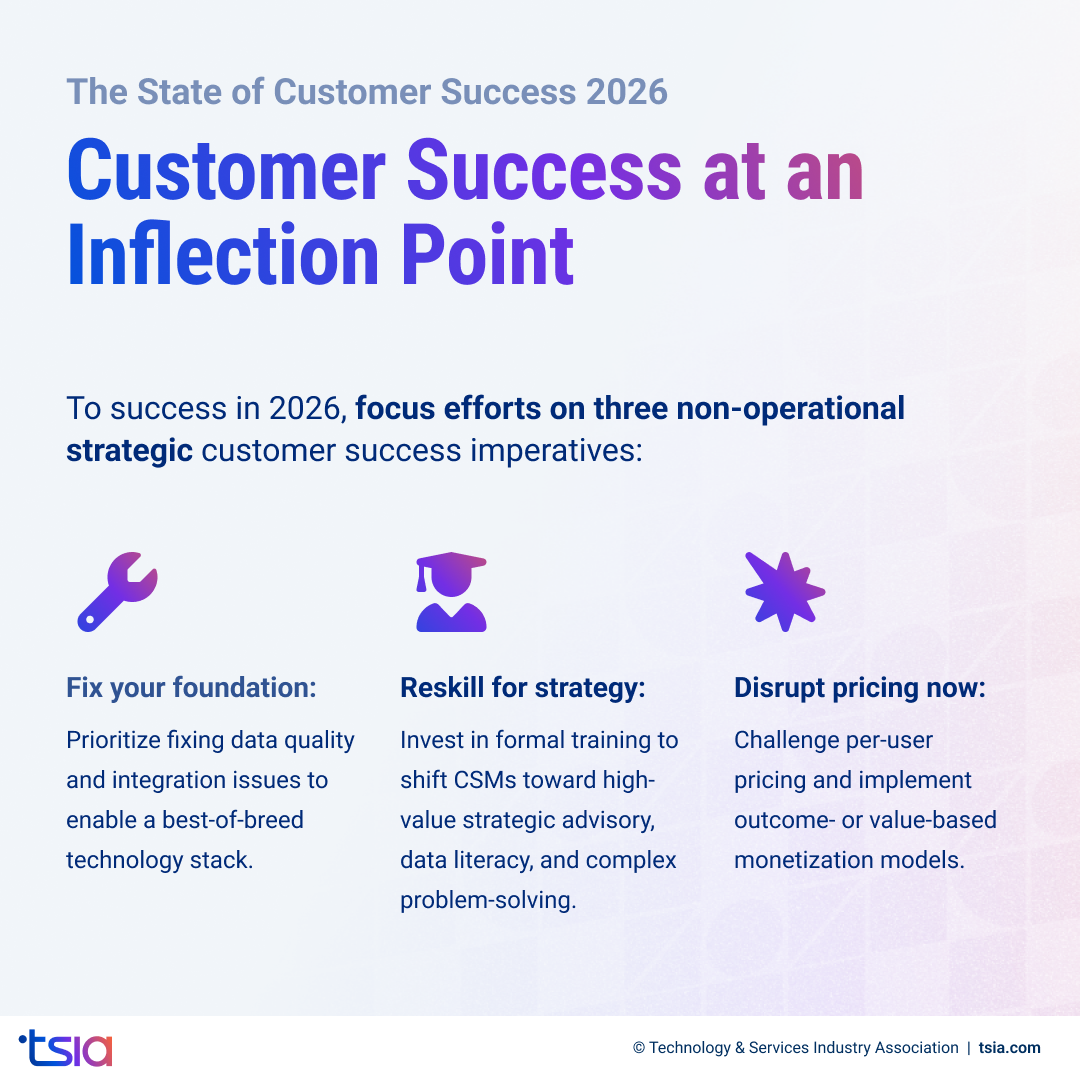
To succeed in 2026, focus efforts on three, non-optional, strategic customer success imperatives:
- Fix your foundation: Prioritize fixing data quality and integration issues to enable a best-of-breed technology stack.
- Reskill for strategy: Invest in formal training to shift CSMs toward high-value strategic advisory, data literacy, and complex problem-solving.
- Disrupt pricing now: Challenge per-user pricing and implement outcome- or value-based monetization models.
FAQs
What is changing most about customer success in 2026?
Customer success is shifting from relationship-based engagement to outcome-driven value management, with increased focus on financial impact, data literacy, and AI-enabled decision-making.
Why is unified customer data so critical for customer success teams?
Without a unified view of the customer, AI cannot deliver accurate predictions or personalization. Data integration enables proactive intervention and scalable growth.
How does AI Economics affect customer success strategy?
AI Economics forces organizations to rethink pricing, services, and value delivery. Customer success plays a central role in proving outcomes that justify new monetization models.
Smart Tip: Embrace Data-Driven Decision Making
Making smart, informed decisions is more crucial than ever. Leveraging TSIA’s in-depth insights and data-driven frameworks can help you navigate industry shifts confidently. Remember, in a world driven by artificial intelligence and digital transformation, the key to sustained success lies in making strategic decisions informed by reliable data, ensuring your role as a leader in your industry.