


For years, customer success and support teams have operated under the same reality: capacity is finite, demand is not. Budgets, staffing limits, and manual processes forced you to make tradeoffs about who gets attention, when issues are addressed, and which customers get proactive engagement. Even your best service motions have been defined by what your teams could do, not what your customers needed.
During his TSIA World ENVISION 2025 keynote, Jim Roth, President of Customer Success at Salesforce, made it clear that this era is coming to an end. Roth urged leaders to retire the assumption that capacity is fixed and showed how AI agents are poised to remove the ceiling entirely. Instead of choosing where to pull back, you now have the chance to scale high-value engagement in ways traditional models simply couldn’t reach.
Key Takeaways
- AI agents remove the capacity ceiling: For the first time, service teams can scale without adding cost or headcount. AI agents handle the high-volume, repetitive work so humans can focus on proactive, high-value interactions.
- Proactive support becomes the new standard: With continuous monitoring and real-time action, AI agents turn early signals into immediate outreach—closing the gap between friction and resolution before customers ever open a ticket.
- Human + AI collaboration delivers better outcomes: AI brings scale and consistency; humans bring empathy and judgment. Together, they create a service model that drives stronger experiences, deeper relationships, and measurable business results.
The Historical Constraint: Customer Service Has Always Been Capacity-Limited
Roth opened his keynote with an observation about Las Vegas—once an empty stretch of desert, now a fully engineered destination—using it as a metaphor for what happens when limits fall away. For decades, customer service has operated under the opposite conditions: everything defined by scarcity.
You’ve felt this firsthand. Too few representatives. Too many tickets. Never enough time. And year after year, budgeting models reinforced the cycle, funding only enough capacity to react—not enough to transform.
The result? Teams spend most of their energy staying afloat. You manage what’s urgent, but seldom get ahead. Proactive outreach becomes aspirational instead of operational.
AI finally breaks this pattern. With automation, multilingual support, and real-time translation, AI agents give you near-instant elasticity—scaling service capacity without adding cost, headcount, or time. What once required dozens (or hundreds) of people, can now be executed continuously, consistently, and without delay.
This is the shift Roth emphasized from the stage. “This is finally the time when we can get proactive,” he said. “The constraint is gone. Now we can go after the top half of the matrix.”
The ceiling that defined customer service for decades is disappearing and opens the door to a level of consistency teams have never achieved.
The Shift: AI Agents Remove the Capacity Constraint
Roth transitioned to a “What If?” moment—introduced through Salesforce’s Agentforce campaign—challenging a long-standing assumption in customer success and support: you can only give your very best service to a select few.
Every support leader has faced that uncomfortable decision. In a constrained model, you’re forced to decide who gets the most attention, the fastest response, or the most personalized engagement. Someone always loses.
As Roth put it candidly: “Because of constraints, we end up asking: Which customer do we love just a little more? We don’t say it out loud, but it’s the truth.” AI agents rewrite this equation.
Instead of allocating human capacity, AI agents absorb the high-volume, baseline work—accurately, consistently, and at scale. They don’t tire, they don’t back up, and they don’t force you into trade-offs that limit personalization.
The question shifts from “Who gets our best service?” to “Why shouldn’t every customer receive it?”
With AI agents managing routine needs, every customer interaction becomes a source of learning and continuous improvement. This is where the transition from traditional chatbots to true conversational agents becomes meaningful. These systems aren’t just fielding questions—they’re interpreting context, building trust, and resolving issues with a level of fluency that mirrors a human expert.
This is the foundation for AI-powered customer success: scalable, proactive, and deeply aligned to the experience your customers actually want.
The “Brain + Heart” Design Principle
Roth described Agentforce as a glimpse into a new service ecosystem—one where AI agents don’t just automate tasks, but elevate customers' feelings during interactions. Instead of the rigid, transactional chatbot experience most customers have learned to tolerate, this model introduces something different: dynamic assistance that blends intelligence with empathy.
Traditional automation took us part of the way, but it also exposed its limitations. The tone was flat. Scripts were inflexible. Conversations felt mechanical and often created more frustration than resolution.
Salesforce’s own data shows why this needed to change. Roth shared an example of a customer struggling to log in during an AI-assisted chat. The agent responded with a simple acknowledgment: “I understand how frustrating this must be.”
That one line—generated intentionally by the system—significantly improved the customer satisfaction score. It validated what many leaders have suspected: empathy isn’t decorative. It directly influences trust, experience quality, and CSAT.
For AI agents to deliver human-quality service at scale, they need more than just content and context awareness. They need conversational empathy—language that recognizes friction, acknowledges emotion, and connects a customer’s problem to a meaningful next step.
As Roth put it, “Agents need a brain, but they also need a heart.”
That philosophy marks the difference between robotic automation and AI-driven service that genuinely resonates with customers.
Proof of Scale: Real Operational Impact
Roth made it clear that the promise of AI-powered service isn’t theoretical. Salesforce is already seeing measurable, enterprise-level impact. “We are saving $100 million, over 20% of our cost structure in customer service, and reinvesting that directly into proactive customer value,” he shared from the main stage.
The significance of this example extends far beyond cost savings. When AI agents remove repetitive, transactional work from the queue, you unlock something customer service organizations have rarely had before: the capacity to transform.
Human experts can finally focus on high-value work—resolving complex issues, preventing problems before they surface, strengthening customer relationships, and building the kind of proactive programs that have historically been out of reach.
AI also opens new global pathways. By powering support with real-time translation, Salesforce expanded live service coverage into seven languages, with a roadmap to exceed 20 languages by the end of 2025. This breaks a long-standing operational barrier and lays the foundation for a consistent customer experience across geographies.
The broader message is unmistakable: AI doesn’t just make support more efficient. It positions service as an engine for growth, reinvestment, and long-term customer value—shifting the function from a cost center to a strategic catalyst.
The 2×2 Service Model Framework
Salesforce’s success with AI agents reinforces why a simple framework can help leaders pinpoint exactly where to invest their time and resources. Roth highlighted a 2×2 model that organizes service motions across two dimensions:
- X-axis: Self-service → Assisted service
- Y-axis: Reactive → Proactive

Most organizations still cluster in the reactive, assisted quadrant—responding to issues as they arise, with limited capacity to do anything more. Even when early signals point to opportunities or emerging risks, teams often lack the bandwidth to respond without adding headcount or sacrificing other priorities. AI agents change that dynamic.
By absorbing the baseline load and scaling instantly, AI gives your teams the freedom to shift their energy toward the upper half of the model—where proactive service, guided recommendations, and predictive engagement live. It turns what used to be an aspirational quadrant into an operational reality.
Why Proactive Service Was Never Possible Before
Proactive support has been an aspiration for years, but operational realities have made it nearly impossible to achieve. Even with strong telemetry and early warning signals, your teams could only engage where human capacity allowed. Data could show what was happening, but it couldn’t take action on its own.
The core barriers were always the same:
- Too many accounts, not enough people. No team could manually monitor every customer or follow up on every signal.
- Important accounts slipped through the cracks. Leaders had to prioritize urgency, not opportunity.
- Data lacked an execution layer. Insights surfaced problems, but reacting to them still required human intervention—time teams didn’t have.
AI agents remove each of these barriers. They can continuously monitor every account, automate baseline tasks, and immediately act on the signals that used to pile up in backlogs. Humans step in only where judgment, strategy, or relationship-building truly matter.
The math is simple: When AI handles repetitive work and constant monitoring, your team can finally spend its time preventing issues instead of reacting to them. Proactive service stops being a goal you talk about—and becomes something you can reliably deliver at scale.
Related: Hype, Myths, and Realities of Agentic AI
What Proactive Service Looks Like With AI Agents
With AI agents, service no longer waits for a case, alert, or escalation. These systems meet customers exactly where they are and act the moment friction appears. Instead of waiting for someone to raise a hand, AI agents initiate the conversation themselves—closing the gap between signal and action.
In a proactive model powered by AI agents, you see several immediate shifts:
- No-reply inboxes disappear. Agents respond directly in the same channel where the customer reached out, eliminating dead ends.
- Outreach begins the moment telemetry detects friction or an adoption gap. AI takes the first step instead of waiting for a ticket.
- Guidance happens in real time. As customers use the product, agents step in with prompts, recommendations, or fixes before the issue grows.
Roth underscored that, with AI agents absorbing this continuous, proactive monitoring, human teams can finally focus on the entire matrix of customer touchpoints—not just the reactive corner.
Related: The Blueprint for AI Agent Success
AI Agent Use Cases That Deliver Real Service Impact
Renewals
AI agents can review the entire account story—product usage, sentiment, historical context—and prepare a clear, concise summary before a renewal manager joins the conversation. They can also manage long-tail renewals that were previously too small to justify dedicated human coverage, turning an underserved segment into incremental revenue.
Professional Services
Instead of relying on a consultant to interview a handful of stakeholders, AI agents can gather input from dozens—sometimes fifty or more. This builds a far more complete understanding of business goals and constraints before scoping or delivery begins, improving accuracy and strengthening alignment.
Field Services
Roth illustrated how future field technicians could arrive on-site with richer context than ever before—briefings that include equipment history, building specifics, and even small but helpful details, such as the name of the office dog. It’s the kind of situational awareness that improves both efficiency and the customer experience.
The Four R’s of Organizational Transformation
Roth outlined a simple but powerful framework for making AI-driven service transformation stick. These “Four R’s” help leaders redesign work, elevate human roles, and create a structure in which AI agents and humans complement each other rather than compete for the same tasks.
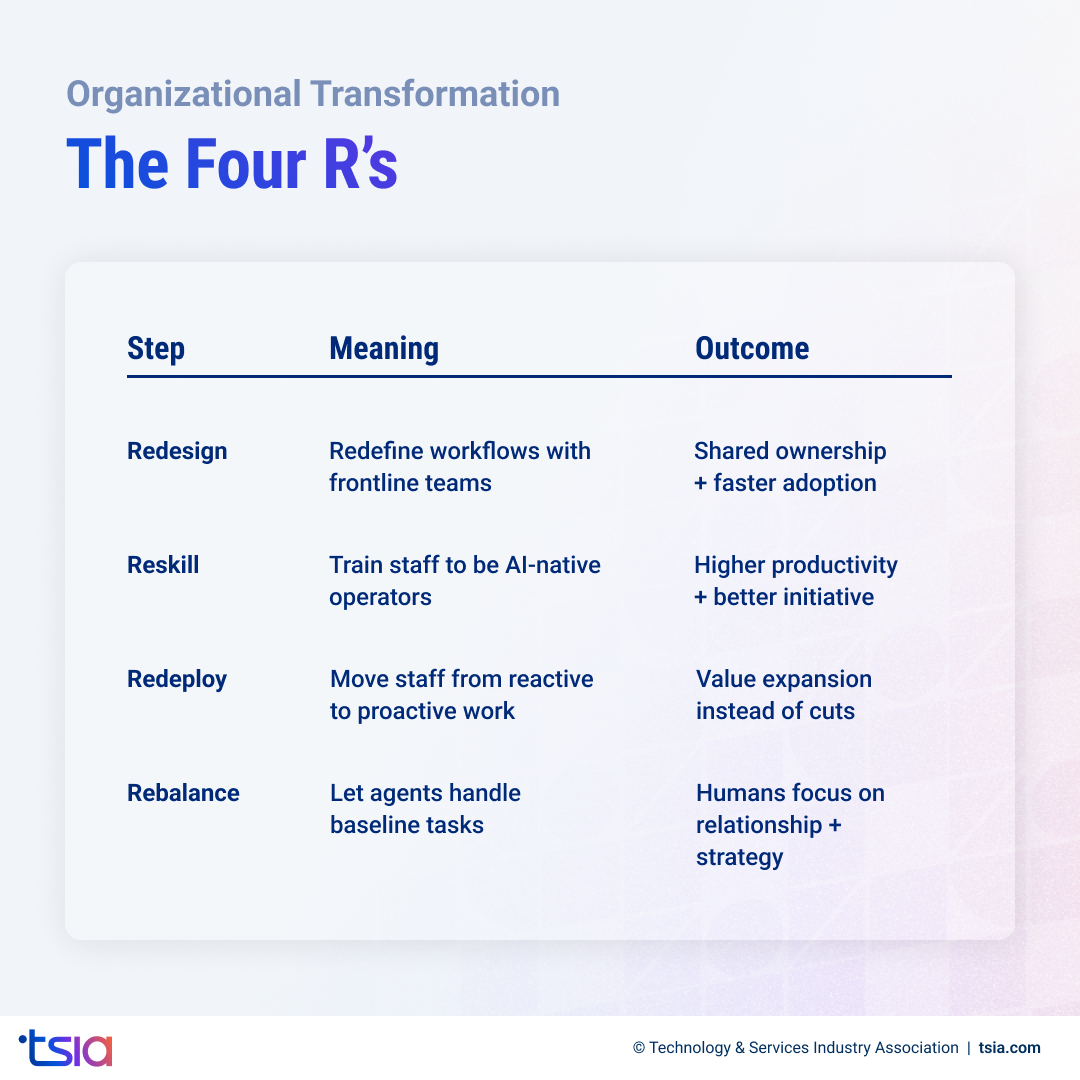
Together, these four actions move organizations from cost pressure to value expansion, making AI-enabled service a sustainable operational model—not just a tech upgrade.
The Human + AI Partnership Model
Roth emphasized that AI in service is no longer a future concept—it’s here, and it’s becoming a defining part of the present-day operating model. But this shift isn’t about choosing between humans and AI. The future of service is working in tandem.
AI agents aren’t designed to replace people. They’re built to complement human expertise, creating a partnership where each side amplifies the other. Roth used the autopilot–pilot analogy to illustrate this point: autopilot handles repeatable, predictable tasks, while the pilot provides judgment, awareness, and decision-making in moments that matter.
AI service agents follow the same pattern. They manage the high-volume, repeatable workflows that once consumed entire teams. Humans bring the empathy, relationship context, and strategic understanding needed to guide customers through complexity. The result is a combined model that delivers more than either could alone—scaling service while elevating the quality of human interactions.
Roth closed with a reminder: “Don't forget about building the heart into your agents.”
It’s the blend of intelligence and empathy that turns AI-driven service from automation into true customer experience enhancement.
Related: Agentic AI Is Driving the Shift to Predictive Customer Success
The Constraint Era Is Over
The era of capacity limitations is ending. With AI agents absorbing the reactive, repetitive load, the barriers that held service teams back for decades are finally gone. Proactive support—once an aspiration—is becoming the new baseline.
Roth captured it best: “With constraints lifted, the impossible becomes inevitable. Now is when the magic happens.”
Organizations that act on this shift won’t just improve efficiency—they’ll create stickier customer relationships, expand NRR, and gain the operational leverage needed to compete in the AI era. The only real question left isn’t whether to adopt AI agents; it’s how quickly you’re willing to move.
FAQs
How do AI agents improve customer experience?
AI agents respond instantly, in any supported language, and act as soon as telemetry detects friction. This prevents issues, reduces effort, and frees human experts to spend more time on the complex, relationship-driven work that customers value most.
Will AI agents replace human service roles?
No. AI agents remove the repetitive work that overwhelms service teams. Humans continue to lead with strategy, empathy, context, and judgment. The partnership model increases overall capacity and improves service quality across all customer segments.
Can AI agents support proactive outreach at scale?
Yes. This is one of their most significant advantages. AI agents continuously monitor accounts, identify adoption gaps, and start conversations the moment something requires attention—making proactive service finally achievable across your entire customer base.
Smart Tip: Embrace Data-Driven Decision Making
Making smart, informed decisions is more crucial than ever. Leveraging TSIA’s in-depth insights and data-driven frameworks can help you navigate industry shifts confidently. Remember, in a world driven by artificial intelligence and digital transformation, the key to sustained success lies in making strategic decisions informed by reliable data, ensuring your role as a leader in your industry.

.png)