


There’s no question that AI has moved from experimentation to economic reality. In fact, AI is already accelerating delivery and automating execution, and increasing value for customers. However, one of the uncomfortable truths many organizations need to confront is that the efficiencies enabled by AI are eroding the pricing structures, service models, and revenue assumptions that have historically underpinned growth.
The State of Offering Management 2026 explores what this disruption means for offering leaders and why unified service portfolios are now essential to monetizing AI-driven value.
Offering management is central to this transition. By organizing products and services into a unified portfolio and reassessing AI's impacts and opportunities across the lifecycle, offering leaders can address the disconnect between the value promised and the value realized. This is why offering management is emerging as one of the most critical disciplines of the AI era.
Key Takeaways
- AI is disrupting effort-based service monetization: As AI automates foundational execution, traditional pricing models no longer reflect how value is delivered. Offering management is now essential to prevent AI-driven efficiency from eroding margins.
- Offering management is becoming the control plane for AI Economics™: In the AI era, your services value cannot survive in silos across professional services, support, and customer success. Offering leaders must orchestrate lifecycle value through a unified portfolio that aligns outcomes, packaging, and monetization.
- Unified portfolios require measurable value defense across the lifecycle: Winning in AI Economics™ depends on more than deploying AI capabilities. You need unified data, clear outcome measurement, and services designed to defend value throughout the customer lifecycle and price based on measured customer outcomes–not supplier effort.
What Offering Management Means in the AI Era
The art of offering management has evolved rapidly in recent years, as AI reshapes how value is created, communicated, and monetized. Offering management is also where economic trade-offs get resolved. The commoditization of foundational services through automation means leaders must determine which capabilities are priced into core technology products and which are offered as distinct premium services.
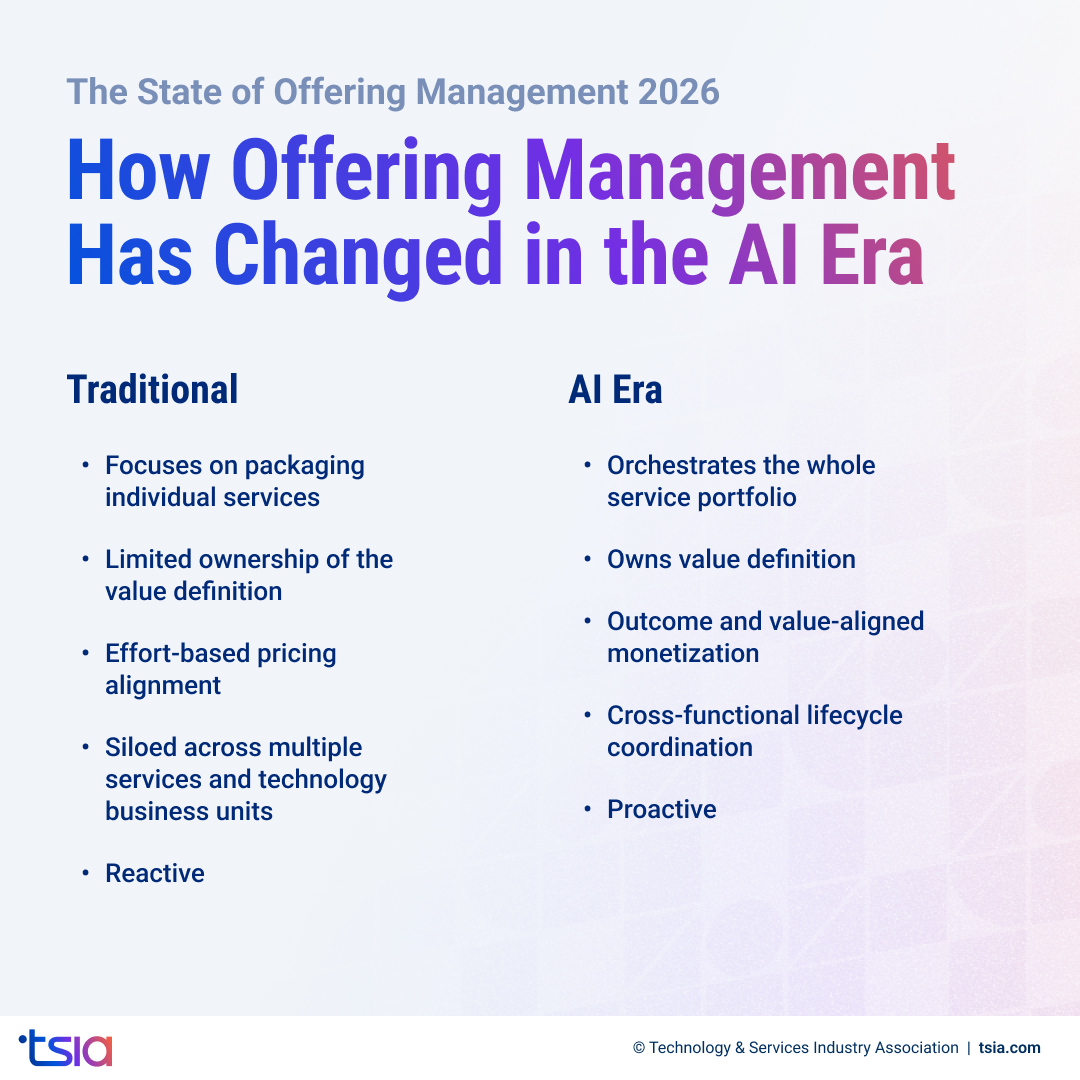
In this context, offering management becomes the control plane for AI Economics™. It helps translate AI-driven capabilities into monetizable value and provides the structure required to consistently defend that value across the lifecycle.
Related: Retooling Your Services Portfolio for the Era of AI Economics™
The AI Value Paradox and the Collapse of Effort-Based Monetization
At the core of the AI economic challenge offering leaders face is a fundamental contradiction: AI enables organizations to deliver significantly more customer value, while also eroding pricing mechanisms that historically captured that value. This is typically referred to as the AI Value Paradox, and it lies at the heart of the disruption reshaping modern service portfolios.
The impact is most noticeable in foundational services, where standard support, basic configuration assistance, and routine operational tasks are handled through digital-first, AI-enabled experiences. This boosts efficiency but also drives rapid commoditization.
Preserving traditional monetization structures can lead to customer friction and value leakage. The AI Value Paradox cannot be navigated simply through pricing adjustments, because the service portfolios of incumbent technology companies are no longer aligned with how value is created. Low-value execution becomes automated at scale, and monetization shifts toward higher-order value, such as insight, orchestration, judgment, and outcome ownership.
This is where offering management stands out as indispensable. By redefining how services are packaged, priced, and positioned, offering leaders can move past legacy revenue streams and focus on designing portfolios that capture AI-enabled value most efficiently and sustainably.
The Execution Gap in Holistic Value Defense
The growth of AI has created significant economic pressures. While many organizations understand this, far fewer have addressed the execution gaps preventing them from defending their value over time. Renewal is the phase when this is most visible, where customer value must be clearly defined and credibly demonstrated.
Holistic Value Defense is the ability to define, measure, communicate, and defend customer value across your entire lifecycle, from pre-sales through onboarding, ongoing adoption, and renewal. Too many organizations struggle to execute the fundamentals, and they often track value poorly once delivery begins. Without this discipline, even AI-enabled services can deliver outcomes without capturing sustainable revenue.
Unified Data as the Foundation of AI Economics
No matter how good your data is, you cannot prove, price, or defend value if your data is scattered across teams and systems. It’s like trying to run financial reports when your figures are spread across multiple different spreadsheets. You know you have money coming in, but you can’t really explain where it came from. In the AI era, data must be treated as a commercial asset and not just a technical one.
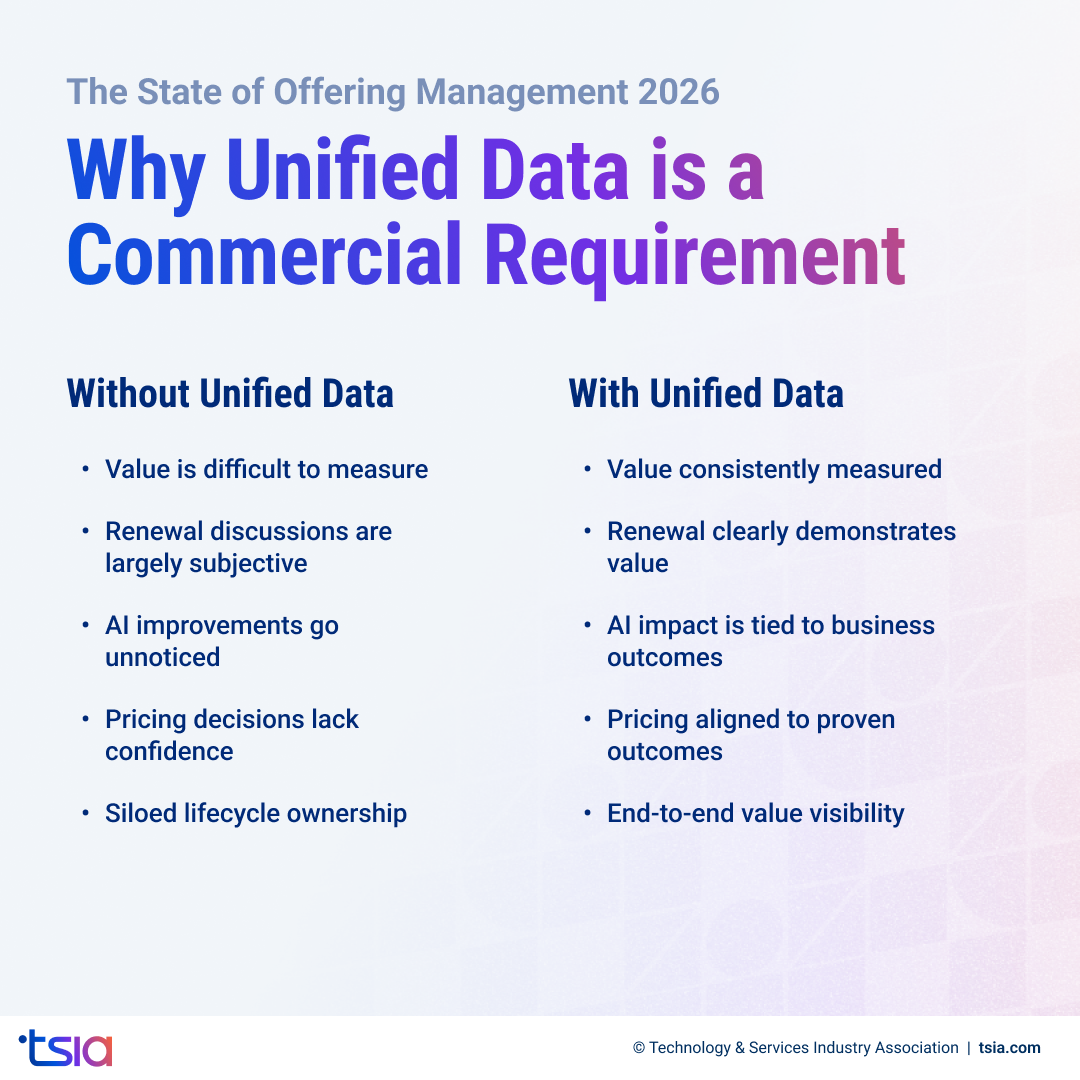
A unified data model provides an AI-driven foundation that enables consistent value management. For offering leaders, unified data is a core pillar for scaling AI-enabled services, defending value at renewal, and moving beyond effort-based monetization. Without this, even well-designed product and service portfolios struggle to translate outcomes into sustainable revenue.
Orchestrating a Unified, AI-Native Service Portfolio
AI is integral to reshaping how value is delivered, which means many traditional service motions no longer hold up. Professional services, support, managed services, and customer success typically operate as separate motions, each with its own offers, pricing models, and success metrics. Fragmentation is a liability in the era of AI, which is why it’s so important to achieve unity.
Offering leaders must step back and reassess which services actually differentiate, which have become table stakes, and which no longer warrant standalone monetization.
The savings from automation can be reinvested into higher-value, AI-augmented areas that consumers will pay for. These include services focused on AI governance, value optimization, and outcome-oriented engagements. These offerings are more complicated to automate and more closely tied to customer outcomes. Effective offering management provides the structure to make these portfolio decisions consistently and defensibly.
Related: The AI-First Services Organization
Pricing for the AI Era
The simple fact is that AI fundamentally disrupts traditional pricing logic. Models traditionally built around time and effort assume a direct link between customer value and human input. However, as AI automation increasingly replaces this and reduces visible effort, that link weakens. The result is a lack of correlation between how value is delivered and how it is priced.
It’s paramount that pricing moves away from effort-based frameworks and shifts toward outcome-based models. Most customers are willing to pay more for tangible results that can be measured and defended internally. This is even more so the case as foundational services become increasingly automated within the core product experience.
Incremental pricing changes are not enough; AI-driven efficiency gains will require alignment across service design, value measurement, and pricing. Organizations that successfully make this shift are well-positioned to translate AI efficiency gains into sustainable revenue, and avoid discounted renewals and eroded margins.
Offering management sits at the center of this transformation. By uniting services and technology value propositions, engineering and defending value across the lifecycle, and aligning pricing with outcomes, offering leaders can address the disconnect between value delivered and value captured.
Related: Pricing-Led Transformation: Why AI Forces You To Rethink Pricing First
FAQs
What is offering management in the era of AI Economics™?
Offering management is not just about packaging services or maintaining price lists. In the era of AI Economics™, it becomes the responsible function for orchestrating a unified service portfolio—one that translates AI-driven capabilities into defensible, monetizable value across the customer lifecycle.
Why does AI disrupt traditional service pricing models?
AI breaks the historical link between human effort and customer value. Foundational services that once required manual delivery are increasingly automated, driving commoditization and weakening effort-based monetization. To sustain profitability, organizations must shift pricing toward outcomes, insight, and higher-order value.
What does it mean to orchestrate a unified AI-native service portfolio?
Orchestrating a unified portfolio means treating services as an interconnected lifecycle system, rather than disconnected motions across support, professional services, and customer success. Offering leaders must reassess which services are now table stakes and how AI-enabled value can be packaged, measured, and monetized consistently over time.
Smart Tip: Embrace Data-Driven Decision Making
Making smart, informed decisions is more crucial than ever. Leveraging TSIA’s in-depth insights and data-driven frameworks can help you navigate industry shifts confidently. Remember, in a world driven by artificial intelligence and digital transformation, the key to sustained success lies in making strategic decisions informed by reliable data, ensuring your role as a leader in your industry.