


Customer success is at a turning point. For years, most customer success organizations have operated with a straightforward formula: assign customer success managers (CSMs) to accounts, monitor customer health, and step in when risk appears. This model, which TSIA has dubbed Customer Success 1.0, helped software companies improve retention and expansion during the early years of SaaS growth. But that model is becoming harder to sustain.
Customers expect faster time to value, more proactive guidance, and measurable business outcomes. At the same time, executive teams are pushing customer success organizations to do more with less. And now, artificial intelligence is changing what is possible.
The rise of AI in customer success is forcing organizations to rethink how they deliver value at scale. The question is no longer whether AI belongs in customer success. The real question is how you redesign your operating model so AI and human expertise work together to improve retention, expansion, and customer outcomes. TSIA’s Customer Success 2.0 Capabilities Framework offers a practical roadmap for making that shift.
Key Takeaways
- AI in customer success enables you to scale personalized engagement without increasing headcount linearly.
- Customer Success 2.0 requires changes across seven core capabilities, from operating model and talent design to service monetization.
- Organizations that treat customer success as a growth engine rather than a cost center will be better positioned to improve retention and expansion.
Why AI in Customer Success Matters Now
Traditional customer success models were built around high-touch, human-led engagement. That approach works well for strategic accounts, but it becomes expensive and difficult to scale as your customer base grows. If every customer interaction requires a human, your costs rise in direct proportion to revenue growth. AI changes this equation.
With the right data and systems in place, AI can help you:
- Monitor customer health continuously.
- Detect churn risks earlier.
- Identify expansion opportunities.
- Trigger personalized outreach automatically.
- Recommend next best actions to CSMs.
- Deliver digital engagement at scale.
This allows your team to focus its time where human judgment adds the most value. In other words, AI in customer success helps you deliver more value to more customers without simply adding more headcount.
Related: The State of Customer Success 2026
The Shift From Customer Success 1.0 to Customer Success 2.0
Customer Success 1.0 was primarily relationship-driven. Customer Success 2.0 is outcome-driven, AI-enabled, and economically scalable.
Customer Success 1.0
In the CS 1.0 model:
- Coverage is based on static segmentation.
- Success plans are updated manually.
- Health scoring is often incomplete or reactive.
- Renewal management is calendar-driven.
- Customer success is funded as a cost center.
- Headcount scales linearly with growth.
Customer Success 2.0
In the CS 2.0 model:
- AI powers health monitoring and predictive analytics.
- Digital engagement becomes the default for most customers.
- Human engagement is reserved for high-value situations.
- Customer success directly contributes to revenue growth.
- Premium success services can be monetized.
- Headcount growth decouples from ARR growth.
This evolution transforms customer success from a reactive support function into a strategic growth engine.
The Seven Pillars of the Customer Success Capabilities Framework
TSIA’s Customer Success 2.0 Framework outlines seven capabilities that must evolve as you adopt AI in customer success.
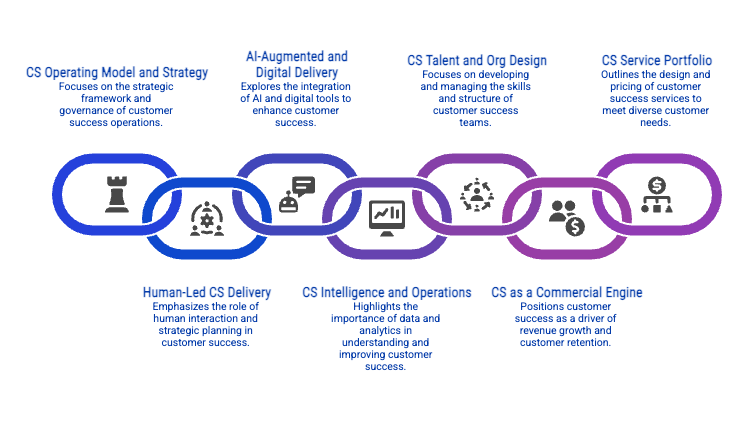
1. Customer Success Operating Model and Strategy
In CS 1.0, customer success is often managed through simple headcount ratios and fixed segmentation. In CS 2.0, your operating model is tied directly to revenue outcomes.
Key changes include:
- Dynamic segmentation supported by AI.
- NRR-at-risk modeling.
- Formal governance for AI and outcome risk.
- Executive visibility into Voice of the Customer trends.
This ensures customer success decisions are grounded in business impact.
2. Human-Led Customer Success Delivery
Human-led engagement remains important, but it should be used selectively.
In Customer Success 2.0, your CSMs focus on:
- Strategic accounts.
- Complex onboarding.
- Executive relationship management.
- High-stakes interventions.
This lets your most experienced talent concentrate where they can have the greatest impact.
3. AI-Augmented and Digital Delivery
This is where AI in customer success delivers the most immediate value. Instead of treating digital engagement as a secondary motion, CS 2.0 makes it the primary coverage model for most customers.
Capabilities include:
- Automated health monitoring.
- Trigger-based outreach.
- Personalized digital journeys.
- Segment-level cost-to-serve analysis.
This creates a scalable system that improves consistency and efficiency.
4. Customer Success Intelligence and Operations
AI is only as effective as the data behind it. Customer success intelligence provides the analytical foundation for both AI and human decision-making.
Core capabilities include:
- Predictive churn and expansion models.
- Dynamic journey mapping.
- Continuous Voice of the Customer programs.
- Knowledge management.
- Integrated technology platforms.
Without this foundation, AI recommendations will be incomplete or unreliable.
5. Customer Success Talent and Organizational Design
AI changes the role of the customer success manager. Instead of manually managing every interaction, CSMs become orchestrators of AI-driven workflows.
New core competencies include:
- AI fluency.
- Data literacy.
- Commercial acumen.
- Strategic consulting skills.
This shift also requires formal change management to help teams adopt new ways of working.
6. Customer Success as a Commercial Engine
In Customer Success 2.0, CS has clear accountability for revenue.
This includes:
- CS-influenced pipeline.
- Expansion opportunity generation.
- Renewal forecasting.
- Customer advocacy and references.
When AI surfaces signals earlier, your team can proactively engage customers before opportunities or risks become obvious.
7. Customer Success Service Portfolio
Many companies still bundle customer success into subscription pricing.
Customer Success 2.0 reinforces monetizable offerings such as:
- Premium success plans.
- Adoption services.
- Journey intelligence.
- Consumption optimization.
This allows customer success to generate direct revenue while demonstrating measurable value.
Related: From Dashboards to Action: AI Agents and the Future of Customer Success
How AI Changes the Role of the Customer Success Manager
One of the biggest misconceptions about AI in customer success is that it replaces CSMs. In reality, AI changes how CSMs spend their time.
Instead of focusing on repetitive administrative tasks, your team can devote more time to:
- Executive conversations.
- Strategic planning.
- Outcome validation.
- Expansion discussions.
AI handles much of the data processing and early signal detection, while humans provide judgment, empathy, and business context.
How To Implement the Customer Success 2.0 Framework
Transforming your customer success organization does not require rebuilding everything at once.
TSIA recommends starting with a structured capabilities assessment across all seven pillars:
- Step 1: Assess Your Current State. Identify where CS 1.0 practices are still dominant and where AI capabilities are underdeveloped.
- Step 2: Prioritize Based on Business Impact. Focus on gaps that have the greatest effect on net revenue retention and operational efficiency.
- Step 3: Strengthen Your Data Foundation. Ensure that your health scores, product telemetry, and predictive models are sufficiently accurate to support automation.
- Step 4: Launch Change Management Early. Treat cultural transformation as a formal workstream with executive sponsorship.
- Step 5: Establish Governance. Define accountability for AI-driven decisions and set escalation paths when automated actions fall short.
Common Pitfalls To Avoid
Many organizations struggle because they move too quickly or focus solely on technology.
Common mistakes include:
- Reducing CSM coverage before health data is reliable.
- Assuming training alone will drive behavior change.
- Automating without outcome risk governance.
- Trying to transform all seven pillars at once.
A phased, disciplined approach delivers better results.
Why Customer Success Must Evolve
The economics of software are changing. Growth increasingly depends on retaining and expanding existing customers. That means customer success can no longer operate as a loosely defined support function. It must become a disciplined, measurable system for delivering customer outcomes at scale. AI in customer success is the catalyst that makes this transformation possible.
Organizations that embrace Customer Success 2.0 will be better positioned to:
- Improve net revenue retention.
- Scale efficiently.
- Demonstrate measurable ROI.
- Create stronger customer relationships.
Those that remain rooted in CS 1.0 will face growing pressure to deliver more, with an operating model ill-suited to the AI era.
Related: Customer Success Playbook: A Step-by-Step Guide for Technology Companies
AI in Customer Success: Your Competitive Advantage
The move to Customer Success 2.0 is more than a technology initiative. It is a strategic transformation that changes how your organization creates value after the sale.
By evolving your operating model, intelligence infrastructure, talent strategy, and service portfolio, you can turn customer success into a scalable growth engine. The companies that lead in the next decade will be the ones that combine AI efficiency with human expertise to deliver measurable customer outcomes.
Frequently Asked Questions
How is AI used in customer success?
AI is used to monitor customer health, predict churn risk, identify expansion opportunities, automate outreach, and recommend next best actions for customer success teams.
Will AI replace customer success managers?
No. AI handles repetitive analysis and workflow tasks, while CSMs focus on strategic relationships, executive engagement, and complex problem-solving.
What is Customer Success 2.0?
Customer Success 2.0 is an AI-enabled operating model that helps organizations deliver customer outcomes more efficiently and at greater scale.
Smart Tip: Embrace Data-Driven Decision Making
Making smart, informed decisions is more crucial than ever. Leveraging TSIA’s in-depth insights and data-driven frameworks can help you navigate industry shifts confidently. Remember, in a world driven by artificial intelligence and digital transformation, the key to sustained success lies in making strategic decisions informed by reliable data, ensuring your role as a leader in your industry.



.png)

.png)
.png)
