


Customer success is no longer a reactive function. It’s a core driver of retention, expansion, and long-term revenue growth. But as your customer base grows and expectations rise, managing customer success manually or with disconnected tools quickly becomes unsustainable. That’s where customer success platforms come in.
If you’re evaluating your options, you’re likely facing a familiar challenge: Should you extend your CRM? Invest in a dedicated customer success platform? Layer in customer experience tools? Or build something internally? The reality is, choosing the right platform isn’t just about features. It’s about aligning technology with how your business delivers value to customers.
This guide breaks down what you need to know to choose the right customer success platform for your organization confidently.
Key Takeaways
- Customer success platforms are essential for scaling proactive engagement, but not all platforms serve the same purpose—and understanding the differences is critical.
- The best solution aligns with your customer success maturity, use cases, and data strategy, not just your budget or existing tech stack.
- A structured evaluation process helps you avoid costly mistakes, especially when factoring in integrations, AI capabilities, and total cost of ownership.
What Are Customer Success Platforms?
Customer success platforms are purpose-built tools designed to help you manage and scale your customer relationships after the sale.
Unlike general systems, these platforms focus on helping you:
- Track customer health.
- Automate engagement.
- Manage onboarding and adoption.
- Identify churn risks and expansion opportunities.
At their core, customer success platforms help you move from reactive support to proactive, data-driven engagement. As customer success has evolved into a strategic function, so has the technology supporting it. Today, these platforms are central to delivering consistent, scalable customer outcomes.
Related: Unlocking Customer Success Platform Potential
Understanding the Customer Success Technology Landscape
Before you choose a platform, you need to understand the broader ecosystem. Most organizations aren’t choosing just one tool—they’re deciding how multiple systems work together.
Customer Relationship Management (CRM) Systems: Your Foundation
Customer relationship management (CRM) systems act as the central hub for customer data. They’re essential for managing accounts, contacts, and sales activity.
But when it comes to customer success, they have limitations:
- Limited workflow automation for customer success use cases.
- Basic reporting compared to customer success-specific tools.
- Heavy customization is required to scale.
You can extend a CRM, but doing so often increases complexity and cost over time.
Dedicated Customer Success Platforms: Purpose-Built for Scale
This is where true customer success platforms come into play.
These tools are designed specifically for customer success teams and typically include:
- Customer health scoring.
- Automated playbooks.
- Lifecycle management.
- Risk and renewal tracking.
They allow your team to operate more efficiently while providing the insights needed to act proactively. However, they depend heavily on integrations, especially with your CRM and product data, to deliver a complete customer view.
Customer Experience Platforms: Voice of the Customer
Customer experience platforms focus on capturing and analyzing feedback.
They help you:
- Understand customer sentiment.
- Identify trends.
- Close the loop on feedback.
While they don’t manage customer success workflows directly, they play a critical role in informing your strategy and improving customer outcomes.
Homegrown Solutions: Flexibility With Trade-offs
Some organizations build their own tools to meet specific needs.
While this can seem cost-effective upfront, it often leads to:
- Scalability issues.
- High maintenance costs.
- Integration challenges.
- Slower innovation.
Over time, these systems can create more friction than they solve, especially as your customer success program matures.
Related: The State of Customer Success 2026
How To Evaluate Customer Success Platforms
Choosing the right customer success platform requires more than comparing feature lists. You need to assess how well each option supports your strategy, operations, and growth. Here’s how to approach it.
1. Align With Your Core Use Cases
Start by asking: What do you actually need this platform to do?
Focus on whether it enables:
- Proactive engagement.
- Onboarding and adoption tracking.
- Retention and expansion strategies.
- Customer feedback integration.
Your platform should support how you deliver value—not force you to change your model.
2. Assess Your Technical Fit
Next, evaluate how well the platform integrates into your ecosystem.
Key considerations:
- Can it unify data from CRM, product usage, and billing systems?
- Does it support APIs and two-way data sync?
- Is the interface intuitive for your team?
A platform that looks powerful on paper won’t deliver value if your team struggles to use it.
3. Evaluate Automation and AI Capabilities
Modern customer success platforms increasingly rely on automation and AI.
Look for:
- Automated workflows and task creation.
- Predictive insights (like churn risk).
- Opportunities for personalization at scale.
These capabilities aren’t just “nice to have”—they’re essential for scaling efficiently.
4. Understand Total Cost of Ownership
One of the biggest mistakes you can make is underestimating cost.
Go beyond licensing fees and consider:
- Implementation and onboarding.
- Integration and customization.
- Ongoing maintenance and support.
- Internal resource requirements.
A lower upfront cost doesn’t always mean a better long-term investment.
Matching the Right Platform to Your Customer Success Maturity
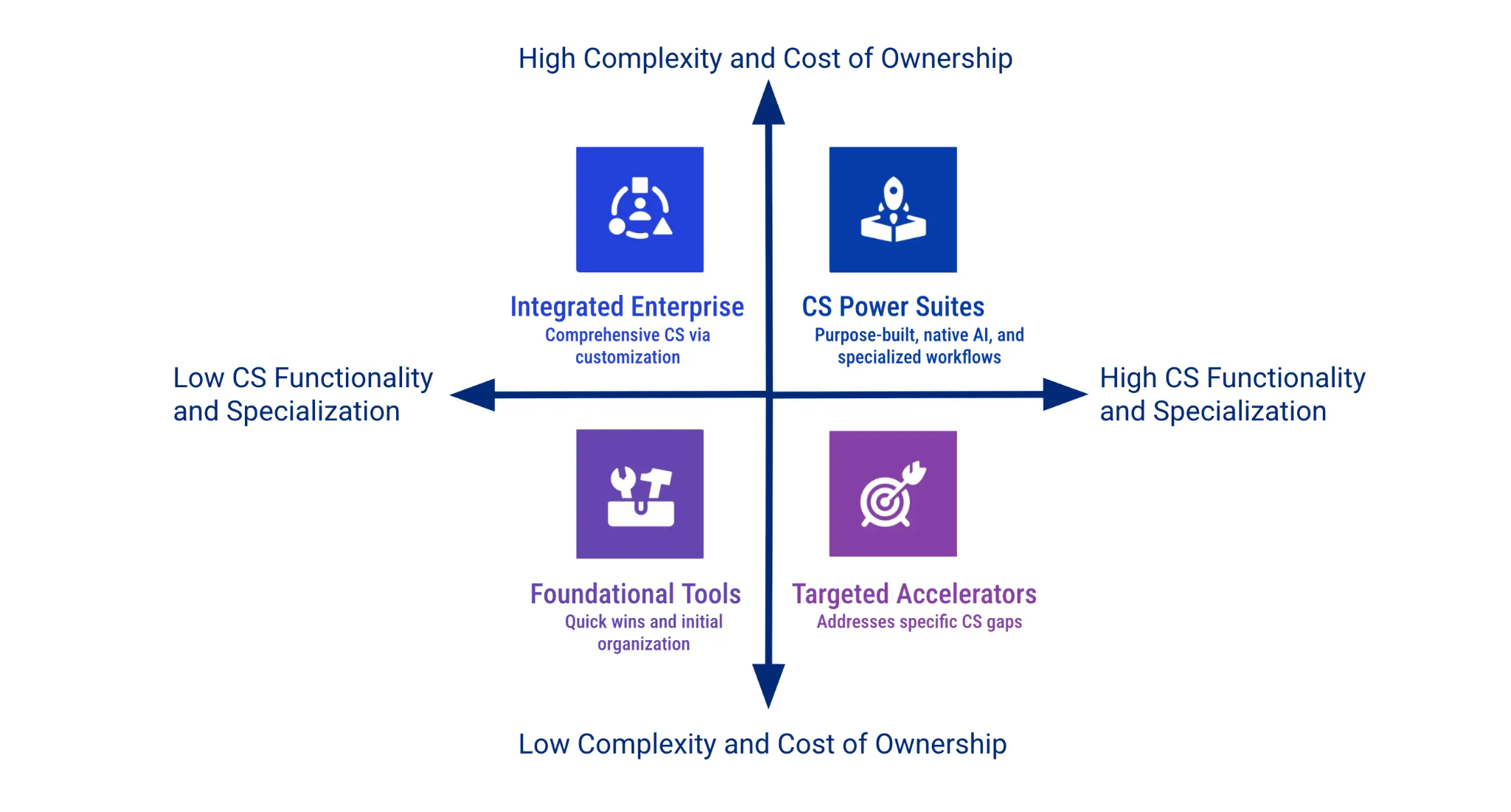
Not every organization needs the most advanced platform. The right choice depends on where you are today and where you’re going. A helpful way to think about this is in terms of four common categories.
Foundational Tools
- Low complexity, lower cost.
- Basic functionality.
- Best for early-stage customer success teams.
If you’re just getting started, simplicity and speed matter most.
Targeted Solutions
- Moderate complexity.
- Focused on specific gaps.
- Ideal for growing teams.
These tools help you solve immediate challenges without overcommitting.
Integrated Enterprise Systems
- High complexity.
- Broad functionality.
- Built around CRM customization.
These are common in larger organizations that prioritize a unified data environment.
Advanced Customer Success Platforms
- High specialization.
- Advanced analytics and automation.
- Designed for mature customer success organizations.
If your goal is to scale proactively and drive measurable outcomes, dedicated customer success platforms shine. To make this easier to visualize, here’s how different customer success platforms are typically positioned based on functionality and complexity:
A Practical Framework for Choosing the Right Platform
Once you understand your options, the next step is making a decision. Here’s a simple, structured approach you can follow.
Step 1: Assess Your Current State
Define:
- Your customer success maturity level.
- Your biggest challenges.
- Your most important use cases.
This ensures you’re solving the right problems.
Step 2: Evaluate Your Options
Compare platforms using consistent criteria.
You might:
- Build a scoring model.
- Assign weights to priorities.
- Rate each platform objectively.
This helps remove bias from the decision.
Step 3: Build Your Business Case
To secure buy-in, you need to connect the platform to measurable outcomes.
Focus on:
- Improved retention.
- Increased efficiency.
- Revenue impact.
Translate platform capabilities into real business value.
Step 4: Implement and Optimize
Your work doesn’t stop after purchase.
To get the most value:
- Roll out in phases.
- Train your team continuously.
- Track performance against KPIs.
As your business evolves, your platform should evolve with it.
Related: Customer Success Playbook: A Step-by-Step Guide for Technology Companies

Common Pitfalls to Avoid
Even with a strong strategy, there are a few common challenges you’ll want to avoid:
- Resistance to change → Invest in training and clear communication.
- Data silos → Prioritize platforms with strong integration capabilities.
- Hidden costs → Plan for total cost, not just upfront investment.
- Unclear ROI → Define success metrics early and track them consistently.
Avoiding these pitfalls can save you time, money, and frustration down the line.
Choosing the Right Customer Success Platform for Long-Term Growth
Choosing the right customer success platform isn’t about finding the most advanced tool—it’s about finding the one that fits your business.
When your technology aligns with your strategy, you can:
- Scale customer success more effectively.
- Deliver consistent value to your customers.
- Drive long-term, predictable growth.
The key is taking a structured, thoughtful approach—one that balances your current needs with your future goals.
FAQ
What is a customer success platform?
A customer success platform is a tool designed to help you manage customer relationships after the sale. It enables you to track health, automate engagement, and identify risks and opportunities across the customer lifecycle.
Do I need a dedicated customer success platform, or can I use a CRM?
While a CRM provides a strong foundation, it typically lacks the specialized features needed to scale customer success. If your customer success program is growing, a dedicated platform will offer more advanced capabilities.
How do I choose the best customer success platform?
Start by defining your use cases, evaluating integration needs, and understanding the total cost of ownership. Then compare platforms based on how well they align with your strategy and long-term goals.
Smart Tip: Embrace Data-Driven Decision Making
Making smart, informed decisions is more crucial than ever. Leveraging TSIA’s in-depth insights and data-driven frameworks can help you navigate industry shifts confidently. Remember, in a world driven by artificial intelligence and digital transformation, the key to sustained success lies in making strategic decisions informed by reliable data, ensuring your role as a leader in your industry.