


Professional services are standing at a defining crossroads. AI is no longer a future investment or a tactical experiment—it is actively reshaping how value is created, priced, and delivered. And in the middle of this shift sits professional services, caught between legacy operating models and an entirely new economic reality.
If you’re leading or supporting a professional services organization today, you’re likely feeling the tension firsthand. On one side, you still rely on project-based delivery, billable hours, and one-time implementation fees. On the other side, AI is accelerating customer expectations, collapsing seat-based pricing models, and forcing a move toward outcomes, subscriptions, and renewable value.
This is the central finding of The State of Professional Services 2026: awareness of change is high, but execution is lagging. The industry recognizes that Professional Services 2.0 (PS 2.0) is required—but most organizations still operate on a Professional Services 1.0 (PS 1.0) foundation that cannot scale in an AI-driven economy.
That tension creates what TSIA defines as the PS 2.0 Transformation Paradox:
You cannot achieve scalable, AI-powered delivery without first mastering the operational rigor of PS 1.0. AI does not fix broken systems—it exposes them.
This blog breaks down what that means for you, the trends shaping 2026, and what must change for professional services to survive and thrive in the AI Economics™ era.
Key Takeaways
- AI is forcing a shift from effort-based services to outcome-based value. As AI cannibalizes traditional pricing models, professional services must evolve from billable hours to measurable business outcomes.
- Most professional services organizations are strategically aligned—but operationally unprepared. AI maturity, services engineering, data quality, and standardized delivery remain major execution gaps across the industry.
- Professional services are becoming the profit engine of the AI era, not a cost center. In a world where AI technology commoditizes quickly, services become the differentiator, the margin defender, and the path to recurring revenue.
The Collision Defining Professional Services in 2026: Inertia vs. Transformation
Professional services in 2026 are defined by a daily collision between two opposing forces.
The Weight of PS 1.0 Inertia
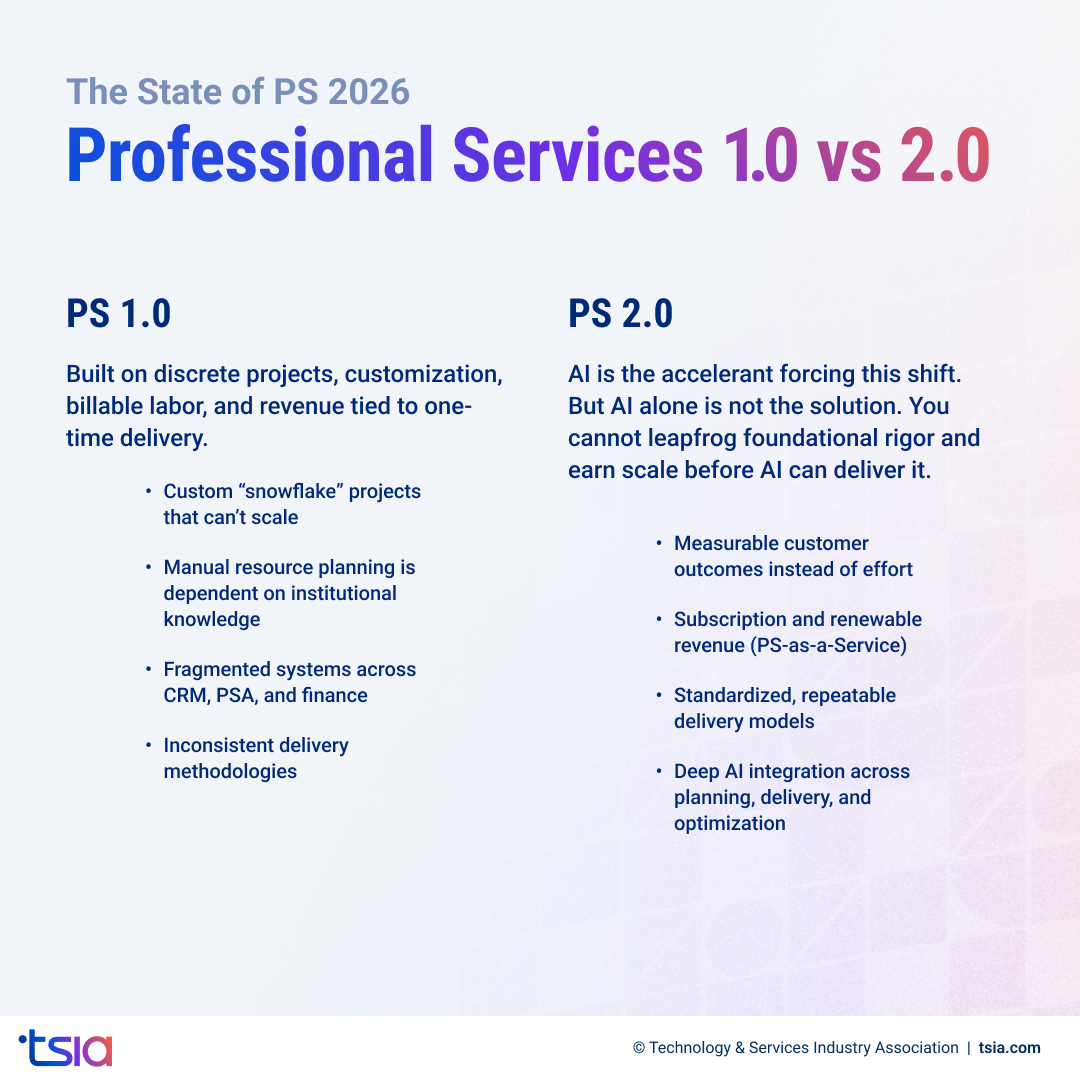
PS 1.0 is built on discrete projects, customization, billable labor, and revenue tied to one-time delivery. Over time, this model has accumulated deep operational debt from:
- Custom “snowflake” projects that can’t scale.
- Manual resource planning is dependent on institutional knowledge.
- Fragmented systems across CRM, PSA, and finance.
- Inconsistent delivery methodologies.
These issues feel risky, slow, and expensive.
The Non-Negotiable PS 2.0 Imperative
PS 2.0 demands something fundamentally different:
- Measurable customer outcomes instead of effort.
- Subscription and renewable revenue (PS-as-a-Service).
- Standardized, repeatable delivery models.
- Deep AI integration across planning, delivery, and optimization.
AI is the accelerant forcing this shift. But AI alone is not the solution. Without operational discipline, AI simply magnifies inefficiency. This is why the PS 2.0 Transformation Paradox matters so much in 2026. You cannot leapfrog foundational rigor. You have to earn scale before AI can deliver it.
Related: The State of Professional Services 2026
The Top Professional Services Trends Accelerating in 2026
AI Is Becoming Embedded—but Maturity Remains Low
AI is no longer peripheral to professional services strategy. It is increasingly embedded into delivery models, internal workflows, and customer-facing services. Yet execution lags badly:
- Only a tiny percentage of PS organizations consider their AI maturity high.
- Most organizations allocate a minimal budget to AI development.
- The majority lack a formal AI roadmap.
What is changing is how AI is being used. Internal workflow optimization remains the starting point, but client delivery optimization and AI solution consulting are accelerating rapidly. This signals a shift from experimentation to economic intent—even if maturity hasn’t yet caught up.
The Shift to PS-as-a-Service and Outcome-Based Pricing Is Underway—but Slow
Professional services portfolios are clearly pivoting toward subscription-style offerings and outcome-based services. But adoption is still shallow. Value-based and outcome-based pricing still account for a small share of total PS revenue. That’s a problem because AI economics is eroding effort-based pricing faster than most organizations are prepared for.
PS 2.0 requires new financial thinking. Instead of tracking success by project margin alone, you must connect services to long-term value metrics like:
- Annual recurring revenue (ARR).
- Customer lifetime value (CLTV).
- Customer time-to-value (CTTV).
- Outcome achievement rates.
If your services can’t demonstrate measurable impact, they won’t survive in an AI-driven market.
Services Engineering Has Become the Gatekeeper of Scale
One of the most important, and least invested-in functions in professional services today is services engineering. AI depends on structure. It needs standardized offers, repeatable delivery motions, and clean data. Without engineered services, every project remains bespoke, and AI has nothing to optimize.
Services engineering ensures:
- Offers are designed before they are sold.
- Delivery is repeatable, not reinvented.
- Knowledge is captured, not trapped in individuals.
Without this discipline, PS 2.0 simply cannot scale.
Partner Ecosystems Are Expanding—but Visibility Is Missing
Delivery partners now play a significant role in the growth of professional services. Yet most organizations lack basic visibility into partner utilization and capacity. That gap creates real risk.
Without tracking how partners are deployed, you can’t forecast accurately, scale responsibly, or maintain delivery quality—especially in a hybrid AI-enabled workforce. PS 2.0 requires tighter partner enablement, shared service designs, and aligned delivery standards.
AI Economics and the Cannibalization Dilemma in Professional Services
At the heart of PS 2.0 is AI Economics, the reality that AI fundamentally changes how revenue is created and captured. Traditional per-seat and per-user pricing collapse under AI. When an AI agent replaces the work of multiple users, pricing based on human headcount declines. Efficiency becomes a liability instead of an advantage. This creates the cannibalization dilemma: If you don’t change your pricing model, AI eats your revenue.
Professional services become the escape hatch. Outcome-based pricing (OBP) allows you to price against results, not effort. Under OBP, value is proven, not promised. You get paid when outcomes are achieved, not when hours are logged. This is why professional services sit at the center of AI Economics. It is the mechanism that translates AI capability into measurable business value.
Related: Professional Services 2.0 Explained: What It Means for Your Business
Why AI Is Creating the Era of Services—Not Eliminating It
Despite fears of automation, AI is not eliminating professional services. It is making services more essential than ever.
AI models commoditize quickly. What doesn’t commoditize is the “last mile” of enterprise adoption:
- Integrating AI into legacy systems.
- Governing proprietary and sensitive data.
- Managing security, compliance, and risk.
- Aligning AI outputs to fundamental business processes.
These challenges cannot be solved by software alone. They require human expertise, judgment, and adaptation. That’s why even AI-native companies and organizations like OpenAI are investing heavily in services. Services are becoming the competitive moat in the AI era.
Related: Why Advanced Services Are Defining the Next Era of AI
The Augmented Consultant and the Rise of New PS Roles
AI is reshaping the professional services workforce—but not by replacing it. Low-value, repetitive tasks are increasingly automated. What remains is higher-value work: strategy, oversight, problem-solving, and ethical judgment. This gives rise to the augmented consultant—professionals empowered by AI rather than displaced by it.
One of the clearest expressions of this shift is the Forward-Deployed Engineer (FDE) model. FDEs operate at the intersection of product engineering and service delivery. They embed deeply with customers, solve complex technical challenges, and accelerate time-to-value—especially in AI-heavy environments.
But there’s a catch. Without services engineering, FDE work becomes another form of bespoke delivery. The value must be captured, standardized, and reused—or scalability breaks down.
The Six Execution Gaps Blocking PS 2.0 Progress
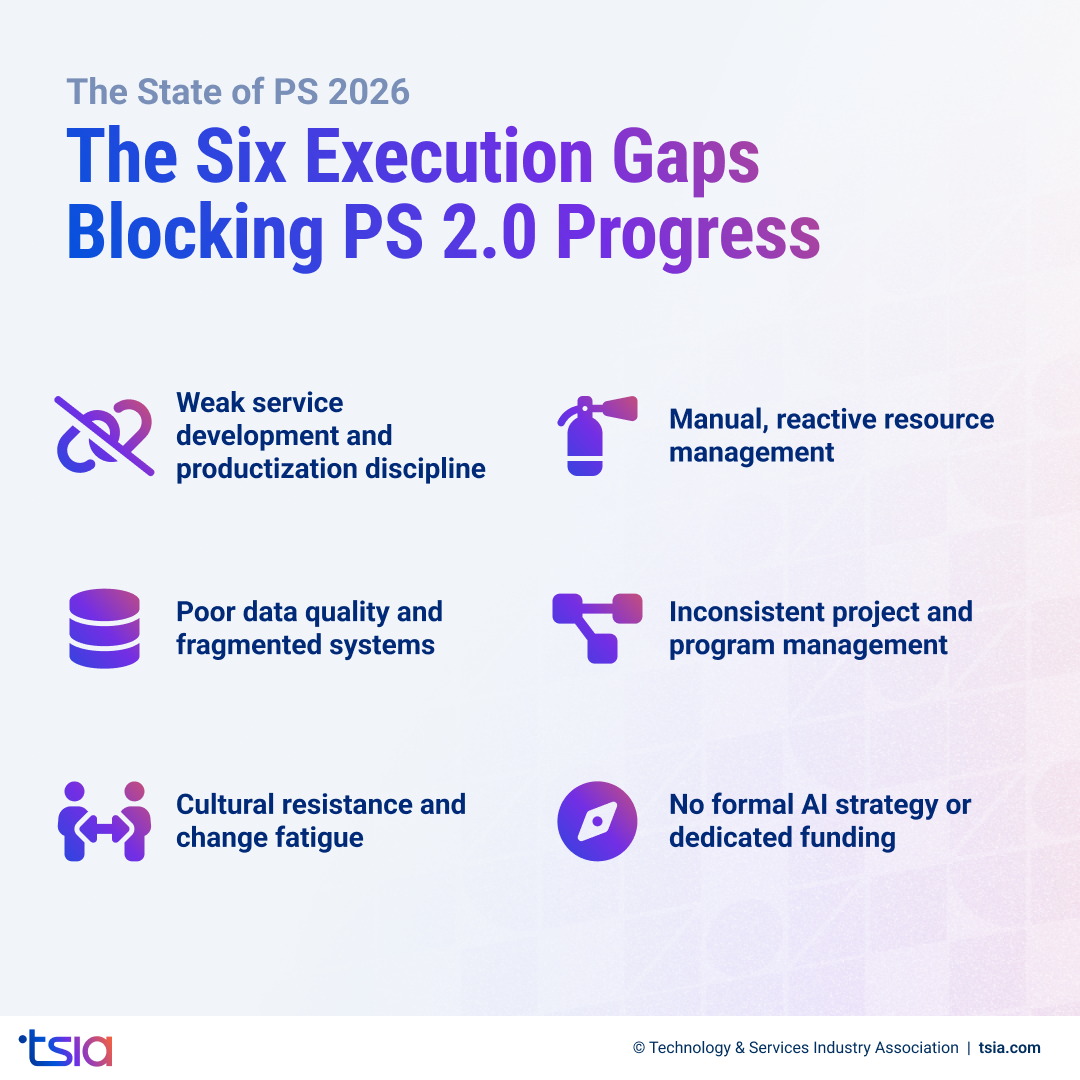
The PS 2.0 Transformation Paradox shows up in six persistent gaps:
- Weak service development and productization discipline.
- Poor data quality and fragmented systems.
- Cultural resistance and change fatigue.
- Manual, reactive resource management.
- Inconsistent project and program management.
- No formal AI strategy or dedicated funding.
Until these gaps are addressed, AI investment will continue to underperform.
Strategic Imperatives for 2026: Mastery First, Then Momentum
To move forward, professional services leaders must pursue two things at once: foundational mastery and future momentum. That means developing a formal, AI-integrated PS strategy, investing in services engineering, fixing data and delivery discipline, and positioning AI as a scalability engine—not a shortcut.
AI does not replace rigor. It rewards it.
Why Professional Services Will Define AI Winners and Losers
The shift to PS 2.0 is not incremental. It is existential. AI is collapsing old pricing models, redefining value, and forcing a move away from effort-based economics. Professional services sit at the center of this change—not as overhead, but as the engine that converts AI capability into real, repeatable outcomes. If you want AI to drive growth instead of erosion, professional services must evolve first.
Frequently Asked Questions
What is Professional Services 2.0 (PS 2.0)?
PS 2.0 is a model focused on scalable, AI-enabled, outcome-based services designed to drive recurring revenue and measurable customer value.
Why can’t AI fix broken professional services processes?
AI depends on standardized workflows, clean data, and repeatable delivery. Without foundational rigor, AI amplifies inefficiency instead of eliminating it.
Why is outcome-based pricing critical in the AI era?
AI cannibalizes effort-based pricing models. Outcome-based pricing aligns revenue with results, enabling services to monetize value rather than labor.
Smart Tip: Embrace Data-Driven Decision Making
Making smart, informed decisions is more crucial than ever. Leveraging TSIA’s in-depth insights and data-driven frameworks can help you navigate industry shifts confidently. Remember, in a world driven by artificial intelligence and digital transformation, the key to sustained success lies in making strategic decisions informed by reliable data, ensuring your role as a leader in your industry.

.png)




.png)

.png)
.png)
