If you’re leading or supporting a professional services organization right now, you’re likely feeling the pressure from all sides. Customers expect faster implementations. Costs are rising. And AI is no longer a future conversation; it’s already reshaping how work gets done. The challenge isn’t whether AI will impact your services business. It’s whether you have a clear plan for where and how to apply it.
That’s exactly why this case study matters. In this example, Salesforce is building a roadmap to apply AI across the entire professional services lifecycle, from project setup to delivery. And what makes this especially valuable is how closely this approach aligns with TSIA research on where AI is delivering real, measurable impact today.
This isn’t just a story about innovation. It’s a practical look at how you can rethink service delivery using AI and what it takes to do it effectively.
Key Takeaways
- AI delivers the most value when applied across the full services lifecycle, not just isolated use cases.
- Starting with high-friction, labor-intensive tasks accelerates adoption and impact.
- Organizations that align AI initiatives with proven frameworks, such as those from TSIA, are better positioned to scale their results.
Why Professional Services Is at a Turning Point
According to TSIA research, many technology organizations are still early in their AI journey, especially in professional services. While support and managed services teams have made faster progress, professional services organizations often lag in developing a structured AI strategy.
At the same time, expectations are rising:
- Faster time to value.
- Lower implementation costs.
- Higher-quality outcomes.
- Better customer experiences.
This creates a gap between what customers expect and what traditional delivery models can support. That gap is where AI becomes critical.
Related: Looking to the Future: Professional Services at Salesforce
How Salesforce Is Applying AI Across the Services Lifecycle
Rather than treating AI as a one-off initiative, Salesforce is taking a lifecycle approach, embedding AI into every stage of a professional services engagement. Here’s what that looks like in practice.
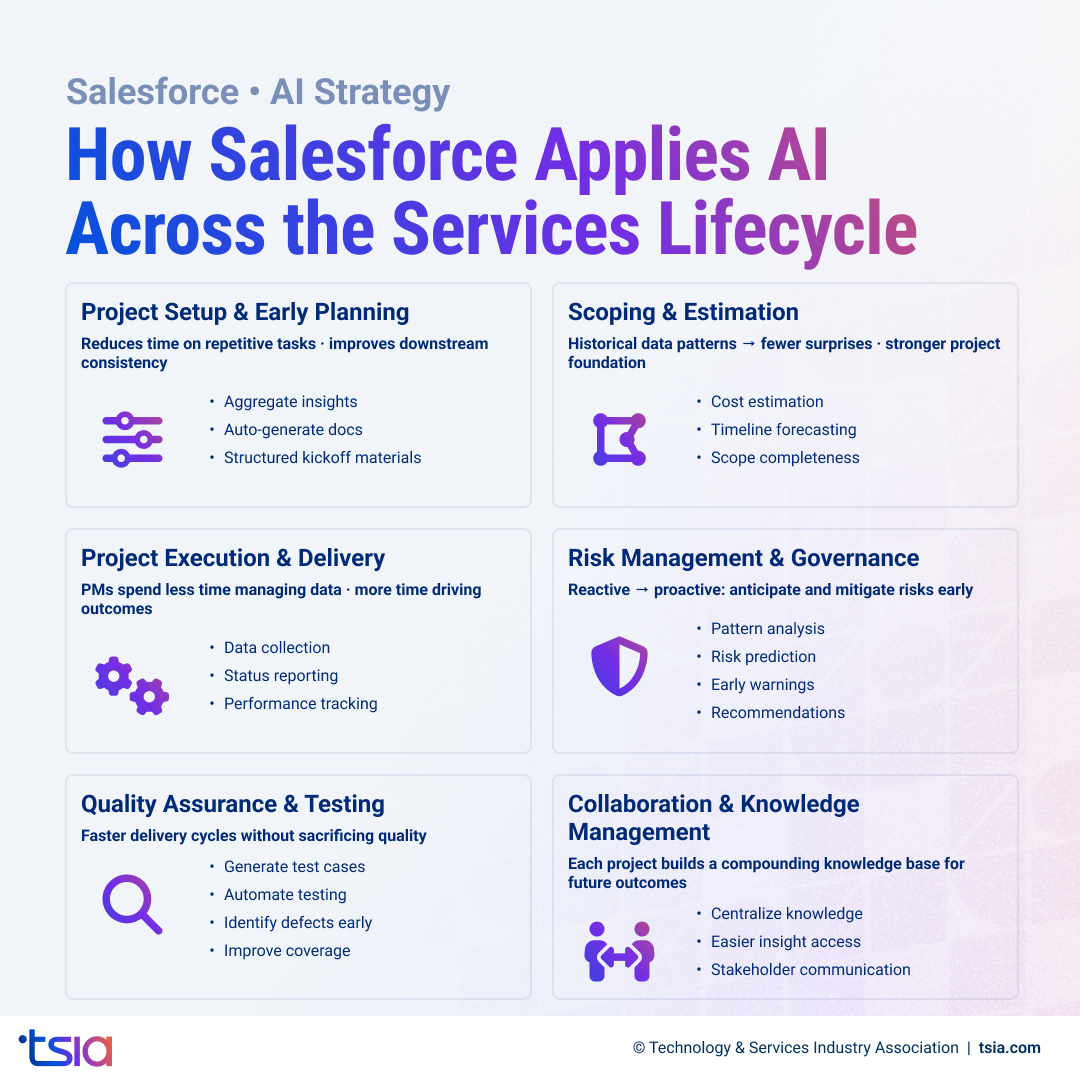
Project Setup and Early Planning
One of the first areas Salesforce targeted was project setup, specifically, the work that happens during discovery.
Instead of manually summarizing inputs and building kickoff materials, AI is used to:
- Aggregate discovery insights.
- Generate project documentation.
- Create structured kickoff materials.
This reduces time spent on repetitive tasks and helps teams start projects faster. More importantly, it improves consistency. When your inputs are structured and standardized from the beginning, everything downstream becomes easier to manage.
Scoping and Estimation
Accurate scoping has always been a challenge in professional services.
Salesforce is using AI to improve:
- Cost estimation accuracy.
- Timeline forecasting.
- Scope definition completeness.
By analyzing historical data and identifying patterns, AI helps project teams make more informed decisions upfront. For you, this means fewer surprises later and a stronger foundation for delivering projects on time and within budget.
Project Execution and Delivery
During execution, AI is helping automate some of the most time-consuming aspects of project management.
This includes:
- Data collection and analysis.
- Status reporting.
- Performance tracking.
The result is simple but powerful: your project managers can spend less time managing data and more time driving outcomes. And when you multiply that across multiple projects, the productivity gains become significant.
Risk Management and Governance
AI also plays a critical role in identifying and managing risk.
Salesforce is using AI to:
- Analyze large volumes of project data.
- Identify patterns that signal potential risks.
- Predict the likelihood and impact of those risks.
- Provide early warnings and recommendations.
This shift from reactive to proactive risk management can dramatically improve project outcomes. Instead of responding to issues after they arise, your team can anticipate and mitigate them early.
Quality Assurance and Testing
Another high-impact area is quality assurance.
AI is being used to:
- Generate test cases.
- Automate testing processes.
- Identify defects earlier.
- Improve overall coverage.
This not only improves the quality of deliverables but also reduces the time required for testing cycles. For your organization, that means faster delivery without sacrificing quality.
Collaboration and Knowledge Management
Beyond execution, Salesforce is also using AI to improve how teams collaborate and share knowledge.
AI enables:
- Centralized knowledge capture.
- Easier access to project insights.
- More effective communication across stakeholders.
Over time, this creates a compounding effect. Each project contributes to a growing knowledge base that improves future outcomes.
The Business Impact You Should Pay Attention To
While Salesforce is still early in its AI deployment, the expected outcomes are clear and closely align with TSIA benchmarks for high-performing organizations.
These include:
- Faster project delivery times.
- Improved implementation quality.
- Higher customer satisfaction.
- Reduced delivery costs.
- Increased adoption of deployed solutions.
These aren’t incremental improvements. They represent a fundamental shift in how service organizations operate.
Related: Beyond Automation: Shaping the Future of Professional Services

What This Means for You
The most important takeaway from this case study isn’t the specific tools or technologies. It’s the approach.
Salesforce didn’t start by trying to transform everything at once. Instead, they focused on:
- High-friction tasks.
- Clear use cases.
- Measurable outcomes.
This aligns directly with TSIA guidance on AI adoption.
Start Where the Pain Is Highest
The fastest way to drive adoption is to target the work your team doesn’t want to do.
These are typically:
- Manual data entry.
- Repetitive documentation.
- Time-consuming analysis.
When AI removes friction, your team sees value immediately.
Build a Roadmap, Not a One-Off Initiative
AI impact compounds when it’s applied across the lifecycle. If you only focus on one area, like testing or reporting, you’ll see limited gains.
But when you connect those use cases across:
- Planning.
- Execution.
- Governance.
- Delivery.
You create a system that continuously improves.
Balance Opportunity with Risk
AI introduces new capabilities, but also new challenges.
Salesforce emphasized the importance of:
- Understanding potential risks.
- Communicating clearly with customers.
- Building trust throughout the process.
This is especially important in professional services, where customer confidence directly impacts success.
Take Your Customers Along the Journey
Not every customer will immediately embrace AI in delivery processes.
Some may have concerns around:
- Accuracy.
- Security.
- Reliability.
Your role is to clearly communicate the benefits and demonstrate their value over time.
Related: The State of Professional Services 2026
This Isn’t Just a Salesforce Story
It’s easy to look at a company like Salesforce and assume its success is hard to replicate. But the reality is different.
What this case study shows is a repeatable model:
- Start with clear use cases.
- Focus on measurable outcomes.
- Build a roadmap that spans the full lifecycle.
- Align your approach with proven research.
This is exactly where TSIA plays a critical role. By combining real-world examples like this with structured frameworks and benchmarking data, TSIA helps you move from experimentation to execution.
FAQ
What can professional services organizations learn from Salesforce’s AI strategy?
You can learn that AI adoption works best when it’s tied to specific use cases and applied across the full engagement lifecycle. Starting small and scaling strategically is key.
How does TSIA support AI adoption in professional services?
TSIA provides research, frameworks, and real-world examples that help you identify high-impact use cases, build adoption roadmaps, and measure results.
What is the first step to implementing AI in your services organization?
Start by identifying your most time-consuming, manual tasks. These are often the easiest places to introduce AI and demonstrate immediate value.
Smart Tip: Embrace Data-Driven Decision Making
Making smart, informed decisions is more crucial than ever. Leveraging TSIA’s in-depth insights and data-driven frameworks can help you navigate industry shifts confidently. Remember, in a world driven by artificial intelligence and digital transformation, the key to sustained success lies in making strategic decisions informed by reliable data, ensuring your role as a leader in your industry.