.png)


For most technology companies, 2025 was the year of AI experimentation. You deployed tools and automated workflows, and began to see pockets of efficiency emerge across the business. But as 2026 begins, a hard truth is setting in: adopting AI is no longer the challenge. Monetizing it is.
The technology industry has entered a new phase, one where AI simultaneously enables powerful outcomes and undermines the pricing, service models, and organizational structures that once sustained growth. Traditional per-user pricing is eroding. Legacy service silos are breaking down. And boards are asking a brutal question: How do you grow revenue with the same, or fewer, people?
This is the shift from AI adoption to AI Economics™. The State of the Technology Industry 2026 report explores what this shift really means for your business, and makes one thing clear: success in 2026 won’t come from adding AI to existing models. It will come from redesigning how you deliver value, organize teams, and price outcomes in an AI-first world.
Key Takeaways
- AI efficiency alone won’t drive growth. In 2026, value must be defined, delivered, and monetized through outcomes, not cost savings.
- Traditional service and pricing models are breaking. Selling time, effort, or seats no longer aligns with how AI creates value.
- Organizational redesign is unavoidable. Governance, services, and go-to-market models must converge around measurable customer outcomes.
From AI Adoption to AI Economics
In 2025, the industry's focus was on speed and efficiency. AI helped you create content faster, automate support tasks, and reduce operational costs. That progress mattered, but it also created a new problem. Efficiency doesn’t equal profitability.
Most early AI ROI came from internal automation. You made the back office cheaper, but customers didn’t necessarily become more successful. Investors and boards are now pushing for proof that AI improves business outcomes, not just internal productivity.
In 2026, the conversation changes. The question is no longer “Can you deploy AI?” It’s “Can you build a profitable business model around it?”
That shift is what defines AI Economics. It forces you to rethink:
- How services create value when AI does the work.
- How pricing scales when growth no longer tracks headcount.
- How teams must be structured when automation blurs traditional roles.
Related: AI Economics.™ TSIA’s Perspective on Profitable AI Business Models
Why Traditional Models Are Under Pressure
Technology leaders are facing unprecedented uncertainty. Cost pressure hasn’t eased, but the easy cuts are gone. At the same time, AI has introduced powerful new capabilities that don’t fit neatly into existing operating models. You’re likely feeling this tension in three places.
Financial pressure hasn’t let up
Boards still expect stronger performance, but now with fewer resources. After years of reducing SG&A, the mandate has shifted to revenue growth without proportional increases in labor. AI promises leverage, but only if you know how to monetize it.
Proving AI ROI is harder than expected
Many companies can point to AI-driven efficiency gains. Far fewer can prove that AI improves adoption, retention, or customer outcomes. In 2026, ROI must extend beyond internal savings to measurable customer impact.
Organizational models are cracking
AI is exposing inefficiencies baked into traditional structures. Separating teams for sales, customer success, and support often duplicates effort and fractures the customer experience. As AI automates basic work, maintaining these silos becomes increasingly costly.
Establishing AI Governance and Trust
As AI becomes embedded in your products and services, governance moves from a technical concern to a strategic imperative. In 2026, trust is the new uptime.
Without transparent governance, AI introduces real risks, from data misuse to regulatory exposure, that can stall adoption and damage customer relationships. Strong governance isn’t about slowing innovation. It’s about protecting your ability to scale it.
Your data foundation matters more than ever
You already know data quality is a challenge. What’s changed is the urgency to govern how that data is used. Formal AI governance frameworks are no longer optional; they are foundational to business continuity.
Transparency builds trust
Customers and regulators expect visibility into how AI decisions are made. Human-in-the-loop processes, clear accountability, and auditable models are becoming table stakes. When trust fails, recurring revenue is at risk.
Compliance is getting more complex
AI regulations are emerging globally, often with conflicting requirements. Managing compliance across regions requires centralized oversight, not a patchwork of policies. Governance must evolve from documentation to active risk management.
Monetizing AI Through Outcome-Aligned Services
Here’s the central challenge of 2026: How do you turn AI-driven efficiency into scalable revenue?
When AI replaces human effort, traditional service lines collapse. Selling hours, tickets, or seats no longer reflects the value you deliver. To grow profitably, you must sell outcomes instead. That shift requires new service categories explicitly designed for the AI era.
AI Readiness and Governance Services (ARGS)
These services help customers build the foundations for their data, governance, and compliance. They are high-value, front-end offerings focused on assessment, design, and risk mitigation. In an AI-driven world, this work is noncommoditized and essential.
Value Optimization Services (VOS)
This is the evolution of managed services. Instead of monitoring uptime, you take responsibility for continuous performance, cost optimization, and security, while tying delivery to measurable business outcomes.
Outcome-Oriented AI Services (OOAS)
This is where pricing fundamentally changes. Per-user models break when AI enables growth without adding people. Outcome-based pricing anchors value to KPIs, assets managed, or business performance—not headcount.
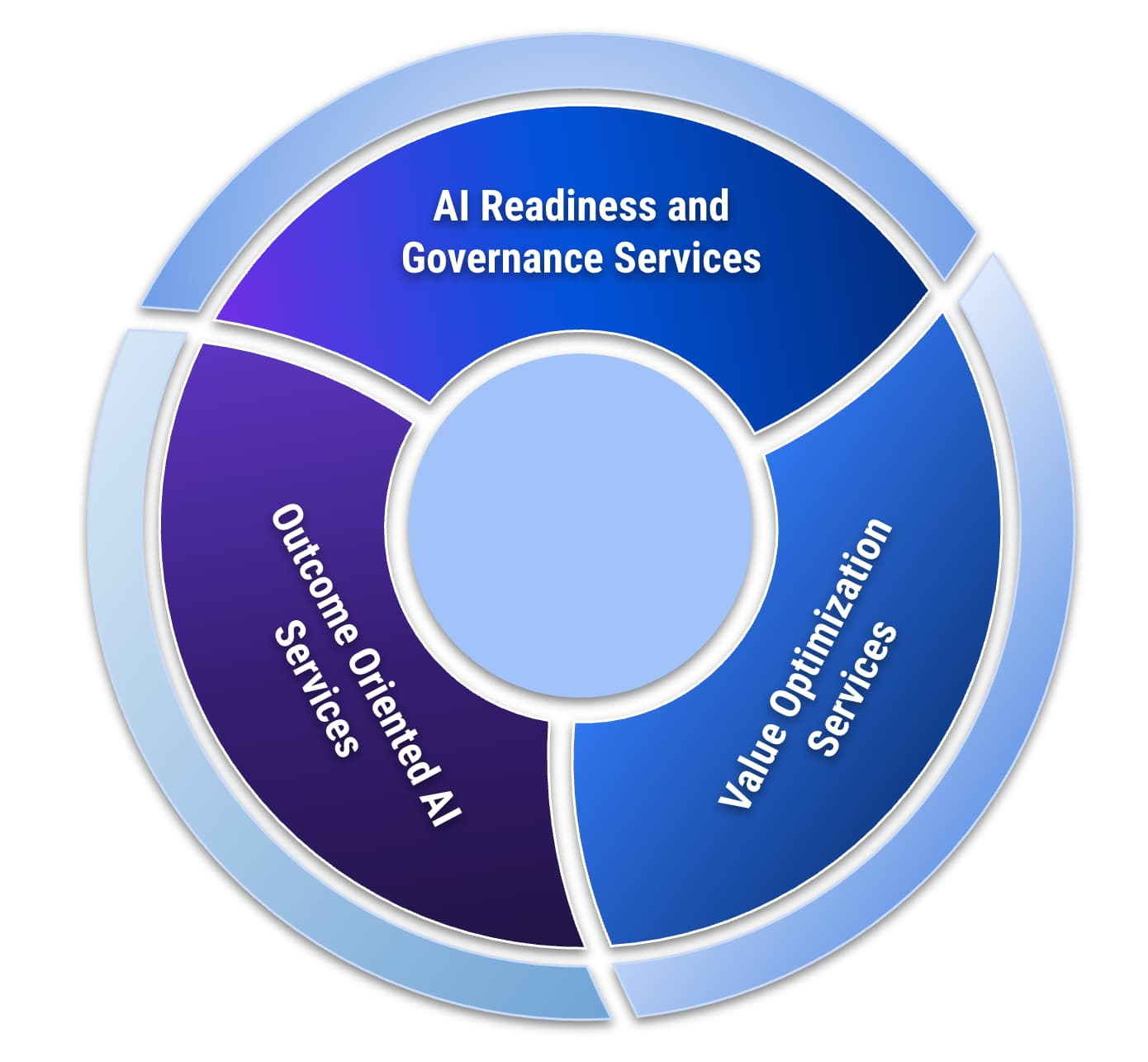
Together, these services redefine how AI value is packaged, delivered, and monetized.
Related: Outcome-Oriented AI Services
Completing the Converged Go-to-Market Model
AI doesn’t just change services. It reshapes how teams work together. As automation handles routine tasks, the need for separate support, success, and sales teams diminishes. What replaces them is a converged go-to-market model, organized around the customer journey rather than internal functions.
This model eliminates the “bucket brigade” of handoffs that frustrate customers and inflate costs. Instead, teams align around the outcomes customers expect to achieve. The focus shifts to the realize and evolve phases of engagement, supported by shared data, unified accountability, and consistent value messaging. Organizations that resist convergence risk higher labor costs, fragmented experiences, and shrinking margins.
The Organizational Capabilities You Need in 2026
To remain competitive, technology companies must build new capabilities that align with AI Economics:
- A value engineering function: Value engineering defines, quantifies, and defends the financial impact of your solutions. It anchors pricing to outcomes and moves conversations from features to ROI. Without it, outcome-based pricing collapses under scrutiny.
- An AI Governance Center of Excellence: This cross-functional group ensures AI is deployed securely, ethically, and compliantly across the business. It manages data lineage, oversight, and regulatory alignment, protecting trust at scale.
- AI-fluent field teams: Your field organization must evolve from task execution to strategic advisory. AI-fluent teams interpret data, synthesize insights, and guide customers toward measurable outcomes. This capability is essential to monetizing high-margin AI services.
Related: The AI-First Services Organization
Why 2026 Is a Defining Year for the Technology Industry
The disruption caused by AI isn’t slowing down—it’s becoming permanent. In 2026, the old technology business models simply won’t hold. Success now depends on your willingness to redesign how value is delivered and captured. That means breaking silos, embracing outcome-based services, and mastering AI Economics before pricing and margins erode further.
The work ahead is complex. But for leaders willing to act, 2026 offers a rare opportunity to build durable, profitable growth in the AI era.
Frequently Asked Questions
What is AI Economics?
AI Economics explains how value is created, delivered, and monetized when AI enables outcomes while disrupting traditional pricing and service models.
Why doesn’t traditional pricing work in the AI era?
Per-user and effort-based pricing break when AI drives growth without adding headcount. Outcome-aligned pricing better reflects the value AI delivers.
What’s the biggest risk technology companies face in 2026?
Failing to redesign organizational and service models fast enough—leading to margin erosion, trust breakdowns, and stalled growth.
Smart Tip: Embrace Data-Driven Decision Making
Making smart, informed decisions is more crucial than ever. Leveraging TSIA’s in-depth insights and data-driven frameworks can help you navigate industry shifts confidently. Remember, in a world driven by artificial intelligence and digital transformation, the key to sustained success lies in making strategic decisions informed by reliable data, ensuring your role as a leader in your industry.

.png)