


A race is underway that most executives don’t even realize they’re in.
AI is accelerating faster than any previous technology wave. It’s eating away at your revenue model, reshaping how customers want to buy, and exposing the fragility of your pricing. The question isn’t whether AI will be profitable. The question is who will capture those profits: AI-native challengers, or incumbent tech providers like you.
In TSIA’s AI Economics™ discussion, leaders J.B. Wood, Thomas Lah, and George Humphrey unpack what’s really at stake:
- Why AI broke your historic pricing engines.
- Why “serviceless AI” is the biggest lie in tech.
- And why whoever owns the last mile of AI adoption will own the economics of this era.
This blog gives you the highlights. To see the whole conversation—and hear how these leaders think about the race to AI profitability—you’ll want to watch the roundtable and explore the AI Economics Resource Center for the complete playbook.
Key Takeaways
- AI is breaking legacy pricing models. Per-seat and per-unit pricing are under pressure as customers generate more value with fewer users and fewer machines, while AI drives massive efficiency and cost savings.
- “Serviceless AI” is a myth. Customers don’t pay for AI features; they pay for outcomes. That requires a services wrapper—AI readiness, value optimization, and outcome-oriented offers—that becomes your new profit engine.
- The race favors whoever owns outcomes. Startups race in with AI-native models and forward-deployed engineers. Incumbents hold the scale, relationships, and domain expertise. The winners will be those who retool services, pricing, and sales around value realization.
The Race Most Tech Leaders Don’t See Coming
If you’ve lived through SaaS, the move to the cloud, or the shift to consumption economics, some of what you’re seeing today may feel familiar. A new wave emerges, major customers begin replacing legacy systems, and a handful of vendors either reinvent themselves or are replaced. AI feels like that kind of wave—only this time, the clock is moving much faster.
Your customers are no longer impressed by feature lists. They’re asking more challenging questions:
- What business outcomes can I count on?
- How will this show up in my P&L?
- Who is accountable when your AI makes a decision that doesn’t pay off?
At the same time, most AI-native companies in TSIA’s AI 20 index are deeply unprofitable. They burn capital, build massive data centers, flood accounts with forward-deployed engineers, and worry about profitability later. The déjà vu is real: AI looks a lot like the early SaaS era—but on fast-forward.
The difference? In SaaS, you had years to adjust. In AI, you have months, not decades.
Related: Breaking Through the Barriers to AI Economics™
When AI Breaks Your Pricing Engine
For years, your growth engine probably looked like this:
- Sell more seats.
- Sell more machines.
- Expand usage.
AI undercuts all of that. If your pricing is tied to users, but your customers can now grow revenue with fewer people, your expansion model stalls. If your pricing is tied to hardware units, but AI-powered throughput enables them to produce more with fewer machines, your volume engine flattens.
At the same time, AI can create tremendous business value—in cost savings, productivity gains, and revenue lift. When you only charge by tokens, API calls, or “usage,” you leave most of that value on the table. TSIA calls this value leakage: your AI unlocks millions in value, while you capture only a fraction of that revenue.
That’s the value paradox of AI: AI makes your product vastly more valuable while quietly destroying your ability to charge for it.
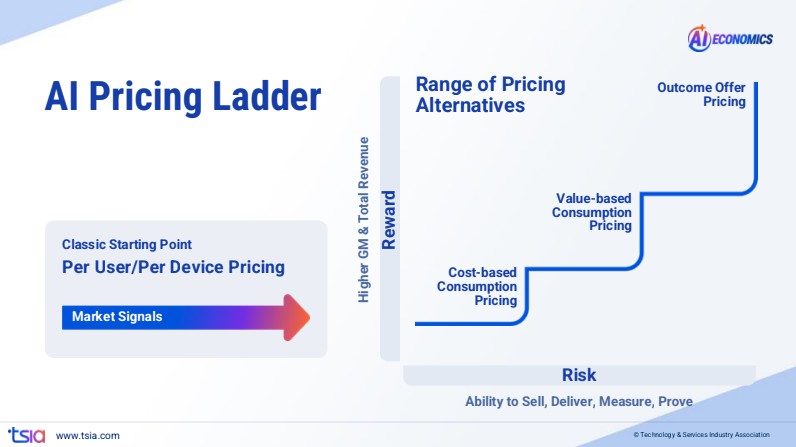
To escape that paradox, you need to climb what TSIA calls the Pricing Ladder:
- Per-seat/per-unit pricing: Simple, familiar, but structurally misaligned with AI.
- Value-based consumption pricing: Pricing higher-value events differently (e.g., “only charge when a ticket is fully resolved”).
- Outcome-based pricing: Pricing around the total value and outcome created, with services and technology tightly bundled.
The problem? You can’t move up that ladder without changing how you deliver value.
Related: The Slow Transition to Value-Based Offer Pricing
The Biggest Lie in Tech: “AI Eliminates Services”
Headlines keep declaring that AI will eliminate services. Boards ask you how many heads you can cut from support. Customers say they no longer want to pay for basic support because “AI should do that.”
There is some truth in that half-sentence. AI will:
- Automate traditional tier1 & 2 support.
- Reduce low-value, repetitive work.
- Make your existing service motions more efficient.
But if you stop there, you’re missing the whole sentence.
The whole story is this:
- AI will absolutely reduce legacy, low-value service functions—and simultaneously create a new generation of services that are essential to making AI work in the enterprise.
- AI is not a “set it and forget it” tool. Models evolve. Data changes. Customer environments shift. When your AI makes decisions and takes actions inside a customer’s business, any failure becomes your problem, not theirs.
That’s why TSIA argues we aren’t approaching the end of services. We are entering the era of services—just not the version your organization grew up with.
Startups vs. Incumbents: The Real Chess Match
On one side of the board, you have AI-native startups who are:
- Built with AI at the core of every workflow.
- Unburdened by legacy org structures and silos.
- Willing to flood accounts with forward-deployed engineers until they deliver a result.
Their weakness? They lack scale, profitable models, and mature service organizations. They can’t run at negative margins forever.
On the other side, you have incumbent providers like you that have:
- Global services scale and partner networks.
- Deep industry knowledge and install bases.
- Longstanding customer relationships and trust.
Your weakness? Inflexible structures, product-centric thinking, and sales motions tied to selling features and old revenue models. It’s easy to underestimate how much you’ll need to change—and how fast.
TSIA’s perspective is blunt: It’s the incumbents’ race to lose.
Palantir is a powerful proof point. It is services-intensive, prices around outcomes, and commands valuation multiples far beyond those of many classic product companies. Their revenue growth and operating margins are the envy of the tech industry. The market is already rewarding vendors that combine AI with high-value, high-margin services that deliver measurable results.
The question is whether you’re willing to retool your services, pricing, organization models, and sales motions to compete in that field.
The New Services That Make AI Profitable
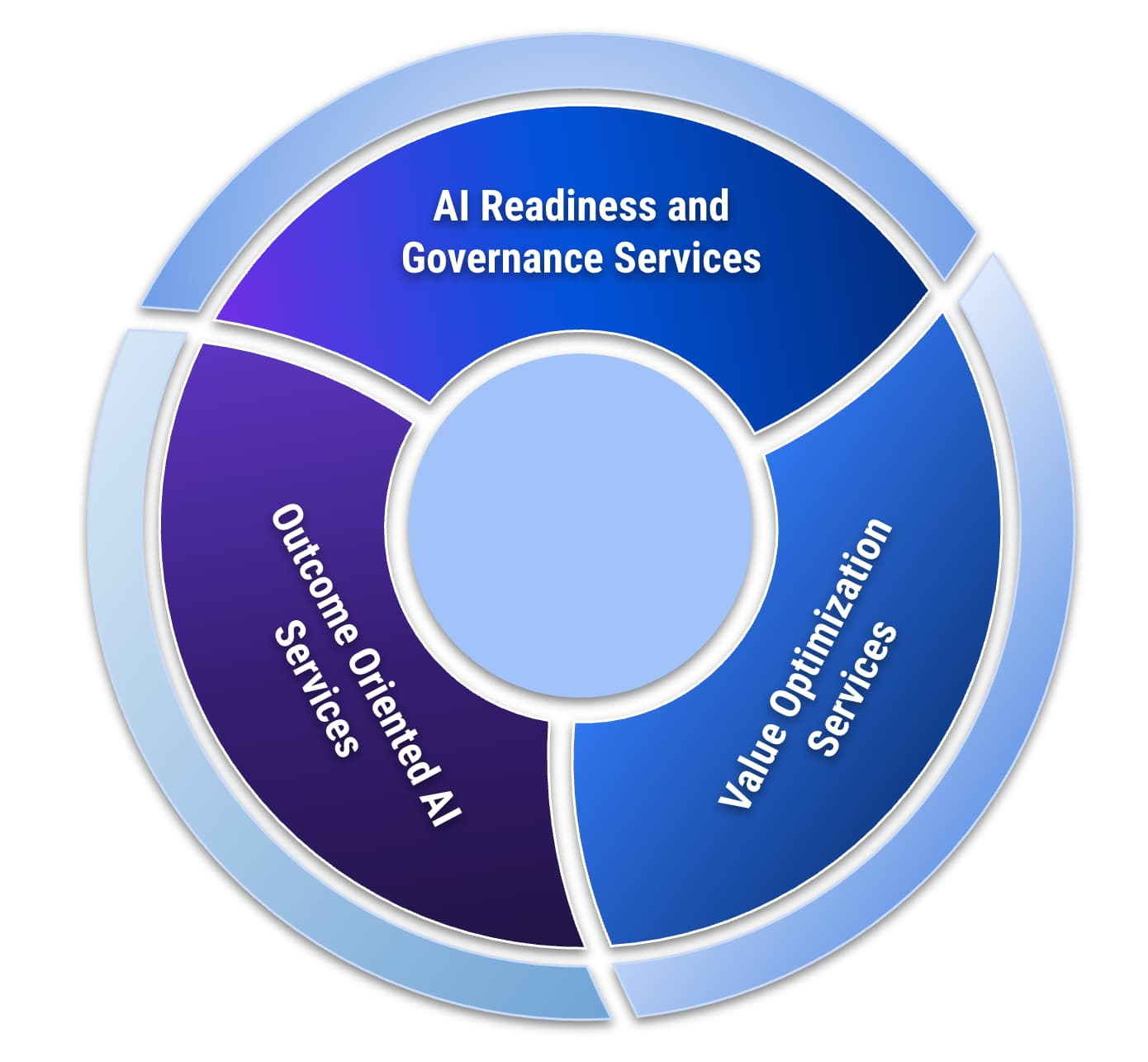
To win in AI Economics, you don’t just need “more services.” You need different services, built to own outcomes rather than just support products. TSIA is defining three critical categories.
1. AI Readiness & Governance Services (ARGS)
Before your customer deploys anything meaningful, you need to answer:
- Is their data ready?
- Are their workflows understood and mapped?
- Do they have guardrails for how AI will operate across the business?
ARGS helps your customers become “AI-ready” by assessing data quality, data integration, data governance, and data risk. It’s where you diagnose what’s possible, what’s dangerous, and where value is likely to appear first.
2. Value Optimization Services (VOS)
Once AI solutions are live, they don’t stay static. Models drift. Data hygiene degrades. New use cases emerge. Business conditions shift.
VOS focuses on:
- Monitoring real-world performance of AI-driven use cases.
- Tuning models and workflows to keep outcomes on track.
- Identifying and prioritizing the next wave of high-impact use cases.
These services create a recurring revenue stream anchored in continuous value realization, not just initial deployment.
3. Outcome-Oriented AI Services (OOAS)
This is where you step fully into outcome-based offers.
OOAS combines technology, advisory services, forward-deployed engineers, and managed services to deliver a defined business result—for example:
- Revenue uplift in a specific line of business.
- Cost reduction in a targeted operational area.
- Risk reduction or quality improvements in regulated processes.
When you can reliably deliver outcomes like these, you can credibly move to outcome-based pricing and capture your share of the value you create.
Where You Start
If you’re an incumbent with an existing services scale, you’re not starting from zero. But you do have to move. Here’s where to focus first.
1. Tell a new story to your board and investors
You will need to shift from product-led to value-led economics. That means explaining why:
- AI stresses your historical pricing.
- Services are central to profitability, not a drag on margin.
- New offers and pricing models will temporarily disrupt your metrics before they strengthen them.
Avoid hiding from this change. Leaders who frame it clearly and confidently will earn more support and patience.
2. Force product and services into the same room
You cannot build AI solutions in a product silo and bolt services on afterward. Start by asking:
- For each AI offer, what outcomes are we promising?
- What ARGS, VOS, and OOAS motions do we need to make those outcomes real?
- How will we price the combined package to reflect the full value—not just usage?
Make this cross-functional team permanent, not a one-time workshop.
3. Build a real value engineering capability
Most “value engineering” teams today are small and focused on slideware. In the AI era, that won’t cut it.
You need a value office that:
- Knows your customers’ industries as well as they do.
- Maps features, data, and services to specific outcomes.
- Provides the analytical backbone for outcome-based pricing and offers.
This isn’t a side project. It’s core to AI Economics.
4. Rethink sales as a design-led, services-first motion
Your future presales motion will look more like a design service than a product pitch.
Forward-deployed engineers, service architects, and value engineers will join early to co-create solutions with the customer.
Top salespeople will see this as an upgrade. Others may resist. Your job is to align compensation, roles, and expectations with a world where selling outcomes—not licenses—is the central act.
Related: Pricing-Led Transformation Under AI Economics™
Why This All Comes Back to Value Realization
Look five years out, and the split is clear:
- Winners will be the vendors your customers trust to design, deploy, and continually optimize AI to drive your business outcomes. They will hold disproportionate wallet share and influence because they own the last mile of value realization.
- Others will be feature vendors fighting on price for commoditized technology, constantly undercut by cheaper models and more innovative competitors.
The North Star that separates those two groups is simple: value realization.
If your offers, services, and pricing are built around proving and sharing in that value, AI becomes a profit engine—not a margin drain.
FAQs
1. What is AI Economics?
AI Economics™ is TSIA’s research-based movement explaining how AI is rewiring value, revenue, and service models across tech. It exposes the paradox where AI creates massive product value while destroying legacy pricing and service models. Companies must redesign how they price, sell, and deliver, or risk losing ground to AI-native disruptors and retooled incumbents.
2. How does AI change tech pricing models?
AI stresses models like per-seat, per-device, and simple consumption pricing because:
- Customers can achieve more with fewer people and fewer machines.
- The value created often far exceeds what usage metrics capture.
- Competing AI providers quickly drive down unit prices.
To stay ahead, you need to move up the Pricing Ladder: from per-seat and basic consumption models toward value-based consumption and outcome-based pricing. This requires stronger value engineering and a richer services wrapper.
3. What should services leaders focus on right now?
If you lead services, your to-do list in the AI era should include:
- Defining your AI Readiness & Governance, Value Optimization, and Outcome-Oriented services.
- Building a stronger partnership with product and sales to take full offers to market.
- Investing in talent that blends consultative skills, technical depth, and industry expertise.
- Creating a clear point of view on how AI-driven services can become a primary profit engine.
You are not just defending your headcount. You are designing the core capabilities that will decide who wins the AI economy.
Smart Tip: Embrace Data-Driven Decision Making
Making smart, informed decisions is more crucial than ever. Leveraging TSIA’s in-depth insights and data-driven frameworks can help you navigate industry shifts confidently. Remember, in a world driven by artificial intelligence and digital transformation, the key to sustained success lies in making strategic decisions informed by reliable data, ensuring your role as a leader in your industry.

.png)