Enterprise software companies have spent decades refining a familiar formula. A vendor sells a license or subscription, then layers services, support, and customer success around the product. The model produced large ecosystems of consultants, solution architects, and support specialists, whose work kept systems running and customers expanding their deployments. Artificial intelligence is now forcing that model to change.
In the TECHtonic podcast episode “AI Economics™, Experts React to What Enterprise Tech Isn’t Saying Out Loud,” TSIA’s Thomas Lah, Executive Director and EVP, J.B. Wood, President & CEO, and George Humphrey, Senior Vice President of Research, examine what AI really means for the economics of enterprise technology companies. Rather than focusing on the technology itself, their conversation centers on the deeper structural changes already unfolding across pricing models, workforce design, and customer value creation.
Their argument is direct: AI is changing how value is produced, how companies price their offerings, and how organizations structure the work surrounding their products. For software companies built around seat licenses and labor-heavy service models, this shift creates both risk and opportunity.
In this blog, we’ll highlight several key takeaways from the discussion to help you understand how AI Economics™ is reshaping the enterprise technology landscape—and why technology providers must rethink pricing, organizational structures, and service delivery to stay competitive. To hear the full conversation and deeper insights from the experts themselves, you can listen to the complete TECHtonic podcast episode in the TSIA Portal.
Key Takeaways
- AI is breaking the traditional enterprise software model: For decades, technology companies relied on seat-based licensing supported by large services, support, and customer success teams. AI automation is reducing the labor required to deploy and maintain systems, forcing companies to rethink how their businesses create and capture value.
- Automation is reducing repetitive work across support and services: AI can resolve common support issues, accelerate implementations, and automate routine operational tasks. As repetitive work moves into AI systems, companies will need fewer people to deliver the same outcomes—reshaping cost structures and workforce roles across the organization.
- Pricing must shift from effort to measurable outcomes: When automation lowers the cost of delivering results, pricing based on hours worked or users licensed becomes harder to sustain. Technology providers will increasingly need to tie revenue to the business outcomes their technology and expertise deliver for customers.
The Old Model: Licensing Upfront, Labor Downstream
For most enterprise technology companies, the operating model followed a familiar structure. Product teams built the software. Sales teams sold licenses, typically priced per user. Once the contract was signed, a second wave of teams stepped in to make the system work for the customer.
That downstream work often involved multiple groups:
- Professional services leading deployments and implementation projects.
- Support teams resolving issues and maintaining system stability.
- Customer success teams monitoring adoption and driving renewals.
Over time, this structure produced large service organizations attached to product companies. Services were essential to deployment and adoption, but they also created an economic tension: they supported product growth without being treated as the primary profit engine, and the more complex the implementation, the more labor the model required.
As Humphrey explained in the discussion, product companies have historically handled some of the most valuable parts of the customer engagement process without directly monetizing them.
“Every product company gives away the consultation and the design.” —George Humphrey, Senior Vice President of Research, TSIA.
In many cases, consulting and solution design happened early in the sales cycle as part of the effort to win the deal. Professional services teams might later monetize implementation work, often tied to the value of the software being deployed. However, the early diagnostic and advisory work, in which companies helped customers define the solution itself, was typically treated as part of the sales process rather than as a billable service.
The result was an uneven economic structure. Product revenue drove margins, while services were expected to support growth without becoming too expensive. At the same time, customers often faced long deployment cycles, large project teams, and complex implementation efforts to bring enterprise systems online.
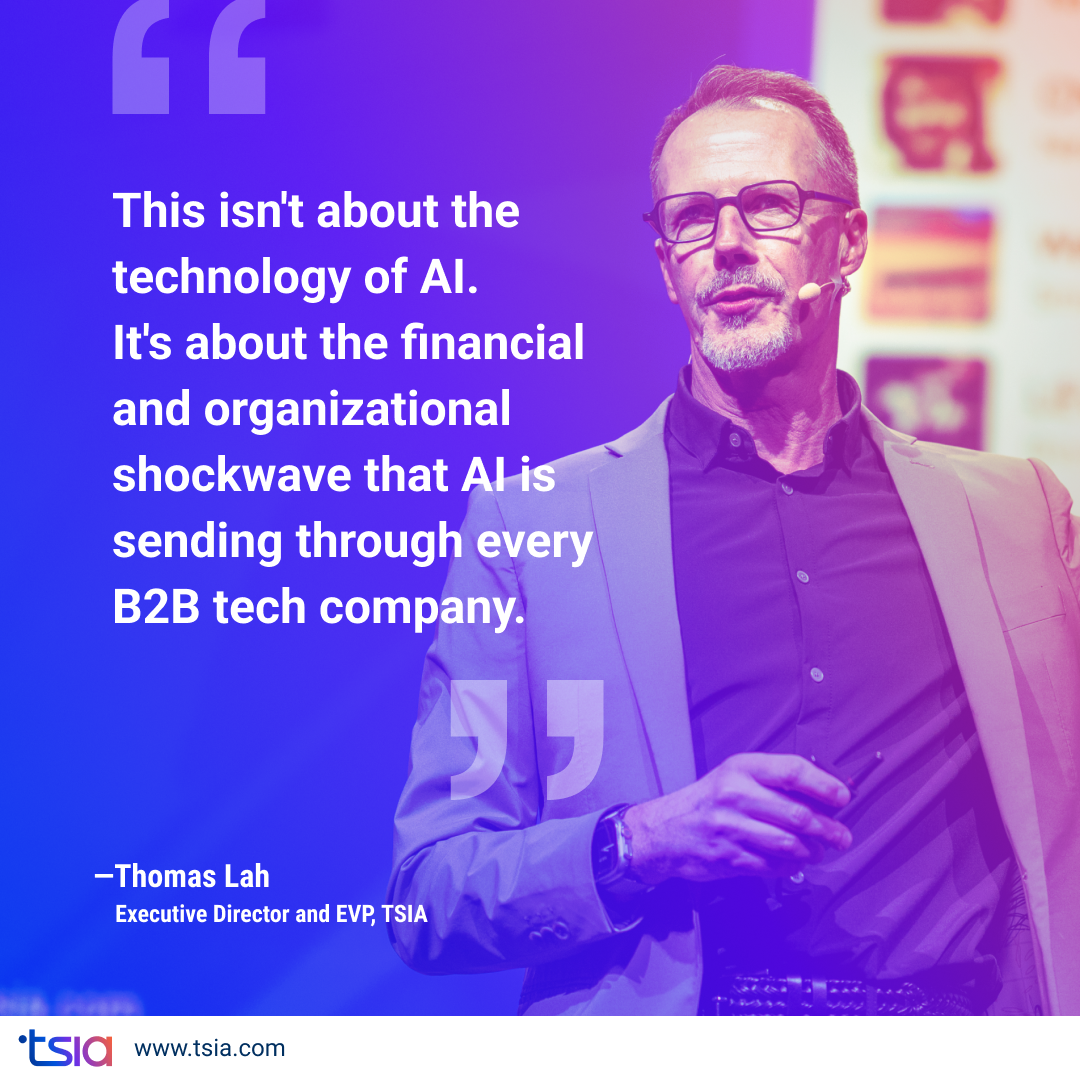
For years, this tradeoff was simply accepted as part of enterprise software. AI is now forcing companies to reconsider whether that structure still makes sense. As Lah says in the episode, “The old rules are collapsing. Per-user pricing is now a liability.”
AI Removes Large Swaths of Repetitive Work
Much of the work performed by support engineers, consultants, and customer success teams revolves around repeatable processes. Diagnosing issues, retrieving knowledge, configuring systems, and guiding users through common tasks often follow established patterns.
AI is well-suited to such tasks. The experts describe this as one of the central economic effects of AI: large amounts of repetitive labor can be automated.
Support Tasks Shrink
Support organizations are among the first to feel the change. AI systems can answer common questions, retrieve relevant documentation, and guide users through troubleshooting steps without human intervention. The technology can monitor systems and detect problems before customers even open a ticket.
The implication for support leaders is significant. Work that once required large teams may shrink dramatically. Companies are already experimenting with these changes. If an AI agent can resolve common issues automatically, the number of people required to manage ticket queues drops.
Yet the experts emphasize that reducing headcount is only part of the story. As J.B. Wood explains, “The question is, what do you do with that money? How do you reinvest that money to get yourself ready for the age of AI?” When organizations remove repetitive work, they must also decide where the savings go. If leaders fail to reinvest those resources into higher-value roles, they risk weakening their ability to help customers realize value from the product.
Fewer People for the Same Outcomes
Taken together, these shifts point to a clear economic outcome: companies can deliver the same result with fewer people. That matters because labor has historically been the largest cost component in service organizations.
When AI reduces the need for repetitive tasks, the cost of delivering value declines. That creates higher margins for companies that adjust their business models accordingly. But it also raises a difficult question: If a product once required large teams to deploy and support, how should companies charge for it when the work becomes largely automated?
Related: The AI Economics™, Experts React to What Enterprise Tech Isn’t Saying Out Loud
The Value Story Shifts From Hours to Outcomes
The experts argue that AI pushes companies away from pricing based on effort.
For decades, service revenue often reflected hours worked. A consulting engagement expanded when a project required more staff or more time. That structure aligned with the labor-intensive nature of traditional deployments. AI weakens that logic.
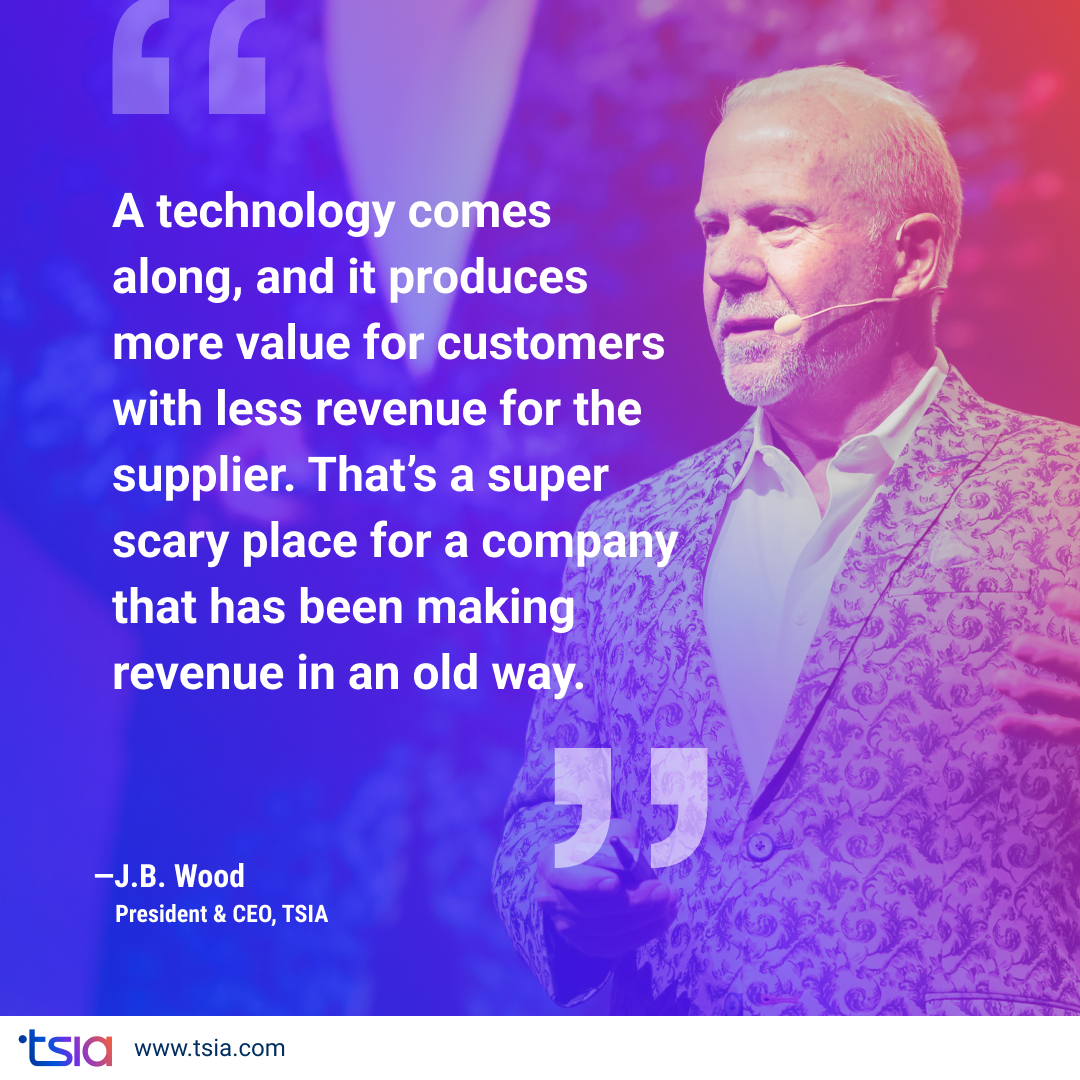
If automation allows a company to deliver results with less effort, customers are unlikely to pay for the same level of labor. Instead, the value conversation shifts toward outcomes. Wood framed the change in terms of value capture. When companies deploy technology that significantly improves customer operations, they will seek to capture part of that value through pricing.
The traditional seat-based licensing model becomes less stable in this environment. If AI tools reduce the number of people required to perform a task, customers may purchase fewer licenses. Wood used the example of large organizations eliminating thousands of roles with automation. A vendor that charges per user could see its license count shrink even as the technology becomes more valuable.
That tension forces vendors to reconsider how they measure and charge for value.
Outcome-based pricing is one possible direction. Rather than charging for the number of users or hours worked, companies may tie revenue to measurable improvements in customer performance.
Some firms are already experimenting with that model. Humphrey pointed to organizations that begin engagements by diagnosing customers' problems and then prescribing solutions to improve specific metrics. In that approach, the value lies not in the software alone but in the combined effect of technology and expertise.
The result is a different commercial relationship. Instead of selling a product and leaving the customer to figure out the rest, the vendor commits to delivering measurable results.
Related: Outcome-Oriented AI Services
Pricing and Packaging Must Catch Up
Shifting toward outcome-based value creates a new set of decisions for software companies. If AI changes both the cost structure and the value delivered to customers, pricing and packaging must evolve to match.
AI Features Do Not Automatically Create Value
AI functionality alone does not guarantee economic value. Companies may release new AI features, but unless those capabilities improve customer performance, the pricing conversation remains difficult.
Wood noted that many firms treat usage-based pricing as a logical next step. Charging based on consumption may help cover the cost of computing resources, but it does not address the deeper question of value creation.
"It's a cost-plus thing," he said, describing models that simply pass infrastructure costs to customers. In his view, that approach fails to link pricing to the results customers achieve. The long-term destination, the speakers argue, will involve models that connect revenue to measurable business impact.
Related: Pricing-Led Transformation: Why AI Forces You To Rethink Pricing First
Services Need Product-Level Discipline
AI also changes how service organizations operate. Historically, consulting engagements often involved custom work. Each project required teams to analyze the customer environment and design a solution from scratch.
That model becomes difficult to sustain when automation can perform many of the same tasks. Service organizations will need to adopt more standardized approaches. Repeatable frameworks, consistent methodologies, and predictable delivery patterns allow companies to scale expertise without scaling headcount at the same rate.
In effect, services begin to resemble product development. Rather than assembling a new team for every engagement, companies develop repeatable motions that can be delivered efficiently across many customers.
The Organizational Impact
The economic changes brought by AI also reshape internal structures. Roles that once dominated technology organizations may shrink, while new responsibilities emerge.
“Today's organizational models that tech companies have been used to for years are unsustainable in the new world.” — George Humphrey, Senior Vice President of Research, TSIA.
Support and Services Shrink in Headcount
One immediate effect is that smaller teams are handling operational work. As AI absorbs repetitive tasks, fewer people are needed to manage support tickets or perform routine implementations. That does not eliminate the need for expertise, but it concentrates that expertise in higher-level roles.
Humphrey described the transition in terms of skills. Customer success managers, for example, will shift from coordinating tasks to analyzing data and advising customers.
Instead of managing adoption checklists, they will need to interpret insights generated by AI systems and recommend next steps.
Customer Success Must Evolve
Customer success organizations face their own transformation. For years, many teams focused on monitoring usage and ensuring customers remained satisfied. In the AI era, those responsibilities expand.
Customer success teams must identify opportunities where automation can unlock new value for the customer. They may coordinate resources across the company to deliver that value. Wood described the potential shift as strategic. Customer success could become a central function for identifying expansion opportunities and guiding customers toward deeper adoption. However, that evolution requires new capabilities and a willingness to redesign existing roles.
The Next Phase of Enterprise Software Economics
AI does not eliminate the need for expertise in enterprise software. What it changes is where that expertise shows up and how companies capture value from it.
Repetitive work that once required large teams—troubleshooting issues, configuring systems, and guiding routine tasks—is steadily being taken over by automated systems. As that happens, human expertise shifts toward higher-value work: diagnosing complex problems, designing solutions, and helping customers translate technology into measurable business outcomes.
For technology companies, that shift reaches far beyond product features. It reshapes cost structures, pricing models, and even organizational design. Support teams become smaller but more specialized. Services organizations adopt repeatable frameworks instead of large custom projects. Customer success evolves from monitoring adoption to guiding customers toward tangible business results.
In other words, AI is not simply another feature layered onto enterprise software. It is redefining the economics of the entire technology services model.
The companies that recognize this shift early will have an advantage. They will redesign pricing around value, restructure organizations around outcomes, and reinvest the productivity gains created by automation. Those that continue operating under the assumptions of the SaaS era may find their traditional revenue models under increasing pressure.
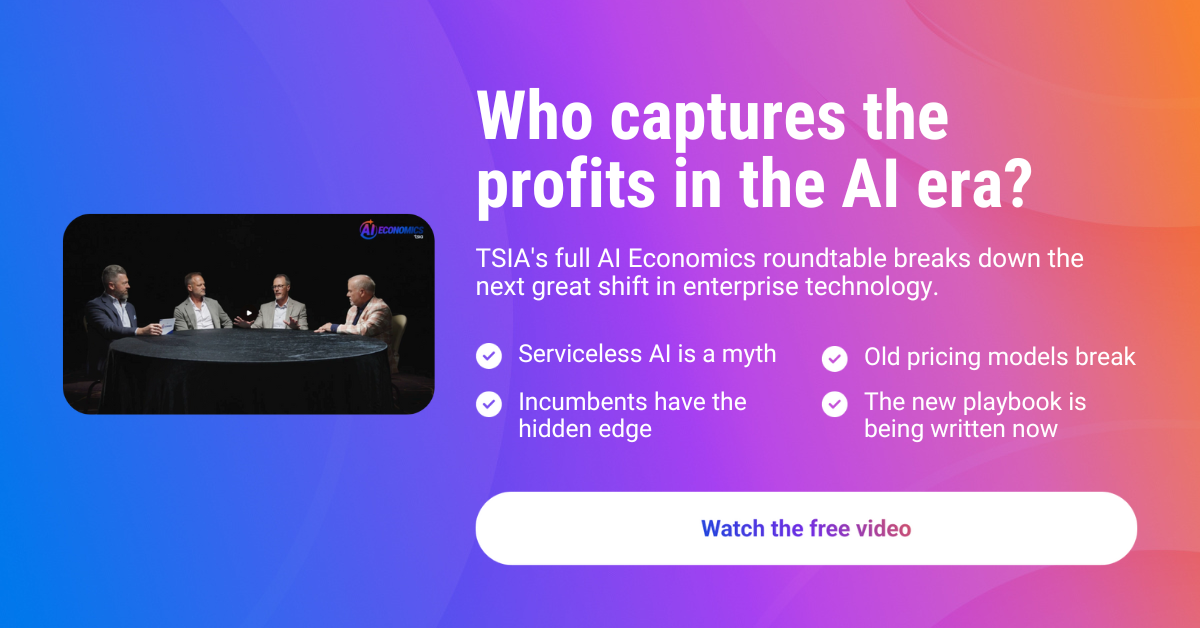
These questions—and the difficult tradeoffs they create for enterprise technology leaders—are explored in depth in the TECHtonic podcast episode “AI Economics™, Experts React to What Enterprise Tech Isn’t Saying Out Loud.”
FAQs
How is AI changing enterprise software and pricing models?
AI is changing how enterprise software companies capture value. Traditional pricing models often relied on user-based licensing or labor-intensive services tied to hours worked. As AI automates repetitive work and allows organizations to achieve results with fewer people, those models become less stable. Many companies are now exploring pricing approaches that align more closely with the outcomes their technology helps customers achieve.
Why is seat-based pricing becoming harder to sustain in the AI era?
Seat-based pricing assumes that more users create more value. AI disrupts this assumption because automation can reduce the number of people required to perform tasks. If a company automates workflows that once required large teams, customers may need fewer licenses even while the technology becomes more valuable. This tension is pushing many vendors to rethink how they measure and price value.
What role will services play in the future of enterprise software?
Services will remain critical, but their structure will change. Instead of relying on large teams performing manual work, service organizations are increasingly adopting repeatable frameworks supported by automation. Human expertise will focus more on diagnosing complex problems, designing solutions, and helping customers achieve measurable business outcomes rather than performing routine implementation or support tasks.
Smart Tip: Embrace Data-Driven Decision Making
Making smart, informed decisions is more crucial than ever. Leveraging TSIA’s in-depth insights and data-driven frameworks can help you navigate industry shifts confidently. Remember, in a world driven by artificial intelligence and digital transformation, the key to sustained success lies in making strategic decisions informed by reliable data, ensuring your role as a leader in your industry.

.png)