

AI is changing the economics of the technology industry faster than most organizations can adapt. And nowhere is that shift more visible than in support. In 2026, support services are no longer operating quietly in the background. You are at the center of the Services Era, where profitability depends on outcomes, not automation alone.
The challenge is that AI is creating a paradox. It makes your products more valuable, more powerful, and more automated while also weakening the pricing models that once funded support and ensured long-term growth.
That is why the State of Support Services 2026 report delivers a clear message: support is no longer a cost center to optimize. It is becoming one of your most strategic engines for monetizing customer outcomes and winning in the AI-driven services economy. This blog breaks down the most prominent themes you need to understand heading into 2026, along with the capabilities support leaders must build now.
Key Takeaways
- AI is deflecting routine work, but escalating complexity. Your teams are handling fewer cases, but the issues they do see require deeper expertise and faster resolution.
- The support business model is under pressure. Embedded “false free” support cannot survive when AI is changing both customer expectations and traditional pricing structures.
- The future of support is outcome-driven and service-intensive. Winning organizations will monetize premium support, strengthen AI readiness, and deliver measurable customer results.
The AI Value Paradox Is Reshaping Support Services
The AI revolution is no longer theoretical. It is actively transforming how technology companies create value, deliver service, and generate profit. In 2025, many organizations accelerated AI adoption. Pilots multiplied. Chatbots improved. Automation expanded. But scaling AI successfully proved far harder than launching it.
This exposed what TSIA calls the AI Value Paradox: AI makes products exponentially more valuable through automation, while also vaporizing the per-user pricing models that have historically ensured profitability. For support organizations, that paradox creates immediate tension.
As AI-powered self-service becomes more effective, customers are submitting fewer basic issues. That sounds like progress, until you realize what remains.
Support professionals are now dealing with:
- More ambiguous, novel, and complex problems.
- Higher expectations for speed and expertise.
- Less human interaction with customers.
- Rapidly evolving delivery models.
You are being pulled into a perfect storm where complexity rises even as traditional funding models break down.
The Support Organization Is Now a Strategic Growth Engine
In the dominant XaaS model, support is often treated as an embedded feature inside a product subscription. It becomes “free” in name, even though it is essential to retention, renewal, and expansion. This creates financial misalignment.
Support is expected to protect recurring revenue, reduce churn, and improve outcomes while operating like a cost center with limited investment. Heading into 2026, the core question is no longer just efficiency. It is survival: How do you monetize support’s value when AI is automating the interactions that once justified your budget?
Winning organizations will stop viewing support as overhead. They will position it as a contractual driver of outcomes and a core pillar of profitable growth.
Related: The Evolution of the Support Services Business Model
The Three Biggest Support Challenges for 2026
TSIA member engagements reveal three persistent themes shaping the support agenda this year.
1. Optimizing the Support Business Model
Your financial model is under strain. When support is embedded as “false free” or “free free,” it becomes difficult to secure funding for:
- Knowledge management.
- AI investments.
- Talent development.
- Premium offer expansion.
Support leaders must evolve from cost containment to value monetization. The future belongs to organizations that can build tiered, outcome-aligned support services that customers are willing to pay for.
2. Scaling Support Operations Beyond AI Pilots
AI adoption is no longer the finish line. Scaling is. Most organizations struggle with the “last mile” of AI transformation:
- Fragmented data.
- Legacy system integration.
- Industry-specific complexity.
- Weak knowledge foundations.
Supporting AI scaling requires more than deploying a chatbot. You need strong operational readiness, including:
- Mature knowledge management.
- Unified search and content governance.
- Install base telemetry and proactive insight.
- Predictive support workflows.
Support organizations must move from “AI base campers” to “AI mountaineers,” with a data strategy that delivers real-world outcomes.
3. Redefining Service Delivery Excellence
Traditional KPIs like response time still matter, but they are no longer enough. In 2026, service excellence is defined by your ability to deliver:
- Proactive service.
- Low-effort customer experiences.
- Outcome-oriented support.
- Faster resolution of complex issues.
That requires structural change. Many organizations are shifting away from rigid, tiered escalation models toward intelligent swarming, in which collaborative teams resolve issues faster and more holistically. It also requires a stronger product-support bridge to ensure frontline insights drive product improvement and reduce long-term case volume.
Related: The AI Last Mile: How AptEdge Is Redefining Enterprise Support
The Strategic Initiatives Support Leaders Are Prioritizing Now
Across TSIA benchmarks and member engagements, several initiatives stand out as urgent investments.
Support organizations are focusing on:
- Evolving support monetization strategies.
- Maturing knowledge management programs.
- Strengthening product-support integration.
- Deploying AI-powered incident routing and agent assist.
- Expanding customer experience measurement through sentiment and effort scoring.
These priorities reflect a broader truth: AI does not eliminate the importance of support. It raises the bar for what support must deliver.
The Three Capabilities You Must Master To Win the Services Era
Support leaders must build capabilities that align directly with TSIA’s AI Economics™ framework.
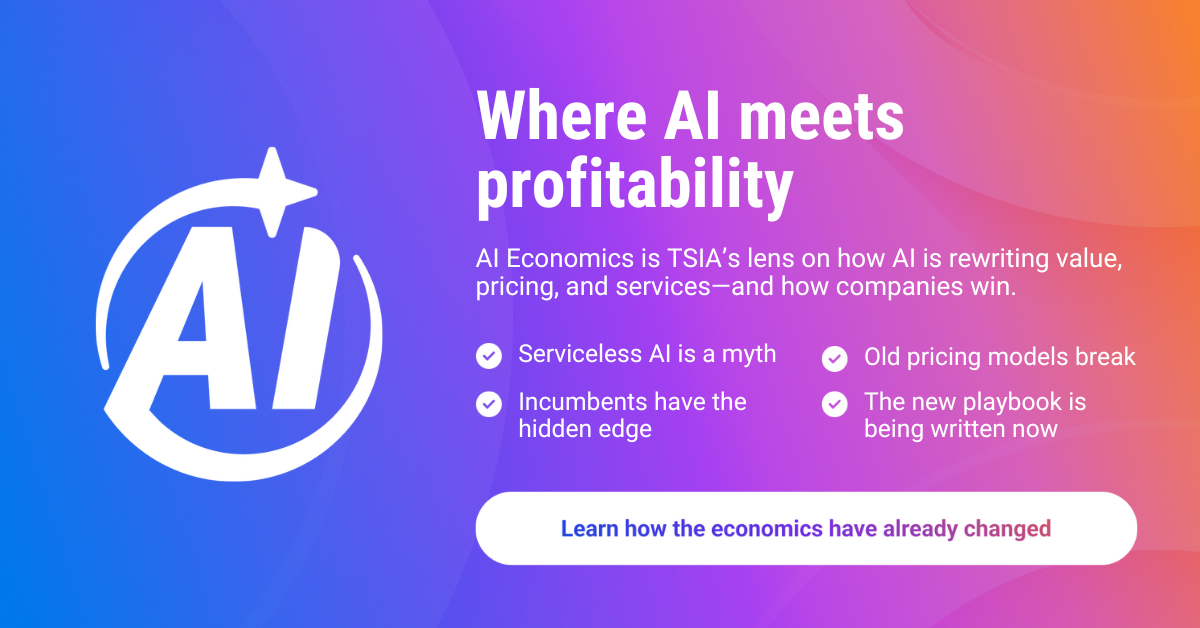
AI Readiness and Governance Services (ARGS)
AI is only as strong as the knowledge and data beneath it. For support, ARGS begins with knowledge management.
A mature knowledge management program provides:
- Structured enterprise expertise.
- Reliable self-service outcomes.
- Clean training data for AI models.
- Consistent customer answers at scale.
Without this foundation, AI initiatives stall quickly.
Model Optimization Services (MOS)
MOS is where AI becomes operational.
Support leaders are using AI to improve efficiency and handle complexity through:
- Complexity prediction and intelligent routing.
- Sentiment analysis to prevent escalations.
- Real-time agent copilots for troubleshooting.
- Automated case summaries and diagnostics.
This is how support scales expertise without overwhelming human teams.
Outcome-Oriented AI Services (OOAS)
This is the highest level of transformation. OOAS means moving beyond automation to deliver measurable outcomes that customers pay for.
Support leaders achieve this by:
- Designing premium bundled offers with outcome-based SLAs.
- Expanding TAM coverage and resolution-focused services.
- Shifting pricing toward value-based models tied to customer impact.
This is how support becomes an engine of growth, not just an operational function.
Related: Three Value Drivers for Three New AI Service Categories
Five Predictions Support Leaders Should Prepare for in 2026
TSIA predicts five major shifts shaping the future of support.
1. Workflows Will Shift to “Prepare-and-Decide.”
AI will provide summaries, context, and recommended actions upfront. Your experts will increasingly validate decisions rather than spend time searching for answers.
2. Actionable AI and Multi-Agent Orchestration Will Rise
Support will move beyond chatbots into coordinated AI agents that execute work across systems. Multiple specialized agents will collaborate to resolve issues faster than humans can manually coordinate.
3. Integration Tax and Agent Spread Will Become Major Risks
AI pilots can create fragmentation unless carefully governed. Support organizations will need architecture review boards to prevent duplicative AI development and rising integration debt.
4. The Total Cost of AI Will Force New Financial Models
Support leaders must evaluate AI consumption costs alongside labor costs. Scaling AI sustainably requires fit-for-purpose infrastructure decisions, not blind expansion.
5. Quality Assurance Will Expand to 100% Coverage
Manual auditing will no longer be sufficient. AI-driven QA agents will review every interaction for accuracy, compliance, and tone, enabling real-time coaching.
Support Is the Front Line of the Services Era
In 2026, support services are at the forefront of AI Economics. You are no longer optimizing a cost center. You are building the service-intensive model required to deliver and monetize outcomes.
Support is where:
- Complexity is felt first.
- Customer trust is earned or lost.
- AI value becomes real.
- Profitability is protected.
The organizations that win will treat support as a strategic advantage, invest in the right capabilities, and move quickly toward outcome-based service models.
FAQs
Why does the State of Support Services 2026 matter for support leaders right now?
The State of Support Services 2026 explains why AI is forcing a fundamental shift in how support organizations operate and deliver value. As routine work is automated and pricing models weaken, support leaders must evolve beyond cost-center economics by building scalable, AI-enabled service models, strengthening knowledge foundations, and monetizing premium, outcome-oriented support offers.
How is AI changing support services in 2026?
AI is deflecting routine issues while increasing the complexity of work agents handle. Support teams must scale AI operations, strengthen knowledge foundations, and adopt new workflows such as intelligent swarming and multi-agent orchestration.
Why is support becoming a growth engine in the AI era?
As traditional pricing models break down, support is becoming essential for delivering measurable customer outcomes, protecting recurring revenue, and creating premium service offers that customers are willing to pay for.
Smart Tip: Embrace Data-Driven Decision Making
Making smart, informed decisions is more crucial than ever. Leveraging TSIA’s in-depth insights and data-driven frameworks can help you navigate industry shifts confidently. Remember, in a world driven by artificial intelligence and digital transformation, the key to sustained success lies in making strategic decisions informed by reliable data, ensuring your role as a leader in your industry.