If you're still thinking about AI as something you add to your managed services portfolio, you're already behind. The shift happening right now isn’t incremental—it’s foundational. AI is no longer just a tool inside your operations. It’s becoming the engine that powers how you design offers, deliver services, and grow revenue.
That’s why the conversation around AI managed services is quickly evolving. It’s no longer about layering AI onto existing models. It’s about rebuilding your entire operating model around it. In this blog, you’ll learn what AI managed services really mean, how the model is changing, and what you need to do now to stay competitive.
Key Takeaways
- AI managed services are redefining the MSP model—you’re moving from service-led delivery to AI-first operations powered by data.
- Your biggest asset is no longer your service catalog—it’s your operational data, which fuels predictive and autonomous capabilities.
- The winners in this space won’t adopt AI—they’ll re-architect their business around it, creating a self-reinforcing cycle of intelligence and growth.
What Are AI Managed Services?
At a high level, AI managed services are offerings powered, enhanced, and increasingly driven by artificial intelligence. But that definition doesn’t go far enough. What you’re really seeing is a shift from human-led, standardized services to AI-driven, dynamic, and predictive service models.
Traditional managed services focused on wrapping products with services and delivering outcomes through structured processes. That model worked, and still does, but it was designed for a world where humans were the primary operators. AI changes that.
Now, you can:
- Automate large portions of delivery.
- Predict customer needs before they arise.
- Continuously optimize service performance.
- Personalize offerings at scale.
The result? Managed services become smarter, faster, and more scalable, but only if your operating model supports it.
Why MSPs Must Build a Service-Led Foundation to Reach AI-First Success
For years, the most successful MSPs followed a clear playbook:
- Standardize your service portfolio.
- Build specialized sales teams.
- Optimize delivery for efficiency and margin.
This model was built on a clear, structured foundation.
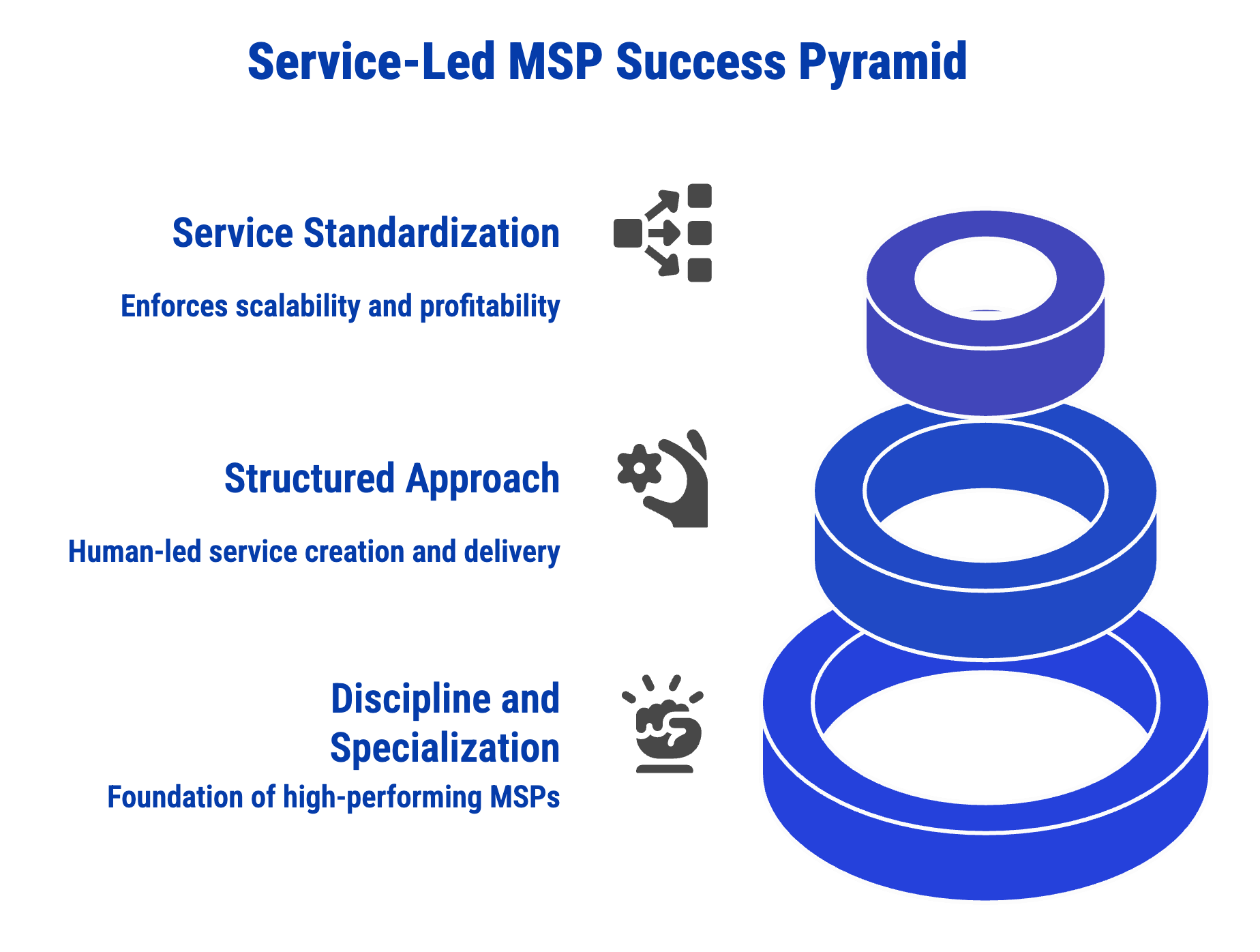
This “service-led” model drove real results. It improved deal velocity, scalability, and profitability. But here’s the problem: That model was built to optimize human-led processes. AI doesn’t just improve those processes—it changes the rules entirely.
The same strengths that made service-led models effective, standardization and specialization, now limit your ability to:
- Adapt in real time.
- Personalize at scale.
- Leverage continuous data feedback loops.
In other words, the model that got you here won’t get you where you need to go next.
Related: Why MSPs Must Build a Service-Led Foundation to Reach AI-First Success
The Shift to AI-First Managed Services
The real transformation isn’t about adding AI tools. It’s about becoming AI-first.
In an AI-first managed services model:
- AI becomes the core operational engine.
- Services become the output of that engine.
- Data becomes the fuel that powers everything.
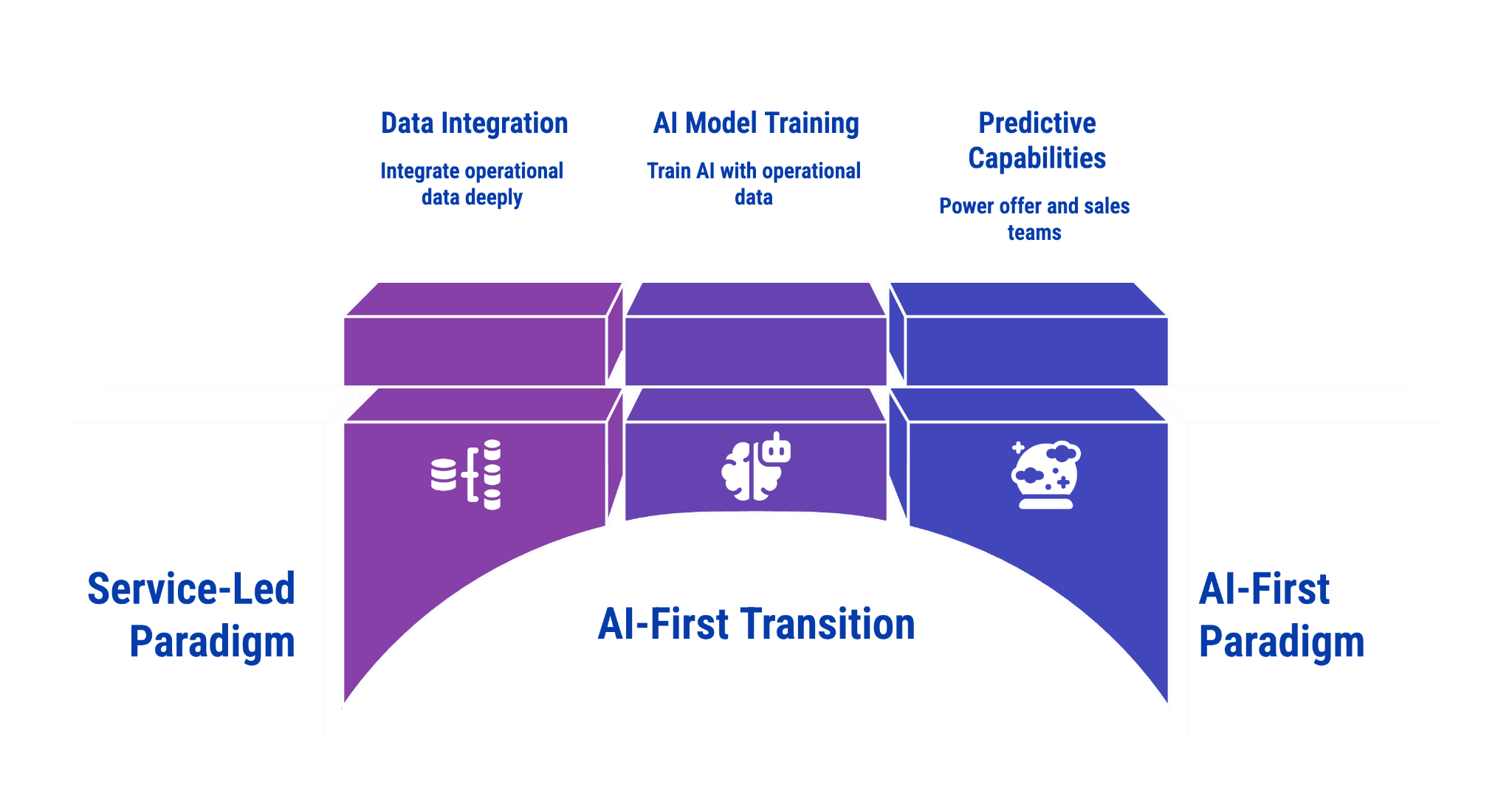
This creates a powerful, self-reinforcing system. This shift isn’t just about adopting new tools—it’s about creating a continuous loop where data fuels intelligence, and intelligence drives better outcomes across your business.
How the AI-First Model Works
At the center of this model is a data-to-intelligence loop:
- Your delivery and customer interactions generate high-value data.
- That data trains your AI models.
- Those models improve how you sell, deliver, and manage services.
- Which generates even better data.
And the cycle continues. This is the shift from static service delivery to continuous intelligence-driven optimization.
Related: Guiding MSPs Through AI-First Transformation
How AI Transforms Each Core Function
To fully understand AI managed services, you need to see how AI reshapes every part of your business.
Offer: From Static to Dynamic
Traditional:
- Fixed service catalogs.
- Manual market analysis.
AI-First:
- AI-generated value propositions.
- Dynamic pricing and packaging.
- Continuous market adaptation.
This allows you to respond faster to market demand and improve margins.
Sales: From Reactive to Predictive
Traditional:
- Relationship-based selling.
- Reactive upsell and expansion.
AI-First:
- Predictive churn and expansion insights.
- AI-assisted selling.
- Data-driven revenue strategies.
You’re no longer guessing where growth will come from—you’re predicting it.
Delivery: From Reactive to Autonomous
Traditional:
- SLA-driven delivery.
- Reactive incident management.
AI-First:
- AIOps-driven automation.
- Self-healing systems.
- Proactive issue resolution.
One real-world example showed an 85% reduction in ITSM incident volume after implementing AIOps. That’s not just efficiency—it’s a complete operational shift.
Client Management: From Lagging to Predictive
Traditional:
- Manual engagement.
- Lagging health scores.
AI-First:
- Predictive customer health.
- AI-driven journey orchestration.
- Proactive retention strategies.
This turns customer success into a science, not a guessing game.
The Role of Data in AI Managed Services
If there’s one thing you should take away, it’s this: Your data is your competitive advantage.
In AI managed services, data is what:
- Trains your models.
- Drives your insights.
- Powers your automation.
- Enables personalization.
The challenge? Most organizations aren’t ready.
Data is often:
- Siloed across systems.
- Inconsistent or incomplete.
- Not structured for AI use.
That’s why your priority isn’t deploying AI, it’s fixing your data foundation.
How to Start Your Transition to AI-First
You don’t need to transform overnight, but you do need to start intentionally.
Step 1: Build a Unified Data Foundation
Bring together:
- Operational data.
- Customer data.
- Delivery data.
Into a single, usable model. Without this, AI won’t scale.
Step 2: Establish AI Governance
AI introduces new risks:
- Data privacy concerns.
- Model bias.
- Security vulnerabilities.
You need clear governance, often by expanding existing operational oversight functions, to ensure responsible use of AI.
Step 3: Invest in AIOps and Automation
Start where the impact is highest:
- Incident management.
- Service delivery workflows.
- Monitoring and optimization.
This is where you’ll see immediate ROI.
Step 4: Rethink Your Commercial Model
AI doesn’t just change delivery—it changes how you monetize.
You should be exploring:
- Usage-based models.
- Outcome-based pricing.
- Dynamic pricing strategies.
This is where AI managed services tie directly into pricing-led transformation.
Related: The State of Managed Services 2026
What the Future of AI Managed Services Looks Like
Looking ahead, the end state is clear:
- Autonomous service operations that self-heal and optimize.
- Generative AI-powered sales and offers that adapt in real time.
- Predictive customer success models that drive retention and expansion.
- A fully integrated system where data, AI, and services continuously reinforce each other.
To make this shift more concrete, here’s how the journey to an AI-first managed services model typically unfolds:
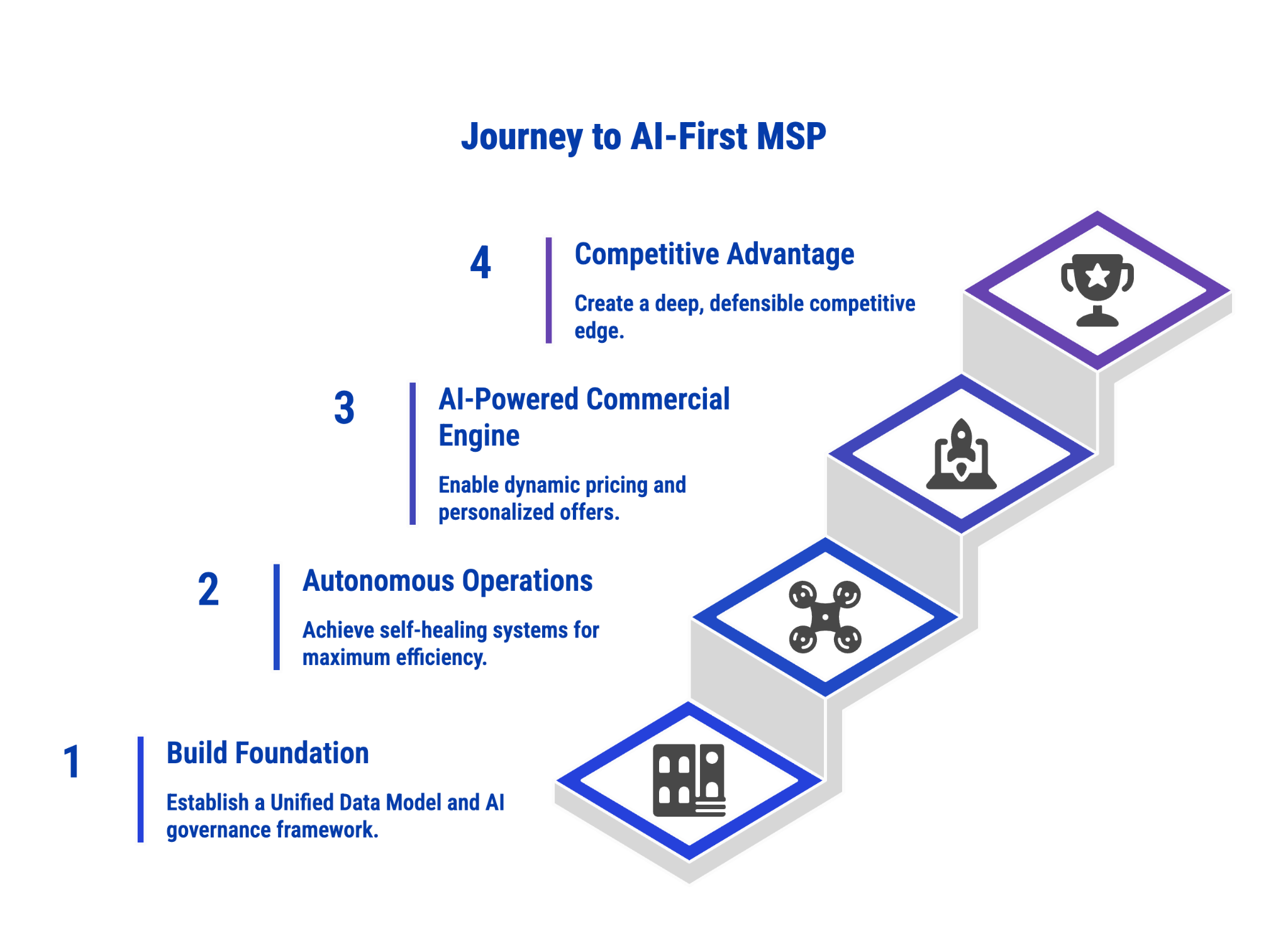
This isn’t just evolution, it’s a complete redefinition of how managed services operate. And once you reach this state, the advantage is hard to replicate. AI managed services aren’t about doing what you already do, just faster.
They require you to rethink:
- How you operate.
- How you deliver value.
- How you generate revenue.
The organizations that win won’t be the ones that experiment with AI on the edges. They’ll be the ones who rebuild their business around it.
FAQ
1. What are AI managed services?
AI managed services are service offerings powered by artificial intelligence that enable automation, predictive insights, and continuous optimization across service delivery, sales, and customer management.
2. How are AI managed services different from traditional managed services?
Traditional managed services rely on standardized, human-led processes. AI managed services use data and AI to automate operations, predict outcomes, and dynamically adapt services in real time.
3. Where should you start with AI managed services?
Start with your data foundation. From there, focus on AIOps, automation, and governance before expanding into predictive sales, dynamic offers, and AI-driven customer success.
Smart Tip: Embrace Data-Driven Decision Making
Making smart, informed decisions is more crucial than ever. Leveraging TSIA’s in-depth insights and data-driven frameworks can help you navigate industry shifts confidently. Remember, in a world driven by artificial intelligence and digital transformation, the key to sustained success lies in making strategic decisions informed by reliable data, ensuring your role as a leader in your industry.