


If you work in managed services today, you can feel the shift happening under your feet. AI is no longer something you “add” to your services portfolio. It’s becoming the operational and commercial core of how value is delivered and how revenue is captured. That change is forcing managed services organizations to rethink everything from pricing models to delivery structures to how success is measured.
The reality is uncomfortable but straightforward: market share in 2026 will be won or lost on how effectively you operationalize AI, not on whether you have AI tools or have run pilots. But whether you can run, govern, price, and continuously improve AI-driven services at scale.
This is the heart of AI Economics™. And it’s why managed services are no longer a support function—they are becoming the primary engine of profitable growth.
Key Takeaways
- AI creates ongoing operational responsibility, not one-time projects. Managed services are essential for owning the full AI lifecycle.
- Traditional pricing models break in the AI era. You must move beyond user-based and cost-plus pricing to align revenue with outcomes.
- Data, governance, and autonomous operations separate leaders from laggards. Without these foundations, the value of AI erodes over time.
Why AI Economics Is Rewriting Managed Services
For years, managed services followed a familiar formula: human expertise delivered at scale, priced around effort, users, or fixed contracts. That model worked—until AI fundamentally changed the economics.
Today, AI is shifting managed services from human-led execution to an AI-first operating model. In this new paradigm, AI doesn’t just assist your teams—it becomes the system through which services are delivered, monitored, and optimized.
This matters because AI changes how value is created:
- AI improves efficiency, often reducing manual effort.
- AI systems require constant tuning, governance, and monitoring.
- AI outcomes depend heavily on data quality, integration, and operational discipline.
If you don’t evolve your service model, you risk falling into a dangerous trap: delivering more value while capturing less revenue.
The “Last Mile” Problem Didn’t Disappear—It Expanded
Early AI adoption was dominated by product-led experimentation. Teams tested models, ran proofs of concept, and explored use cases. The technology worked—but scaling it inside real businesses proved far harder.
This gap between what AI can do and what it actually delivers is often referred to as the last mile of implementation. It includes challenges like:
- Poor or fragmented data.
- Legacy systems that don’t integrate cleanly.
- Inconsistent workflows and processes.
- Lack of operational ownership.
Professional and managed services stepped in to bridge this gap. But as organizations move into production, a new challenge emerges: AI doesn’t stop needing attention after deployment.
The Rise of AI Operational Debt
Once AI systems are live, they introduce a permanent layer of operational complexity as models drift, data pipelines break, security risks evolve, and regulatory expectations change. This creates what many organizations are now experiencing firsthand: AI Operational Debt.
Unlike traditional technical debt, this isn’t something you clean up once and move on from. AI operational debt is ongoing and erodes ROI if not actively managed.
That’s why 2026 marks a turning point. One-off projects are no longer sufficient. You need a managed AI services model where your organization assumes ongoing responsibility for:
- Model performance and accuracy.
- Data integrity and governance.
- Security and compliance.
- Continuous optimization and uptime.
This is where managed services shift from helpful to indispensable.
Related: Why Advanced Services Are Defining the Next Era of AI
The Three Biggest Challenges Facing Managed Services in 2026
1. Pricing Model Paralysis and the Profit Paradox
AI often makes customers more efficient. But if your pricing is tied to users, hours, or static contracts, that efficiency can shrink your revenue. This creates the profit paradox: the more value your AI delivers, the less you earn.
Many organizations struggle to break free from familiar pricing structures. Cost-plus and per-user models feel safe, even when they no longer reflect how value is created. Until pricing evolves, AI success can actually undermine profitability.
2. Defining and Proving ROI for AI Is a Strategy Problem, Not a Technology Problem
One of the biggest reasons AI initiatives stall or quietly fade away is not that the technology fails. It’s because organizations never align use cases, strategy, and measurement in a way that sustains investment. In managed services, this manifests as confusion about ROI. Teams experiment with AI, see early promise, but struggle to answer a simple question: What business value is this actually delivering?
In practice, most organizations fall into one of four patterns, depending on how clearly they define AI use cases and how rigorously they measure outcomes.
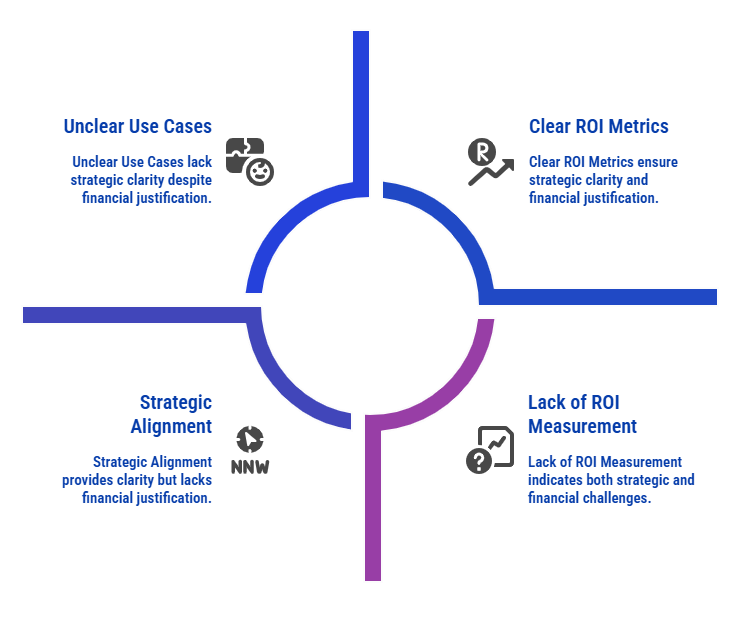
- Unclear Use Cases: AI investments exist, but without strategic clarity. Teams struggle to explain why the AI matters, even if funding has been approved.
- Strategic Alignment: Leadership understands the role AI should play, but financial justification is weak or missing, making long-term investment fragile.
- Lack of ROI Measurement: AI is deployed and operational, yet outcomes are not tracked. Value erodes quietly as AI becomes “just another cost.”
- Clear ROI Metrics: AI initiatives are directly tied to measurable business impact, providing the confidence to scale, optimize, and reinvest.
The critical insight is this: only one of these quadrants supports sustainable AI Economics. Without clear ROI metrics, even strategically aligned AI programs eventually stall under budget pressure.
This is where managed services become essential. By owning ongoing measurement, not just deployment, you shift AI from experimentation to accountability. ROI is no longer assumed or anecdotal. It’s defined, tracked, and improved over time, creating a feedback loop that protects margin and reinforces value.
In the AI era, proving ROI isn’t a one-time exercise. It’s a continuous, operational capability, and one that managed services are uniquely positioned to deliver.
3. Integration and Talent Gaps
AI adoption also exposes deep organizational and technical gaps. Many managed services organizations struggle with:
- Fragmented data spread across systems.
- Legacy platforms that resist integration.
- Shortages of skilled AI talent.
- Disconnected teams operating in silos.
Without a unified data model and modern workflows, AI initiatives stall. Integration challenges and talent constraints don’t just slow transformation—they compound operational debt.
Related: Reshaping Managed Services
The Capabilities High-Performing MSPs Are Building Now
Despite these challenges, leading organizations are making measurable progress by focusing on three core capabilities.
- Building the AI Data Foundation and Governance
Your journey to becoming an AI-first organization starts with data. Successful organizations prioritize:
- A unified data model that connects operational, customer, and financial data.
- Clear data ownership and accountability.
- Formal AI governance frameworks to ensure responsible use.
When data is integrated and governed, AI becomes reliable and scalable. Organizations that invest here are better positioned to expand revenue and protect margins over time. Without this foundation, every AI initiative becomes more complex and riskier than it needs to be.
- Moving Toward Autonomous Operations
The next step is to reduce manual intervention through automation. Technologies like AIOps and robotic process automation help shift managed services from reactive firefighting to proactive, self-healing operations. This allows you to:
- Reduce incident volume.
- Improve uptime and reliability.
- Free specialized staff to focus on innovation and higher-value work.
Autonomous operations don’t eliminate people—they amplify them by removing low-value friction from daily workflows.
- Mastering Outcome-Based Value Delivery
As AI matures, the market is shifting from selling access to tools to guaranteeing outcomes. This requires new service capabilities, including:
- Outcome definition and measurement.
- Adoption and enablement support.
- Continuous optimization tied to business KPIs.
When you can measure and predict outcomes, like renewal likelihood or service health, you transform services into a strategic growth lever, not just an operational function.
Reinventing Pricing for the AI Era
To escape pricing paralysis, most organizations won’t jump straight to outcome-based contracts. Instead, they are adopting hybrid pricing models that combine:
- Subscription elements for stability.
- Consumption-based components for flexibility.
- Outcome-based upsells aligned to business value.
This approach bridges today’s contracts with tomorrow’s value-based models. Equally important is how services are packaged and named. Moving away from generic tiers toward value-driven offers helps customers understand what they are actually buying, and why it matters.
Related: Pricing-Led Transformation Under AI Economics™
The AI-First Transformation Path
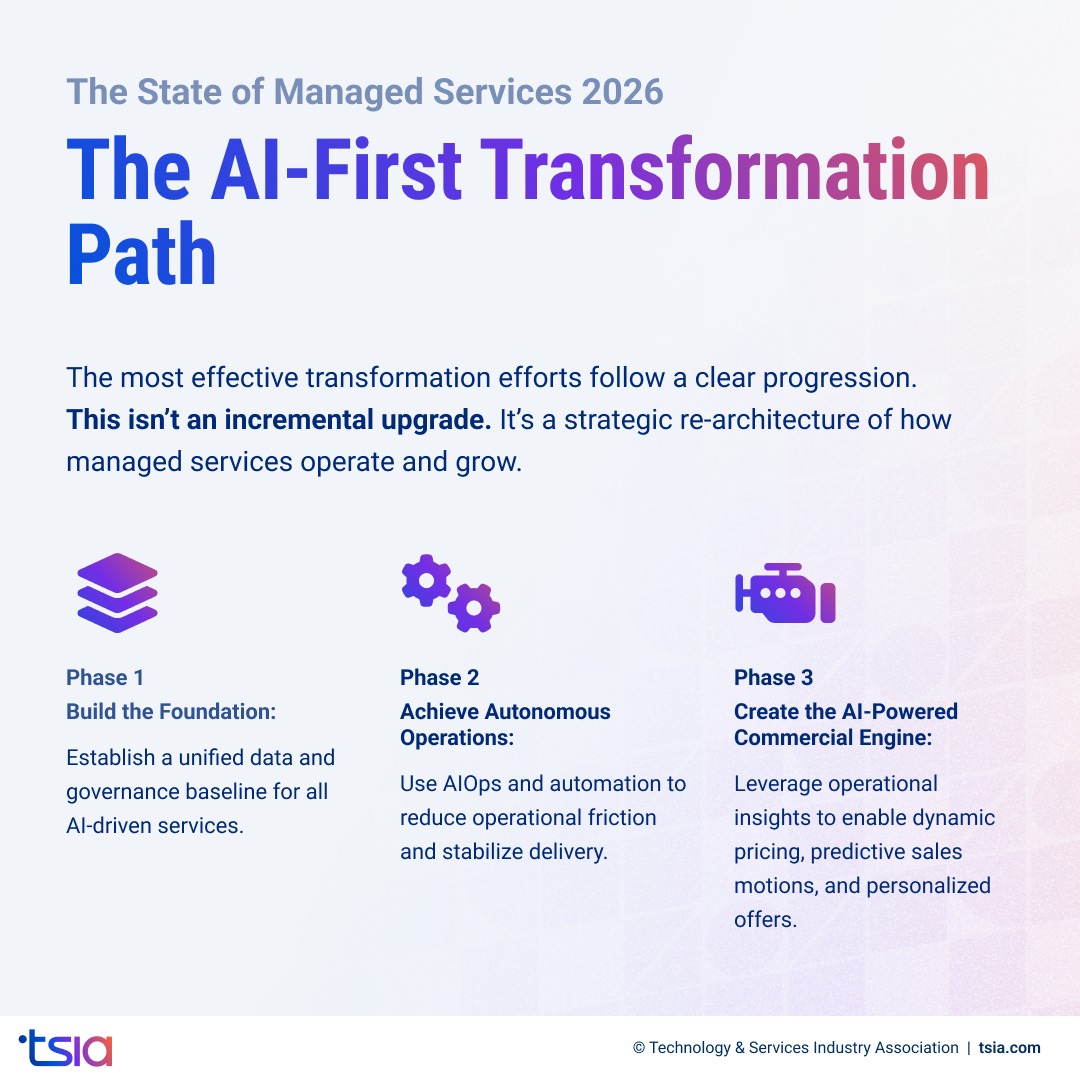
The most effective transformation efforts follow a clear progression:
- Phase 1: Build the Foundation: Establish a unified data and governance baseline for all AI-driven services.
- Phase 2: Achieve Autonomous Operations: Use AIOps and automation to reduce operational friction and stabilize delivery.
- Phase 3: Create the AI-Powered Commercial Engine: Leverage operational insights to enable dynamic pricing, predictive sales motions, and personalized offers.
This isn’t an incremental upgrade. It’s a strategic re-architecture of how managed services operate and grow.
Why Managed Services Define the Future of AI Economics™
AI Economics is forcing a reset across the technology industry. Traditional delivery and monetization models can’t survive unchanged. In this new era, services are no longer a cost center or a support layer. They are the mechanism through which AI delivers and captures value.
If you want durable growth in 2026 and beyond, your managed services organization must evolve into an AI-first engine built on data, autonomy, and outcomes. The companies that succeed won’t just use AI. They’ll operationalize it.
Frequently Asked Questions
What is AI Operational Debt?
AI Operational Debt refers to the ongoing maintenance burden created by AI systems, including model drift, data issues, security risks, and governance requirements that erode ROI if left unmanaged.
Why do traditional pricing models fail in the AI era?
User-based and cost-plus pricing disconnect revenue from value. As AI improves efficiency, these models can reduce revenue even as outcomes improve.
What is a managed AI services model?
A managed AI services model involves taking full lifecycle ownership of AI systems from deployment through continuous operation, optimization, and governance rather than treating AI as a one-time project.
Smart Tip: Embrace Data-Driven Decision Making
Making smart, informed decisions is more crucial than ever. Leveraging TSIA’s in-depth insights and data-driven frameworks can help you navigate industry shifts confidently. Remember, in a world driven by artificial intelligence and digital transformation, the key to sustained success lies in making strategic decisions informed by reliable data, ensuring your role as a leader in your industry.

.png)