If you’re building, selling, or scaling AI-powered solutions, your pricing strategy is no longer a packaging decision—it’s a business model decision. Traditional pricing models, especially per-user or seat-based approaches, are quickly breaking down in an AI-driven world. Why? Because AI changes how value is created. The more efficient your product becomes, the fewer users there may be to charge.
That puts you in a difficult position: your product is delivering more value, but your pricing model may capture less revenue. This is why understanding modern AI pricing models is critical. Whether you’re exploring usage-based pricing, outcome-based models, or hybrid approaches, your choice will directly shape your margins, customer relationships, and long-term growth.
Let’s break down what these models actually mean and how you should think about them.
Key Takeaways
- AI breaks traditional pricing models. As AI drives efficiency, per-user pricing collapses, forcing you to rethink how you monetize value.
- Usage-based pricing offers flexibility, but not profitability on its own. It introduces revenue volatility and often fails to reflect true business value.
- Outcome-based pricing is where the market is heading. It aligns revenue directly with customer results, unlocking higher margins and stronger differentiation.
Why AI Pricing Models Are Fundamentally Different
AI doesn’t behave like traditional software, and that’s the root of the pricing challenge. In a traditional SaaS model, you charge based on access: seats, licenses, or subscriptions.
But AI changes the equation:
- It automates work, reducing the number of users.
- It creates value through outcomes, not usage.
- It introduces variable and often unpredictable costs.
That means pricing based on access or activity alone will miss the mark. Instead, your pricing model needs to answer a different question: How do you capture the value your AI actually delivers? This is where modern AI pricing models come into play.
While AI is pushing the industry toward value- and outcome-based pricing, most companies haven’t made the shift yet.
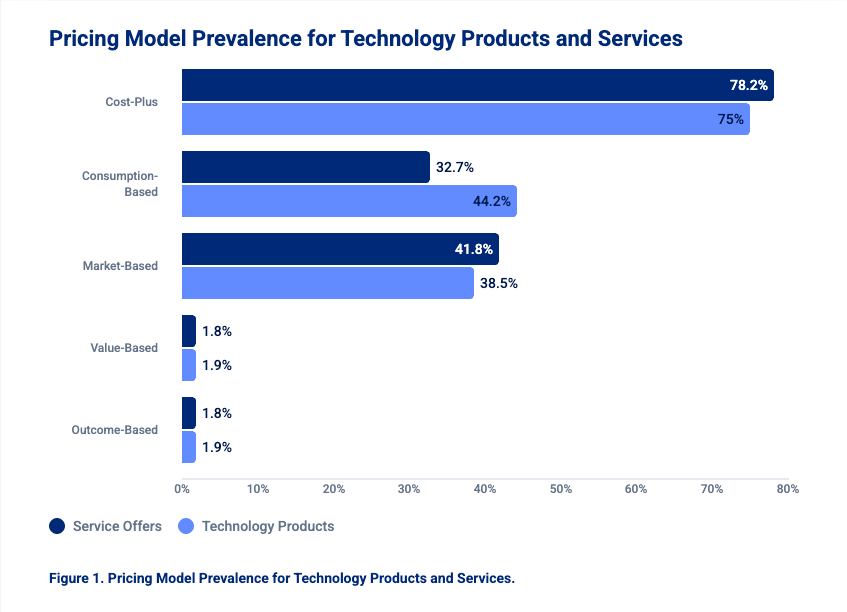
As you can see, traditional models like cost-plus and market-based pricing still dominate, while value-based and outcome-based models remain a small minority. This gap highlights both a critical opportunity and a significant risk. Companies that don’t evolve their pricing strategy may struggle to capture the full value of their AI investments.
Related: AI Pricing Models Supercharge the Drive to Value Realization
Usage-Based Pricing: Flexibility With Trade-Offs
Usage-based pricing is one of the most common approaches you’ll see in AI today. At its core, it’s simple: customers pay for what they consume. That could mean API calls, tokens, compute usage, or requests.
Why it works:
- Gives customers high control over their spend.
- Aligns cost with actual usage.
- Scales naturally as adoption grows.
Here’s the problem: usage doesn’t equal value.
AI introduces several challenges that make pure consumption models risky:
- Revenue unpredictability: Your revenue fluctuates based on usage patterns, making forecasting difficult.
- Cost misalignment: AI workloads can spike unpredictably, creating margin pressure.
- Value disconnect: Customers care about outcomes, not how many tokens they used.
- Efficiency penalty: As customers optimize usage, your revenue can decline even while value increases.
This creates a paradox: the better your product performs, the less you may earn. That’s why usage-based pricing alone is rarely enough.
Outcome-Based Pricing: Aligning Revenue With Value
Outcome-based pricing flips the model entirely. Instead of charging for usage or access, you charge based on a measurable business result.
That could look like:
- Increased revenue.
- Reduced costs.
- Improved productivity.
- Lower risk (like fraud reduction).
Why this model is gaining momentum
Outcome-based pricing solves the biggest challenge in AI monetization: value alignment.
- You get paid for results, not activity.
- Customers take on less risk.
- Your incentives are fully aligned with customer success.
This is why many organizations are moving in this direction. As AI becomes more embedded in business processes, executives care less about inputs and more about outcomes.
The upside:
- Higher margins.
- Stronger differentiation.
- Deeper customer relationships.
The challenge: It’s not easy to execute.
Outcome-based pricing requires:
- Clear measurement of business impact.
- Strong service capabilities to drive outcomes.
- Deep customer partnerships.
But if you can deliver on it, it becomes a powerful competitive advantage.
Hybrid Pricing Models: The Bridge Between Today and Tomorrow
Most companies won’t jump straight to outcome-based pricing, and that’s where hybrid models come in.
A hybrid pricing model combines:
- A fixed base fee (subscription or platform access).
- A variable component (usage, credits, or performance-based metrics).
Why hybrid models are so effective
They strike a balance between:
- Predictability (for both you and your customer).
- Flexibility (to scale with usage).
- Value alignment (through variable components).
This makes them a practical stepping stone as you evolve your pricing strategy.
In many cases, hybrid models allow you to:
- Protect baseline revenue.
- Introduce value-based elements gradually.
- Reduce risk while experimenting with new pricing structures.
The Shift Toward Value-Based Consumption
There’s a growing middle ground between usage-based and outcome-based pricing: value-based consumption. This approach still uses consumption as a pricing mechanism, but ties it more directly to value.
Instead of pricing all usage equally, you:
- Charge more for high-value capabilities.
- Differentiate pricing based on business impact.
- Align consumption with customer outcomes.
This allows you to move beyond “pay for what you use” toward “pay for what delivers value.”
Related: Consumption Economics in the Era of AI
Choosing the Right AI Pricing Model for Your Business
Here’s where things get real: there is no one-size-fits-all answer. Your pricing model needs to align with your broader business strategy.
When evaluating AI pricing models, ask yourself:
1. What drives value for your customers?
Is value tied to:
- Usage?
- Efficiency gains?
- Business outcomes?
Your pricing should reflect that.
2. Can you measure outcomes?
Outcome-based pricing only works if you can:
- Define success clearly.
- Measure it reliably.
- Prove it consistently.
If you can’t, a hybrid approach may be a better starting point.
3. What is your cost structure?
AI introduces new costs:
- Compute and inference.
- Model training and optimization.
- Ongoing orchestration.
Your pricing model must cover these costs—or you risk margin compression.
4. How do your customers want to buy?
Enterprise buyers often prefer:
- Predictable pricing.
- Clear ROI.
- Reduced financial risk.
That’s one reason outcome-based and hybrid models are gaining traction.
Pricing Is Now a Strategic Lever
Here’s the bigger shift you need to understand: pricing is no longer just about monetization. It’s about transformation.
Your pricing model will directly impact:
- Your gross margins.
- Your revenue predictability.
- Your service model.
- Your customer relationships.
- Your market positioning.
In fact, this is what TSIA refers to as pricing-led business model transformation. The companies that get this right won’t just price better—they’ll operate differently.
Related: Pricing-Led Transformation: Why AI Forces You To Rethink Pricing First
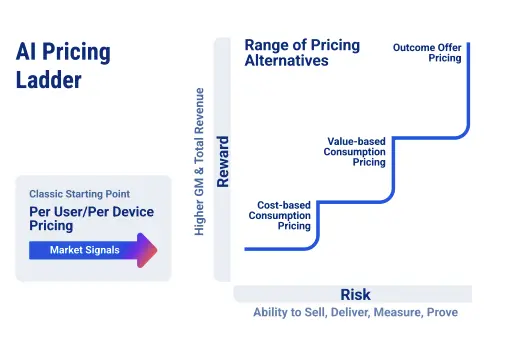
The AI Pricing Ladder: Where the Market Is Headed
AI pricing models are evolving along a clear path:
- Per-user pricing (legacy model).
- Cost-based consumption.
- Value-based consumption.
- Outcome-based pricing.
As you move up this ladder:
- Revenue potential increases.
- Margins improve.
- Complexity rises.
But so does your ability to capture the full value your AI delivers. The reality is this: staying at the bottom of the ladder isn’t sustainable.
You Can’t Afford To Get AI Pricing Wrong
If you’re treating pricing as an afterthought, you’re already behind. AI is forcing a fundamental shift in how value is created and how it’s monetized.
- Usage-based pricing alone won’t get you to profitability.
- Outcome-based pricing offers the highest upside but requires maturity.
- Hybrid models give you a practical path forward.
The companies that win won’t just build better AI. They’ll price it better. And that starts with aligning your pricing model to the value you actually deliver.
FAQs
1. What are the most common AI pricing models?
The most common AI pricing models include usage-based (pay for consumption), outcome-based (pay for results), and hybrid models that combine fixed and variable pricing components.
2. Why is usage-based pricing not enough for AI?
Usage-based pricing often fails to capture the true value of AI. It can lead to unpredictable revenue, misalignment with business outcomes, and margin pressure as costs fluctuate.
3. What is the best pricing model for AI solutions?
There is no single “best” model. However, many organizations are moving toward outcome-based or value-based pricing because these models align revenue with the business value delivered.
Smart Tip: Embrace Data-Driven Decision Making
Making smart, informed decisions is more crucial than ever. Leveraging TSIA’s in-depth insights and data-driven frameworks can help you navigate industry shifts confidently. Remember, in a world driven by artificial intelligence and digital transformation, the key to sustained success lies in making strategic decisions informed by reliable data, ensuring your role as a leader in your industry.

.png)