


AI is rapidly becoming one of the most significant forces shaping how companies create and capture value. While much of the conversation has focused on productivity gains and cost reduction, a more fundamental shift is underway.
For finance leaders, this is not a technology discussion. It is a structural change in how revenue is generated, priced, and sustained over time. Organizations that treat AI as a feature upgrade risk missing the broader implication: AI is redefining the economics of the business itself.
Key Takeaways
- AI is shifting the focus from cost efficiency to the redesign of profitability models.
- Traditional pricing models, particularly per-seat, are becoming structurally unstable.
- Markets are rewarding companies that deliver measurable outcomes, not access.
The Race to Profitability Has Changed
AI is altering the economics of value creation at a foundational level. Historically, technology investments were justified by efficiency gains, reduced labor costs, improved utilization, or automation of repetitive work. That model is no longer sufficient.
As AI increases productivity, it simultaneously introduces new categories of value that are more service-intensive and outcome-driven. This creates a shift from cost optimization toward profitability expansion. One of the key implications is that value is no longer realized through access to technology alone. It is realized through the outcomes that technology enables.
Insight: AI is creating a paradox. It automates traditional services while driving demand for new, higher-value service categories that are directly tied to business outcomes.
The Revenue Trap
AI introduces a structural challenge to existing pricing models. As software becomes more productive, fewer users are required to generate the same or greater output. This directly impacts per-seat pricing models, which depend on user volume for revenue growth.
The trap can be summarized as follows:
- Fewer users produce more output.
- Per-seat revenue declines.
- Total value delivered increases.
At the same time, many organizations are shifting toward consumption-based pricing. While this aligns costs with usage, it often fails to capture the full value of AI-driven productivity gains.
- The risk: Significant portions of delivered value remain unmonetized.
- The implication: Value created does not translate into value captured.
Without a shift in pricing strategy, organizations may find themselves scaling impact while eroding revenue potential.
Related: Pricing-Led Transformation: Why AI Forces You To Rethink Pricing First
The Market Proof
Market behavior is already reflecting this shift. Organizations that align their models around outcomes rather than access are being rewarded with premium valuations and stronger growth expectations.
- Palantir is trading at significantly elevated revenue multiples, reflecting confidence in its outcome-driven model.
- Salesforce has reduced thousands of traditional support roles while increasing investment in forward-deployed engineering.
- OpenAI is building a large-scale services business designed to support adoption and ensure measurable outcomes.
The common pattern is clear:
- AI alone does not deliver outcomes.
- Services are required to operationalize AI at scale.
- Products and services are converging into a unified delivery model.
This convergence represents a departure from the traditional separation between software and services. Increasingly, value is delivered through an integrated system in which the two are inseparable.
The Strategic Pivot
To adapt to this shift, organizations must rethink the role of services in their business models. Historically, services were treated as a cost center, necessary for support, but not central to value creation. Under AI Economics™, this assumption no longer holds.
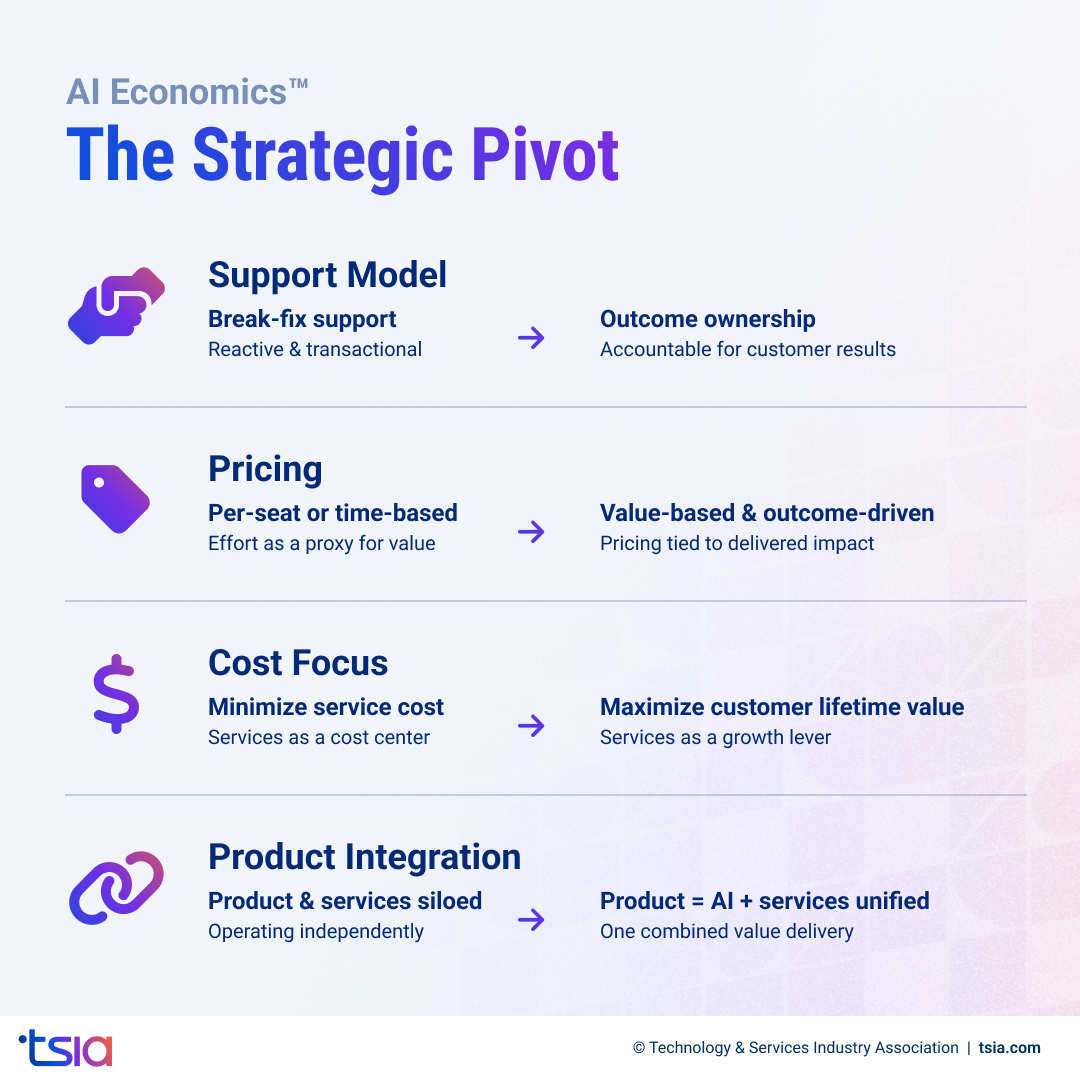
The shift can be defined across four dimensions:
- From: Break-fix support.
- To: Outcome ownership.
- From: Per-seat or time-based pricing.
- To: Value-based and outcome-driven pricing.
- From: Minimizing the cost of service.
- To: Maximizing customer lifetime value.
- From: Product and services operating separately.
- To: Product functioning as a combination of AI and services.
This transition requires alignment across financial planning, pricing strategy, and service delivery models.
CFO mandate:
- Ensure pricing reflects delivered value.
- Align cost structures with outcome delivery.
- Treat services as a revenue and margin lever, not an expense line.
Related: The AI-First Services Organization
The Stakes
The implications of this shift are significant. Organizations that successfully align around outcome delivery will gain greater control over customer relationships and capture a larger share of enterprise spending. Those that do not adapt will face increasing pressure on pricing as AI reduces differentiation and compresses traditional revenue models.
This outcome is not dependent on competitor behavior. It is driven by structural changes in how value is created and measured. The central question: Is the organization capturing the value created by AI, or enabling it without compensation?
Choosing the Next Step
Addressing AI Economics requires more than incremental adjustments. It involves a reassessment of how pricing, services, and delivery models interact.
Key considerations include:
- Whether current pricing models reflect productivity gains driven by AI.
- How service investments contribute to revenue growth versus cost containment.
- Where value is being created but not captured.
Organizations that take a structured approach to these questions are better positioned to adapt as AI-driven disruption accelerates.
Related: How AI Economics™ Is Disrupting the Biggest Names in Tech
Rethinking Value Capture in the AI Era
AI is increasing the total value that technology can deliver. At the same time, it is weakening the mechanisms traditionally used to monetize that value. This creates a gap between impact and revenue.
Closing that gap requires a shift toward outcome-based models, supported by service capabilities that ensure those outcomes are realized. The transition is already underway. The remaining question is how quickly organizations align their business models to reflect it.
FAQs
Why are services becoming more important in the AI era?
AI systems require configuration, integration, and ongoing optimization to deliver business outcomes. This increases demand for services that ensure adoption and performance. As a result, services are shifting from a support function to a primary driver of value realization.
How should CFOs respond to this shift?
CFOs should evaluate three areas:
- Pricing models: Do they reflect the value AI creates?
- Service strategy: Are services positioned to drive revenue or treated as a cost center?
- Margin structure: Is the organization capturing or losing value as AI adoption scales?
What is the risk of not adapting to AI Economics?
Organizations that maintain legacy pricing and delivery models risk creating value they cannot monetize. Over time, this leads to margin compression, reduced pricing power, and increased commoditization.
Smart Tip: Embrace Data-Driven Decision Making
Making smart, informed decisions is more crucial than ever. Leveraging TSIA’s in-depth insights and data-driven frameworks can help you navigate industry shifts confidently. Remember, in a world driven by artificial intelligence and digital transformation, the key to sustained success lies in making strategic decisions informed by reliable data, ensuring your role as a leader in your industry.

.png)



.png)
.png)
.png)
