

For decades, field services organizations have done precisely what they were supposed to do: optimize for efficiency. You measured utilization, maximized billable hours, and pushed technician productivity to its limits. The math made sense. Labor is expensive, especially when it involves travel, overtime, and physical presence at customer sites.
But that relentless pursuit of efficiency has quietly eroded the expertise and judgment that make field services valuable.
Today’s skilled field service technicians spend too much time on low-value, transactional tasks. Highly trained technicians now spend a disproportionate time on forms, logging, inventory, and administrative work unrelated to problem-solving.
Now, that approach is colliding with an existential crisis: the talent shortage. The "silver tsunami" of retiring senior technicians is taking decades of irreplaceable, proprietary expertise out the door.
Here's what's changed: artificial intelligence is no longer a future concept or a nice-to-have enhancement. It's the only scalable solution capable of breaking this cycle. AI can decouple labor effort from service value by automating the administrative friction that bogs down your team and by productizing the tribal knowledge that's walking out the door with every retirement. This isn't about replacing humans. It's about restoring their humanity. When AI handles the transactional work, technicians can focus on complex problems and customer relationships.
Key Takeaways
- AI shifts field services from utilization to absorption: When AI automates administrative and transactional work, technicians log fewer hours but deliver more value. The organizations that win in 2026 will stop measuring time spent and start measuring outcomes delivered.
- The talent crisis is really a time-to-value crisis: The problem isn’t hiring. It’s that new technicians take too long to become useful. AI captures senior expertise, guides junior staff in real time, and cuts time-to-proficiency in half—unlocking growth without more headcount.
- AI turns field services from a cost center into a growth engine: By enabling predictive maintenance, autonomous resolution, and outcome-based pricing, AI lets you sell uptime, performance, and reliability—not technician visits. That’s where durable margins and customer loyalty live.
The Top Three Business Challenges Facing Field Services in 2026
In 2026, three forces are reshaping field services: talent, value measurement, and technology investment. These aren't isolated problems you can solve one at a time. They're interconnected challenges that reinforce each other, creating a cycle that traditional approaches can't break. Understanding how they connect is the first step toward addressing them strategically.
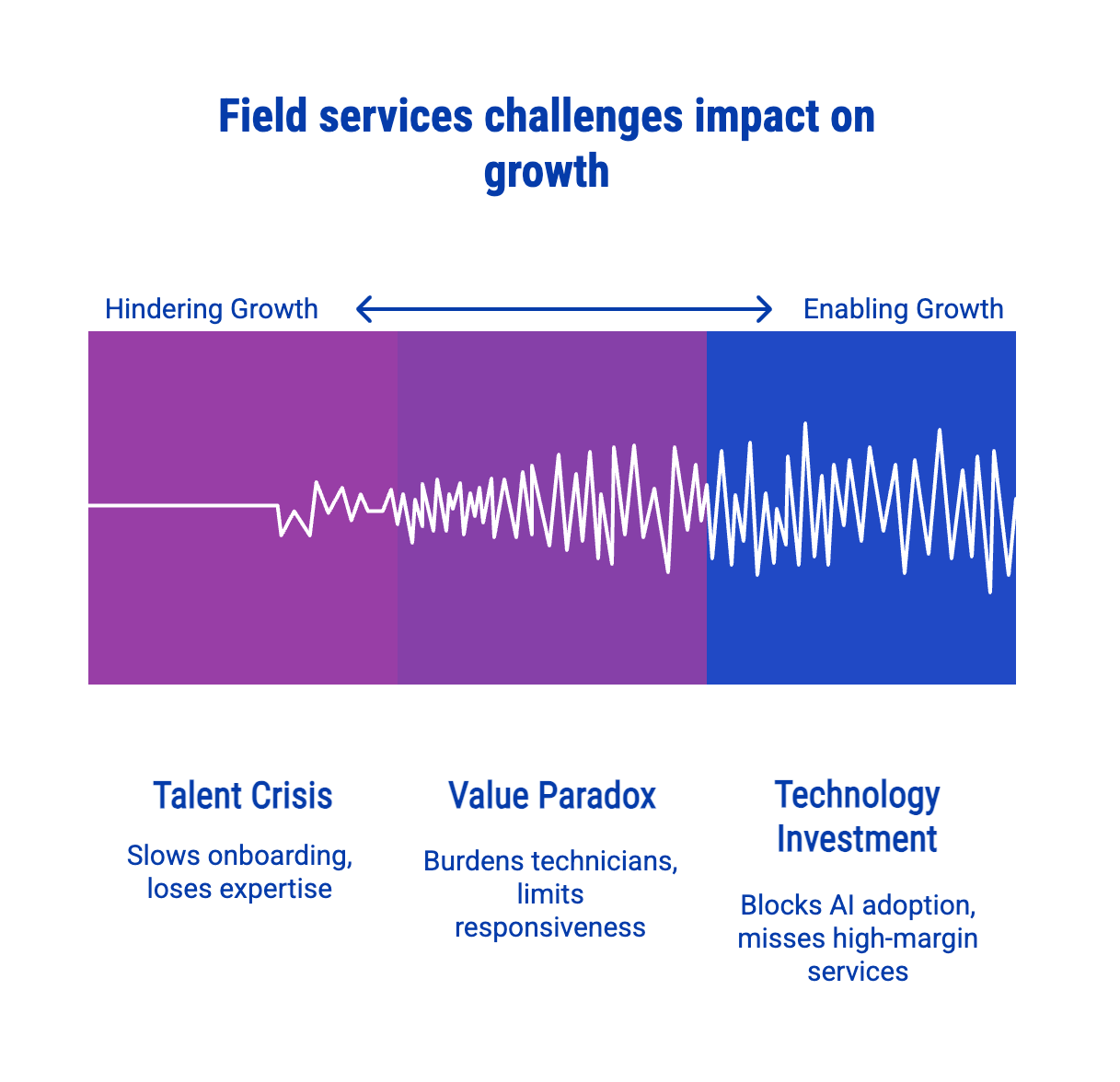
The Talent Crisis and Knowledge Gap
The model is breaking down because:
- Senior technicians are retiring with decades of proprietary expertise.
- Traditional training methods can’t close the gap fast enough.
- New hires take too long to become productive.
You know this firsthand. Your senior technicians don't just know how to fix equipment—they know the quirks of specific installations, the workarounds for edge cases, the subtle signs that predict failures before they happen. They've built mental models over 20 or 30 years that help them diagnose issues in minutes that would take others hours to identify.
What used to be an HR challenge is now a strategic risk. Knowledge loss threatens service quality, customer satisfaction, and your ability to compete. You need a fundamentally different approach to capturing, preserving, and transferring expertise—and you need it to work at the speed of retirement announcements, not the speed of traditional training programs.
Related: How Can AI Transform Field Services Onboarding?
The Value Paradox and Utilization Dilemma
Here’s an uncomfortable reality: the metrics that built your field services operation are now working against you. Utilization—the percentage of time technicians spend on billable activities—has been the north star for decades. It made sense when service was transactional. Keep technicians busy, maximize billable hours, and increase revenue.
Now, AI exposes the flaw in this model. AI automates routine work and removes administrative burden. That’s precisely what you want—except it conflicts with utilization. If AI handles scheduling, documentation, and basic diagnostics, technicians log fewer billable hours. By traditional measures, utilization drops even as value delivery increases.
This is the value paradox: AI improves efficiency and effectiveness, but legacy metrics make productivity look worse. At the same time, the support provided by equipment and systems technicians is increasingly complex, requiring more profound expertise and judgment—human skills that AI can’t replicate.
This is why the shift must be from utilization to absorption. Utilization measures time spent. Absorption measures the value delivered relative to cost—and whether the service generates enough revenue and customer outcomes to justify investment.
When you optimize for absorption:
- Low-value work is automated.
- Human effort shifts to high-value interactions.
- Customer retention and expansion increase.
Organizations that cling to utilization will resist AI because it threatens their numbers, even as it improves service. The winners will be those who embrace absorption as the primary measure of field services success.
Lagging Technology Investment vs. AI Economics™
Field services have historically underinvested in technology. The reasons are understandable: high travel costs, overtime expenses, and the perception that field services is a labor-intensive cost center. Why invest in expensive technology when the work requires physical presence and hands-on expertise?
That logic is now obsolete. The services era—as outlined in TSIA’s AI Economics™ Declaration—operates on different principles. Profitability comes from mastering services and moving up the AI Pricing Ladder toward outcome-oriented AI services (OOAS). In this model, you’re not selling time or even solutions—you’re selling guaranteed business outcomes enabled by AI.
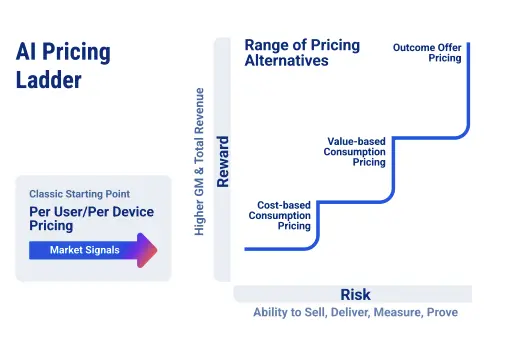
In practice, customers don’t want to pay for technician visits or successful repairs. They want equipment to run continuously, operations to stay productive, and outcomes to be met. AI enables service delivery and pricing based on outcomes rather than labor hours.
But you can’t participate in the OOAS economy without investing in AI infrastructure. AI is required to handle last-mile challenges—data integration, system complexity, and administrative friction. Without this investment, you’re stuck selling commodity break-fix services while competitors move upmarket.
The cost-center mindset creates a vicious cycle. Underinvestment limits service capability, reinforces the perception that field services aren’t strategic, and drives continued underinvestment. AI Economics™ provides the framework to break this cycle—but only with real technology investment.
Organizations that act will reposition field services from cost center to revenue driver. Those that don’t will become increasingly commoditized, competing on price as margins erode.
Related: Field Services Is AI-Ready, but Implementation Is Pending
The Three Capabilities Field Services Must Master
Understanding the challenges is necessary, but it's not sufficient. You need a clear framework for transformation. The path forward requires strategic alignment across three interconnected cornerstones—people, processes, and technology—underpinned by intelligent AI solutions.
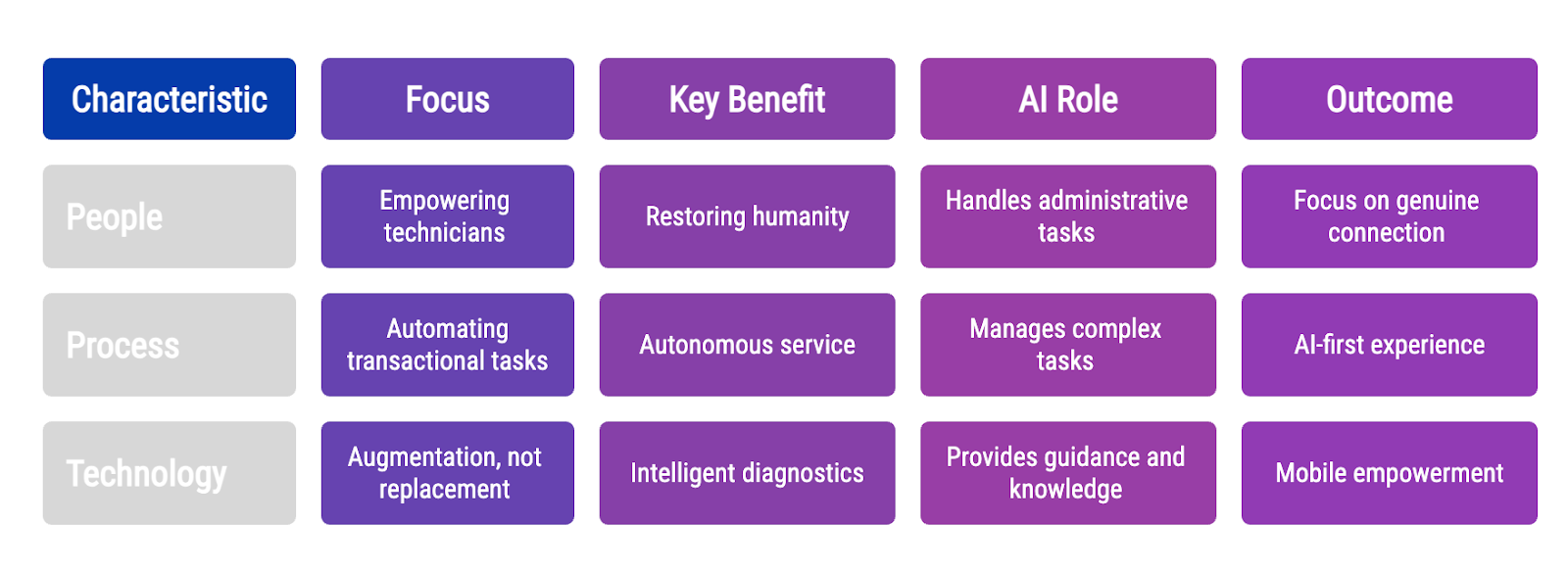
People: Empowering the Technician Hero
The top-performing organizations aren't waiting for the talent crisis to resolve itself. They're using AI to immediately close the knowledge gap and accelerate time-to-value for new technicians.
Here's the shift: instead of requiring high technical aptitude at entry, leading organizations are leveraging AI to digitize senior technicians' expertise and make that knowledge instantly accessible. When a junior technician encounters an unfamiliar issue, AI-powered tools can identify troubleshooting pathways, surface relevant documentation, and recommend next steps based on similar cases resolved by veteran staff.
This isn't about lowering standards. It's about equipping people to perform at levels that would traditionally take years to achieve. A technician with six months of experience, using the right AI tools, can handle scenarios that previously required five years of field experience. You're not replacing expertise—you're democratizing access to it.
The impact on your workforce is profound. When agentic and generative AI handle administrative tasks—automated scheduling adjustments, work summaries, case documentation—your technicians gain something they've been missing for years: time to be human.
This creates two critical outcomes. First, reduced administrative burden means technicians spend less time collecting data and documenting findings. They're freed from the constant context switching between fixing problems and logging information about those fixes. Second, they can focus on genuine customer connection. When your technician arrives on-site, they're not rushing through the interaction to get to the paperwork. They have space to listen, explain, reassure, and build the kind of relationship that turns transactions into partnerships.
Remember: The field service technician who becomes the last resort after an AI-driven digital support experience has to be exceptional. They're dealing with your most frustrated customers, your most complex technical issues, and your most critical business situations. These are the moments where human judgment, emotional intelligence, and creative problem-solving make the difference between a lost customer and a loyal advocate.
AI enables more of your team to reach that level. The junior technician who might have struggled before now has instant access to institutional knowledge. The mid-level technician who was drowning in administrative work can now focus on skill development. The senior technician who was stuck documenting tribal knowledge can spend that time mentoring and handling your highest-value customers.
This is what empowerment looks like: giving people the tools to do work that matters, work that requires their humanity, and work that creates lasting value for customers and competitive advantage for your organization.
Process: Automating the Transactional, Prioritizing Outcomes
AI is creating an age in which empowered humans deliver timely solutions to complex issues and critical systems. Getting there requires systematically automating the low-complexity processes that currently dominate technician time.
The transformation follows a clear progression along what we call the remote services continuum—a journey from reactive break-fix toward autonomous, outcome-focused service delivery.
- Embedded Diagnostics and Self-Healing: The foundation is equipped with embedded diagnostics and agentic self-healing capabilities. Modern machines detect anomalies, diagnose likely causes, and often resolve issues automatically without human intervention.
- Intelligent Self-Service and Remote Support: The next layer is generative AI–powered self-service and remote support. Virtual assistants and guided troubleshooting can resolve more than 80% of client questions without human interaction. This reduces the volume of basic inquiries reaching support teams and reallocates resources to complex, high-value work.
- Agentic Automation: At the highest level, agentic AI manages complex tasks without constant oversight. This includes autonomous dispatching based on real-time priority and location, automated parts returns and warranty processing, intelligent case note generation, and on-demand quoting. Agentic AI can handle end-to-end scenarios, including autonomous escalation for critical failures, initial diagnostics, and resource mobilization before a human reviews the case.
The strategic insight is that automation moves you from break-fix to predictive maintenance and outcome-based pricing. When routine work is automated, the remaining human touchpoints are maximized for value absorption, rather than billable hours.
This is the fundamental process transformation. AI handles everything predictable, repetitive, and rules-based. Human resources focuses on judgment, creativity, and relationship-building. Success is no longer measured by the number of service calls logged, but by customer outcomes delivered and revenue generated relative to cost.
Technology: Augmentation, Not Replacement
Let’s be clear about the goal: AI augments your technicians’ capabilities. It doesn’t replace them. Every technology investment should make your workforce more effective, more confident, and more valuable—not redundant.
Leading organizations understand this. They’re investing in technologies designed to enhance human capability. Our research shows 71.4% of field services organizations are investing in AI-guided troubleshooting, and 67.9% are implementing AI-powered chatbots and virtual assistants. These are not replacements—they’re force multipliers.
- Intelligent Diagnostics and Guidance: AI-driven tools can analyze case descriptions and match them with historical resolutions to recommend next steps. Features like Agent Assist significantly reduce the time support personnel spend researching solutions, allowing them to focus on implementation and customer communication. Your technicians aren't learning to rely on AI—they're learning to leverage it as a research assistant that never forgets and always has the latest information.
- Knowledge Management: AI accelerates the creation of comprehensive, searchable knowledge bases by automatically extracting key information from manuals, technician notes, and case histories. This makes institutional knowledge accessible to everyone, not just the veterans who built that knowledge over decades. A technician in their first year can instantly access insights from your most experienced staff, evening out the capability curve across your entire workforce.
- Mobile Empowerment: Innovations such as voice-controlled AI agents provide hands-free access to work orders, troubleshooting guides, and real-time expert support while technicians are on-site. They can ask questions, pull up schematics, or document findings without interrupting their physical work. This isn't a minor convenience—it's a fundamental improvement in how technical work gets done in the field.
This is the technology mandate: invest relentlessly in augmentation. Every dollar spent on AI that makes technicians smarter, faster, and more effective compounds across the workforce. You’re not building a technology stack—you’re building a capability multiplier that makes every person more valuable.
Related: The State of Field Services 2026
TSIA's Observations: Why Incumbents Have the Advantage
Here's the counterintuitive reality: in the AI-driven services era, the advantage belongs to incumbents—not because of legacy technology, but because of massive scale in services and decades of domain expertise. Established field services organizations have what new entrants can’t replicate: years of service data, customer history, and operational knowledge. AI needs this to be effective.
The risk: Focusing on utilization commoditizes service. Optimizing time over value signals service is transactional and interchangeable.
The winning strategy: shift from utilization to absorption—measure revenue and value delivered.
- Core teams handle complex, high-value issues.
- AI or partners handle routine maintenance efficiently.
AI amplifies your scale advantage, letting you deliver personalized, high-touch service to top customers while serving the broader base efficiently. Incumbents who act decisively will own the next decade of field services. Smaller, agile competitors will overtake those who hesitate.
TSIA's Recommendations for Field Services Leaders in 2026
The path forward requires decisive action in three strategic areas. Each recommendation directly addresses the challenges we've outlined and positions your organization to capitalize on AI-driven transformation.
- Prioritize Talent Time-to-Value
The key to the talent crisis isn’t hiring faster—it’s getting new hires productive faster. Shift AI goals from reducing costs to reducing time-to-proficiency. Only 10.7% of organizations measure AI ROI by training impact. AI can cut time-to-proficiency from 18 months to nine, scaling service despite talent shortages.
Use AI to close knowledge gaps and replace lengthy training with agile solutions like microlearning and microcredentials. Measure how quickly new hires reach full productivity and handle complex cases. Optimizing time-to-value turns a talent crisis into a manageable constraint.
- Focus on Outcome-Oriented AI Services
Shift pricing and delivery toward outcome-based models that reward value, not hours. Sell guaranteed uptime, productivity, or business results, not technician time. AI enables predictive maintenance, autonomous resolution, and continuous optimization.
Investment in AI infrastructure and operational discipline is required to deliver outcomes consistently. Outcome-oriented models escape commoditization, allow premium pricing, and strengthen customer relationships.
- Invest in Strategic Empowerment
Continuously equip technicians with AI tools and training to become strategic problem-solvers. AI-guided diagnostics, knowledge management, mobile interfaces, and voice assistants free technicians to focus on judgment, creativity, and relationship-building.
This is an ongoing investment, not a one-time purchase. Stopping erodes competitive advantage.
FAQs
How does AI actually improve field service technician productivity?
AI removes the work that never required human judgment—documentation, scheduling, data logging, basic diagnostics, and parts management. That frees technicians to focus on troubleshooting, customer communication, and complex decision-making. The result isn’t just faster service—it’s higher-value service that drives retention, expansion, and trust.
Why does AI make utilization a broken metric for field services?
Because AI eliminates billable busywork while increasing real customer value. When AI handles routine tasks, technicians log fewer hours but solve bigger, more meaningful problems. Utilization declines even as profitability and customer outcomes improve. That’s why leading organizations are shifting to absorption—measuring value and revenue delivered relative to cost, not time spent.
What does outcome-oriented field services mean in the AI era?
It means customers pay for results—uptime, performance, reliability, and productivity—instead of technician visits. AI enables predictive maintenance, autonomous resolution, and continuous optimization, enabling outcome-based pricing. You stop selling labor and start with the certainty of sale.
Smart Tip: Embrace Data-Driven Decision Making
Making smart, informed decisions is more crucial than ever. Leveraging TSIA’s in-depth insights and data-driven frameworks can help you navigate industry shifts confidently. Remember, in a world driven by artificial intelligence and digital transformation, the key to sustained success lies in making strategic decisions informed by reliable data, ensuring your role as a leader in your industry.