

There’s no question that AI has revolutionized the way in which education services operate. In 2025, businesses rapidly adopted AI to improve productivity, dramatically increasing content creation and reducing manual effort for training teams. Courses were developed more quickly, libraries grew rapidly, and operational efficiency improved almost instantly.
However, as education services enter 2026, a more complicated reality is setting in. AI has undoubtedly made training cheaper and faster to produce, yet too many organizations are struggling to demonstrate that learning drives meaningful business outcomes.
This marks a significant shift in the education services industry, moving from Consumption Economics to AI Economics™, where value must be defined, delivered, and defended through outcomes.
This new model sees education services having to demonstrate how learning accelerates time-to-competency, improves customer health, and contributes to revenue performance. Success in 2026 will be determined by organizations that use AI to connect learning outcomes to measurable business impact.
Key Takeaways
- AI efficiency is no longer enough to defend education services: Faster content and lower production costs don’t prove value. In 2026, education teams must demonstrate how learning directly improves time-to-competency, adoption, and customer health.
- Foundational data is now a commercial requirement, not an IT nice-to-have: Without integrated learner, role, and customer data, education services can’t connect training to renewals, expansion, or retention, making ROI impossible to prove in the AI Economics era.
- Transformation-first education turns learning into a growth engine: When education is embedded in the sales and success motion, monetized around mastery, and aligned to outcomes, it shifts from a cost center into a driver of revenue, renewal, and expansion.
The Value Paradox: When Efficiency Fails To Prove Impact
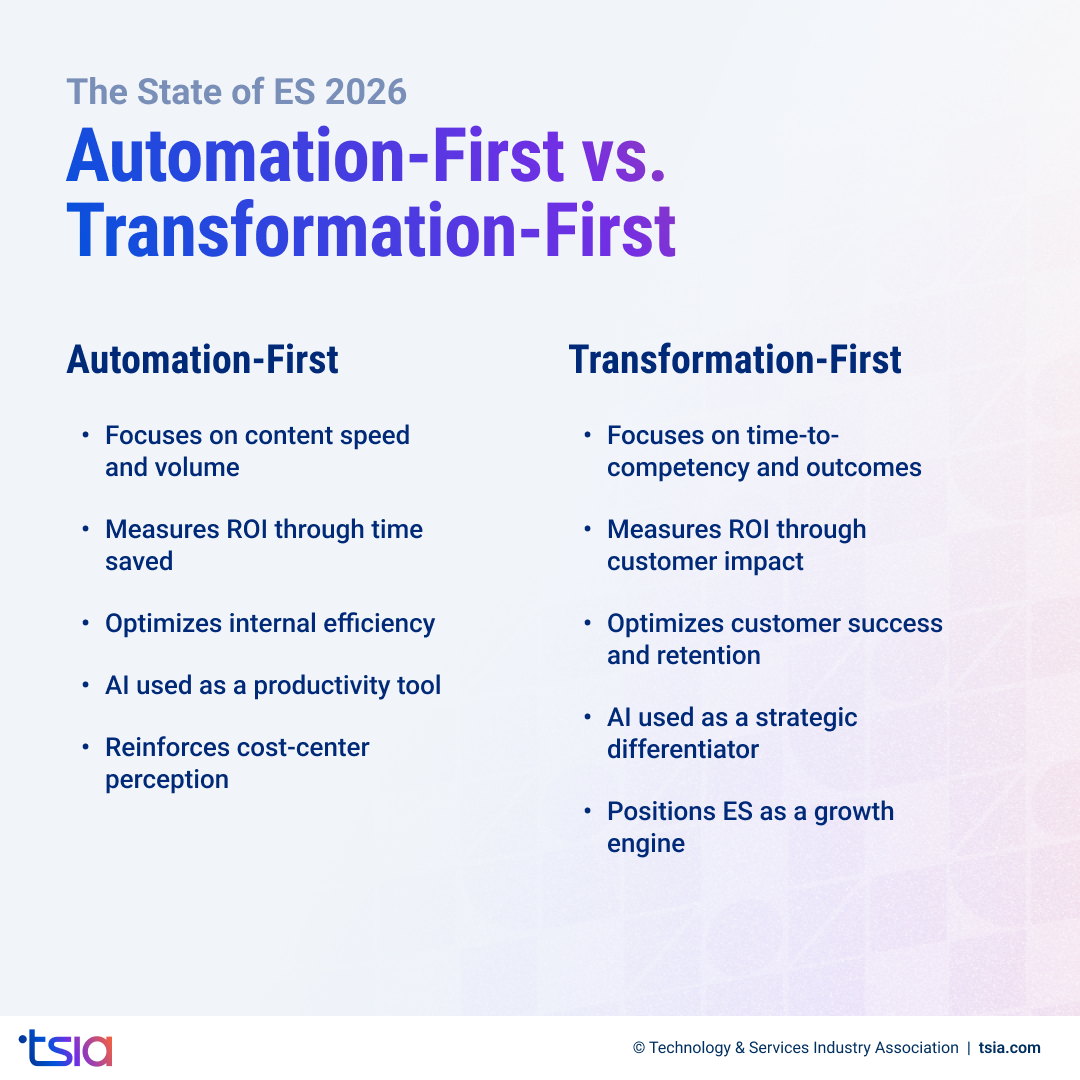
There’s no question that AI has completely transformed education services. They now deliver efficiency gains and accelerate content creation, reducing manual effort and enabling training teams to scale faster. However, efficiency alone does not prove value. Many education services continue to rely on internal productivity metrics, such as time saved, content volume, and production speed.
While these are perfectly adequate for signaling efficiency, they also fail to demonstrate where learning actually improves adoption, accelerates time-to-competency, or supports retention and renewal. Consequently, education services become faster and cheaper, but from a business impact perspective, they are no longer defensible as they once were. This is the Education Services Value Paradox: more learning is delivered, but less value is demonstrated.
As AI increases product complexity, the gap widens. Resolving this paradox requires moving beyond an automation-first approach toward a transformation-first approach, prioritizing outcomes over outputs.
Why Foundational Data Is the Make-or-Break Factor
Education services cannot demonstrate value, scale AI, or defend ROI without reliable, connected data. However, many organizations still operate with fragmented learner records, inconsistent role definitions, and disconnected systems. In practice, this makes it very difficult to understand who’s being trained, what skills they’ve acquired, and whether learning is influencing customer outcomes.
This creates a data gap that’s more than simply a technical inconvenience; it’s a business problem. Integration between learning platforms and systems, CRM or customer success tools, and education services can’t connect learning activity to adoption, support volume, or revenue performance.
AI-driven personalization and competency mapping are essential components of an education services strategy; weak data foundations introduce serious risk, stall personalization efforts, and make outcomes unprovable. Treating data as a commercial asset is now a vital part of transformation.
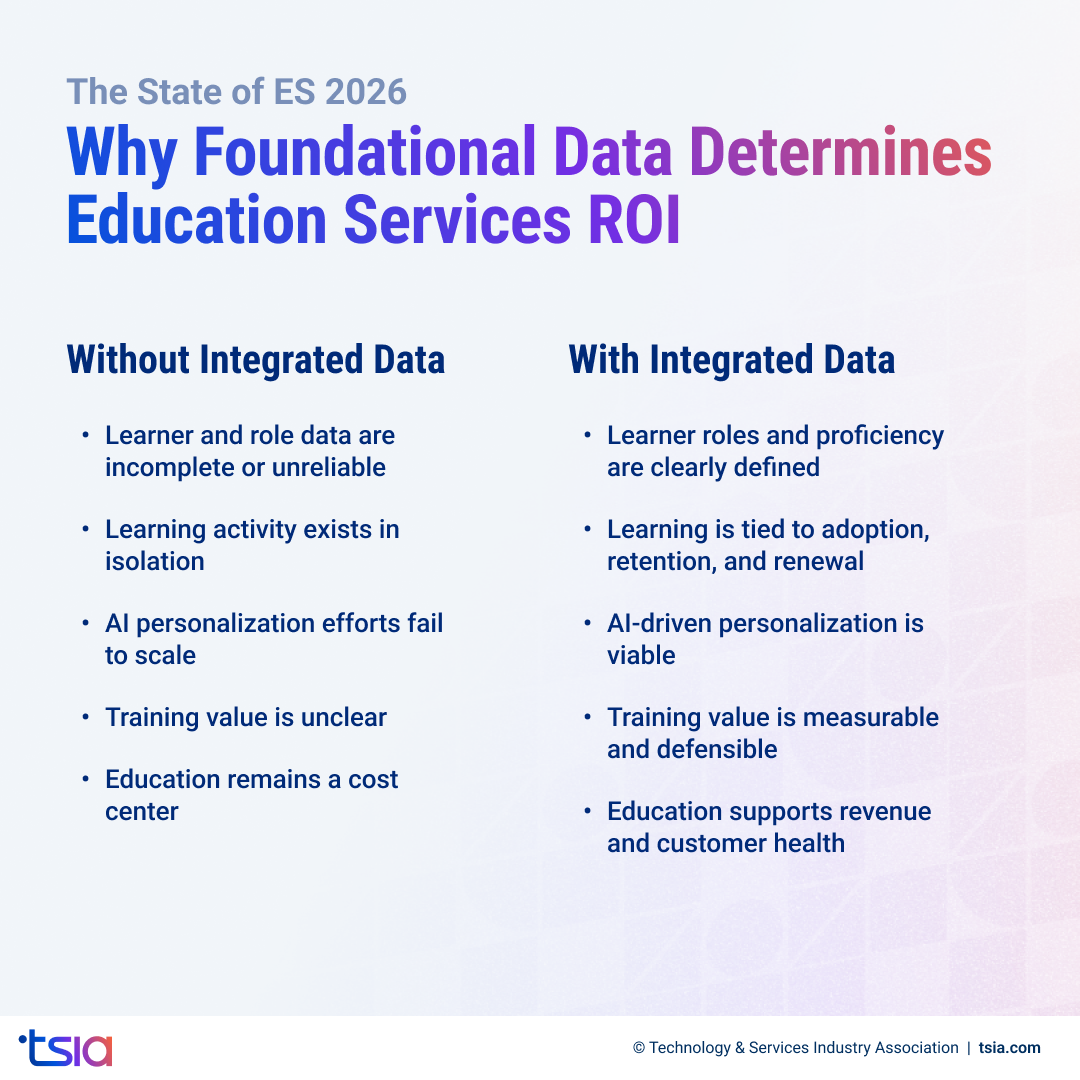
This data layer enables education services to move beyond reporting activity and toward demonstrating outcomes. It creates visibility that helps defend investment, support AI-driven learning strategies, and position education services as a contributor to business growth.
Related: The AI Blueprint for Education Services: From Data to ROI
Top Trends Shaping Education Services in 2026
Education services are evolving in 2026, and providers need to understand the trends driving this change. Adopting strategies that help navigate complexity, prove value, and position education as a growth driver is essential.
AI-Driven Personalization and Competency Mapping
AI evolves from content automation to intelligent personalization, with enterprise-grade organizations using machine learning to create learning paths based on proficiency and behavior. Competency mapping is a key part of education services, guiding learners to master topics quickly, and AI provides real-time feedback and assessment. This frees up human instructors to focus on providing high-value content.
Formalizing Consumption Strategy and Outcome-Based Credentials
Education services teams are recognizing the importance of formalizing consumption strategies to drive adoption and accountability. This means moving beyond per-user pricing toward value and outcome-based models, emphasizing certifications, micro-credentials, and validated skill mastery. This shifts the focus from course completion to demonstrable competency tied to customer success.
Related: The State of Education Services 2026
Monetizing Education Services Without Slowing Adoption
One of the biggest concerns for education services leaders is the perceived trade-off between monetization and adoption. If you charge too early or aggressively, your learning consumption slows down, yet giving too much away keeps education services trapped as a cost center.
In the AI era, successful teams can resolve this tension by separating access from mastery. The goal is not to monetize learning indiscriminately, but to monetize the higher value outcomes customers pay for while accelerating adoption through free education.
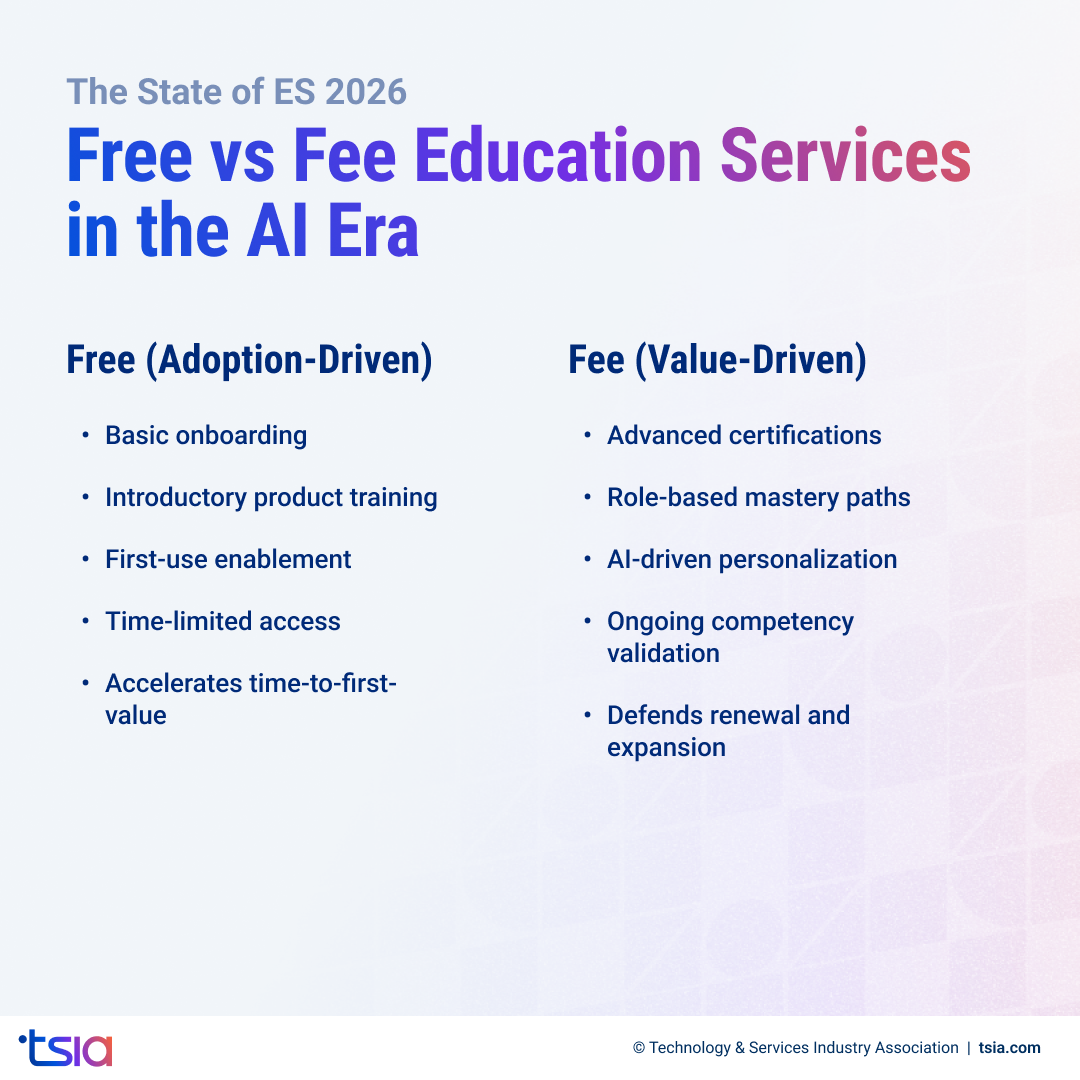
Free education removes friction at the start of the customer journey, supporting faster time-to-value. Monetized education is focused on measurable business impact, and, when appropriately positioned, these offerings reinforce adoption by making it defensible.
Making Education a Non-Negotiable Part of the Sales Motion
Education services don’t drive outcomes unless customers consume the learning. Yet in many organizations, education remains an optional add-on, resulting in delayed time-to-value and low attach rates.
This approach is no longer sustainable. Products are becoming more complex, and education is a prerequisite for long-term adoption and renewal success. Making education optional moves the risk to the customer, boosting churn. The best organizations embed education services directly into the sales motion, positioning learning as a form of risk mitigation rather than as discretionary spend.
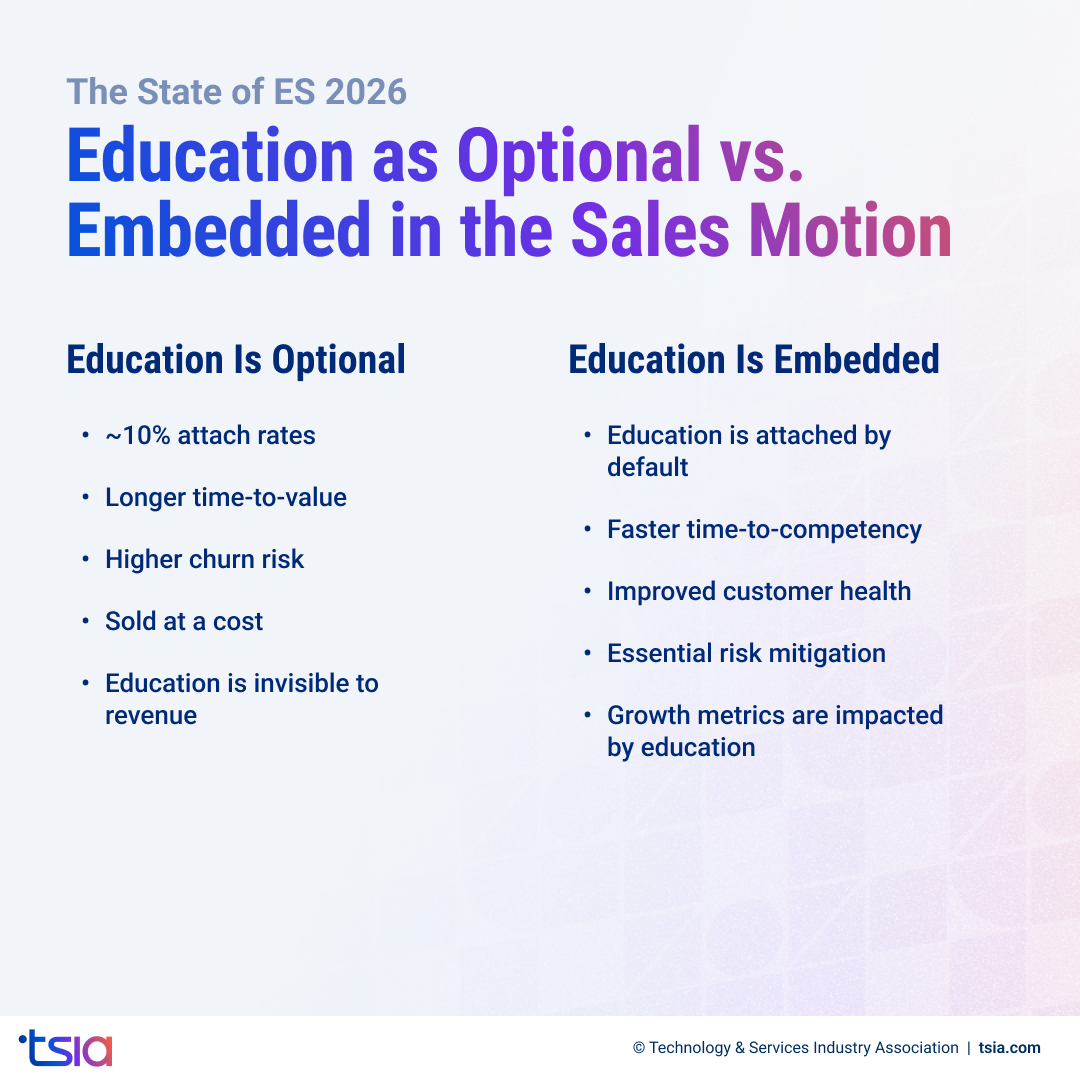
When education is positioned as insurance against poor adoption, sales conversions can change. Customers reach proficiency faster, and education services become a significant contributor to revenue, retention, and renewal performance.
Why Education Services Is Becoming a Growth Engine
Improving your organization's chances of success is key to long-term growth, and in 2026, education services are one of the best growth engines your business can leverage. Training is no longer relegated to a post-sale support function; it now helps facilitate faster adoption, stronger renewals, and expansion readiness.
AI helps drive this shift by increasing product complexity and raising the stakes for long-term customer success. The organizations that rise to the top leverage education to reduce time-to-competency, shorten downstream support burden, and protect long-term revenue.
In this model, education services do not compete for budget; instead, they become a key part of it. Value is visible, measurable, and directly tied to your organization's performance.
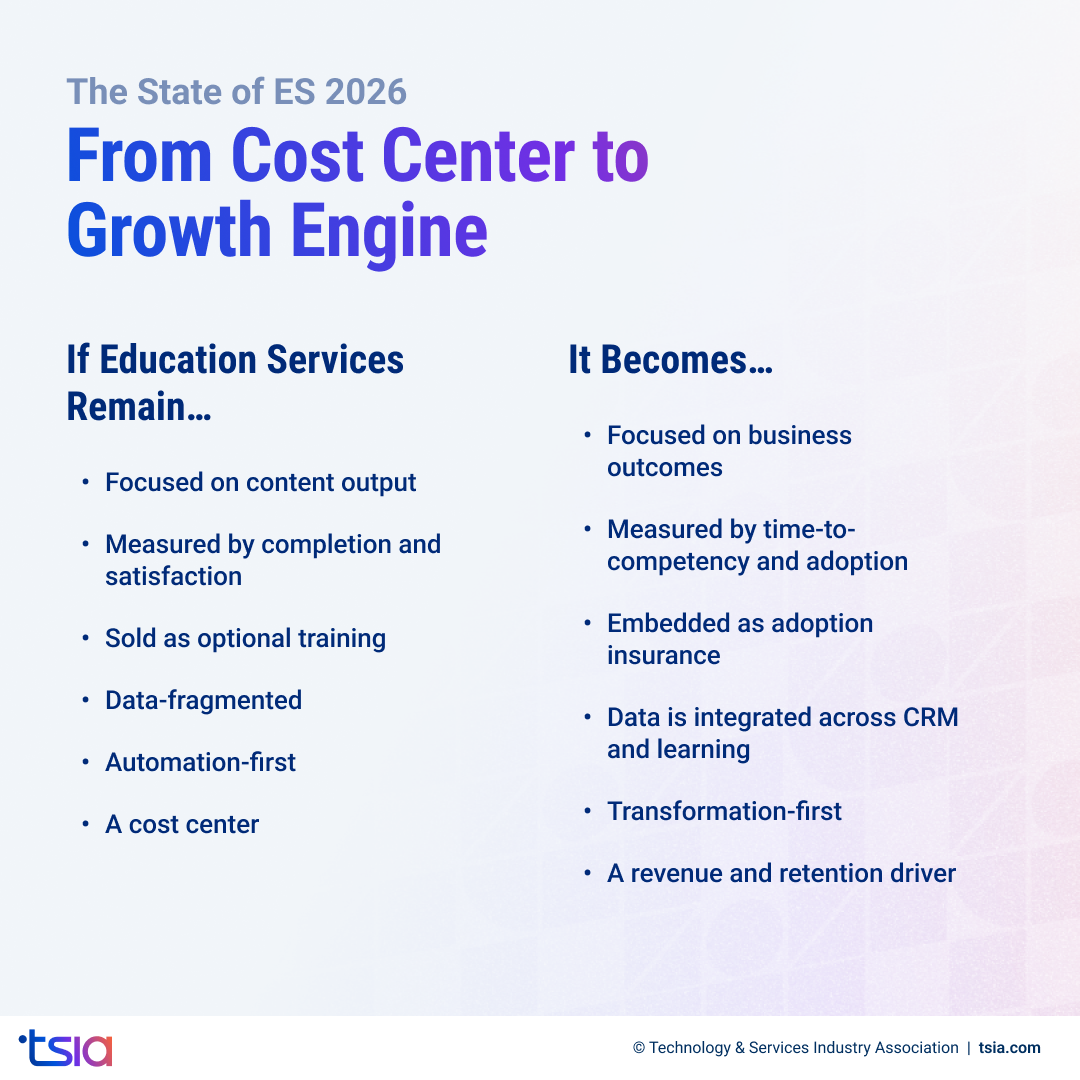
Education Services in 2026: From AI Acceleration to Accountability
The transition into 2026 makes for an exciting and defining moment for education services, and AI has already delivered unprecedented efficiency. However, it is essential to understand that efficiency alone is no longer enough; your business needs to move beyond automation toward a transformation-first approach anchored in accountability, data integrity, and measurable outcomes.
In the era of AI Economics, the value of education services is no longer assumed; it must be proven. Leaders who operationalize this shift effectively will not only defend investment but also position education as an indispensable driver of success.
Related: The AI Blueprint for Education Services: From Data to ROI
FAQs
Why are education services under more pressure to prove value in 2026?
Because AI has dramatically reduced the cost of producing training. When learning becomes cheaper and faster to create, executives no longer accept activity metrics as proof of value. In the AI Economics™ era, education must demonstrate how it improves customer adoption, time-to-competency, and revenue performance, or risk being cut.
What does a transformation-first education services model actually change?
It shifts education from producing content to delivering outcomes. Instead of measuring success by completions or satisfaction scores, transformation-first teams track how learning impacts customer health, renewal risk, support volume, and expansion readiness. AI becomes a tool for accelerating competency and demonstrating impact—not just automating content.
How do you monetize education services without hurting adoption?
By separating access from mastery. Free education removes friction and accelerates adoption, while paid offerings focus on validated outcomes like certifications, role-based proficiency, and ongoing competency. This protects revenue while accelerating time-to-value for customers.
Smart Tip: Embrace Data-Driven Decision Making
Making smart, informed decisions is more crucial than ever. Leveraging TSIA’s in-depth insights and data-driven frameworks can help you navigate industry shifts confidently. Remember, in a world driven by artificial intelligence and digital transformation, the key to sustained success lies in making strategic decisions informed by reliable data, ensuring your role as a leader in your industry.