Artificial intelligence is transforming the technology industry in ways that go far beyond automation. It is reshaping how companies deliver value, how customers measure success, and how providers generate revenue. For years, technology companies relied on a familiar growth model built around subscriptions and user adoption. If customers used the software, renewals and expansion usually followed. AI is changing that equation.
Customers do not want more interaction with technology. They want outcomes. They want AI to detect fraud or automatically optimize a supply chain. The technology becomes valuable only when it produces a real business result.
This shift requires a new engagement model between providers and customers. The DARE Progressive Growth Model (Design, Activate, Realize, and Evolve) offers a framework for how technology companies can move from selling tools to delivering measurable outcomes.
Instead of a static maturity ladder, the DARE model outlines a progression of four engagement levels that companies move through as they build AI capabilities and operational expertise. Each level represents a different business model, operational structure, and financial architecture. Understanding this progression is critical if you want to succeed in the emerging AI Economics™ era.
Key Takeaways
- AI changes the economic model of technology services. Customers care about outcomes, not software usage, which requires providers to rethink pricing, engagement models, and service delivery.
- The DARE Progressive Growth Model outlines four stages of AI engagement. Companies evolve from experimentation to outcome-based partnerships as they gain operational control and expertise.
- The most durable AI businesses deliver outcomes, not tools. Providers that assume operational responsibility for results create deeper customer relationships and more stable long-term revenue.
Why Traditional SaaS Growth Models Break Down in the AI Era
During the SaaS era, the industry widely adopted the TSIA framework, LAER: Land, Adopt, Expand, and Renew. The model assumed that customer adoption was the strongest indicator of success. If customers used the product regularly, the vendor could expect renewals and future expansion. AI introduces a different dynamic.
Customers do not want to spend more time interacting with AI tools. They want the AI system to complete work for them. A marketing team does not want to generate hundreds of prompts; they want high-quality campaign content delivered automatically. A security team does not want to analyze alerts; they want threats detected and resolved. Usage alone no longer signals value.
This creates a new challenge for technology providers. Revenue models built on seats, tokens, or transactions can conflict with customer success. When an AI system works efficiently, it may require fewer interactions and less usage. To address this shift, companies need a new way to structure customer engagement. The DARE framework provides that model.
Related: From LAER to DARE: Why the AI Era Demands a New Customer Engagement Model
The DARE Framework: A New Model for AI Customer Engagement
The DARE framework—Design, Activate, Realize, and Evolve—replaces the linear SaaS engagement model with a cyclical one designed for AI-driven outcomes. Each stage represents a different phase in how providers collaborate with customers to deliver value.
- Design: The provider works with the customer to define the desired outcome, assess readiness, and identify the best AI use cases.
- Activate: The AI solution is implemented, configured, and integrated into the customer’s environment.
- Realize: The AI system begins delivering measurable business value.
- Evolve: The provider continuously improves the system through optimization, retraining, and governance.

This cycle reflects the ongoing nature of AI systems, which require constant monitoring and improvement as data and environments change. The DARE framework also introduces a progression of four engagement levels, each representing a different stage in the evolution of an AI business.
Level 1: The Explorer Phase
At the beginning of the AI journey, trust is the biggest barrier.
Enterprise customers often worry about:
- AI reliability.
- Data security.
- Unclear return on investment.
- Lack of internal expertise.
To overcome these concerns, providers typically start with proof-of-concept (POC) engagements designed to demonstrate feasibility.
What the Explorer Phase Looks Like
In this stage, forward-deployed engineers (FDEs) work closely with customers to build prototypes and validate specific AI use cases.
The work often includes:
- Identifying a narrow pain point that the AI can solve.
- Prototyping solutions using sample customer data.
- Demonstrating technical feasibility.
These projects are usually quick experiments rather than production-ready implementations.
The Financial Reality
The explorer phase rarely generates revenue. Providers should treat these engagements as customer acquisition costs (CAC), absorbing engineering time, cloud resources, and development work to build trust and prove value.
While this approach helps open doors, it can also create challenges. Many companies become stuck running endless pilot programs that never convert into paid deployments. To move forward, providers must introduce clearer success metrics and require customers to commit resources to the project.
Level 2: The Adopter Phase
Once a provider proves that its AI solution can provide a measurable ROI, the next step is driving adoption.
This stage typically introduces consumption-based pricing, such as:
- Pay-per-API call.
- Pay-per-token.
- Pay-per-user.
These models make it easy for customers to start using the technology with minimal commitment.
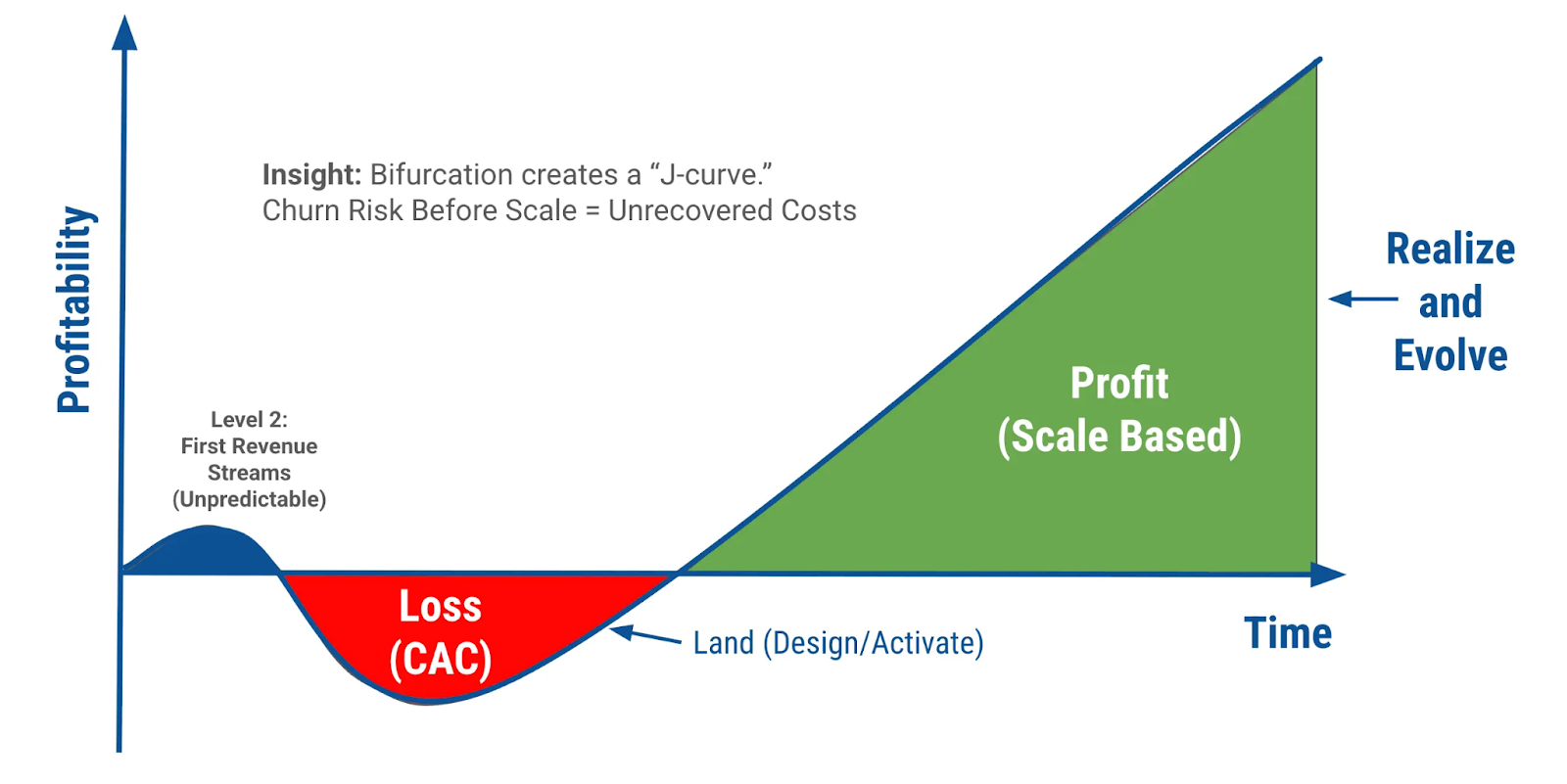
At this stage, many AI businesses experience what economists call a J-curve in profitability. Providers invest heavily in customer acquisition, onboarding, and infrastructure during the early phases of an engagement. Revenue begins to appear as customers start consuming the service, but profitability often arrives later, once adoption scales and the provider reaches the Realize and Evolve phases of the engagement.
Why Consumption Pricing Creates Volatility
Consumption pricing aligns with cloud economics, but it introduces new risks for AI businesses. In many cases, increased usage does not necessarily mean increased value. Consider a customer support AI agent. If the system requires many interactions to answer a simple question, usage increases, but the customer experience suffers. If the agent resolves issues quickly, usage decreases, but the customer is happier.
This creates a misalignment between vendor revenue and customer success. Customers may even deploy internal teams focused on reducing AI usage costs, which directly reduces the vendor’s revenue.
Moving Beyond the Consumption Trap
To progress beyond this stage, providers must connect pricing to outcomes rather than raw usage.
This often involves:
- Committed usage agreements.
- Value engineering practices that demonstrate ROI.
- Clear metrics linking AI performance to business impact.
These steps prepare organizations for the next phase of the DARE progression.
Level 3: The Operator Phase
The operator phase represents the current standard for most enterprise software companies. At this stage, providers introduce traditional subscription contracts, creating predictable recurring revenue. The operational focus shifts toward scalable delivery models supported by professional services, customer success teams, and standardized implementation methods.
The Hidden Challenge: The Value Gap
Although subscriptions stabilize revenue, they introduce a new challenge called the value gap. The vendor delivers software that functions correctly, but the customer struggles to generate meaningful results.
This happens because AI systems require specialized capabilities such as:
- Data engineering.
- Prompt design.
- Model monitoring.
- Continuous optimization.
Most organizations lack the internal talent required to manage these tasks effectively.
The result is a common scenario:
- The software operates as expected.
- The business outcome is not achieved.
- Both sides blame each other.
Support teams become overwhelmed with requests that are really consulting, design, and readiness issues rather than technical problems. To overcome this challenge, providers must take a more active role in delivering outcomes.
Level 4: The Outcome-Oriented Supplier Phase
The final stage of the DARE progression is the outcome-oriented supplier phase. In this stage, the provider assumes operational responsibility for the AI system and the business result it produces. Rather than selling software licenses, the provider delivers a managed outcome.
What Changes in the Outcome Model
At this level, organizations restructure their service model around integrated teams responsible for the entire AI lifecycle.
These teams often include:
- Forward-deployed engineers.
- Data scientists.
- Operations specialists.
- Value engineers.
They work together in a continuous cycle of implementation, optimization, and improvement.
New AI Service Categories
To support this model, companies typically introduce three new service offerings:
- AI Readiness and Governance Services (ARGS): Assess and prepare the customer’s data and infrastructure for AI deployment.
- Outcome-Oriented AI Services (OOAS): Deliver the AI-powered outcome itself, such as automated support or predictive maintenance.
- Value Optimization Services (VOS): Continuously monitor and improve the AI system to maintain performance over time.
These services enable providers to deliver measurable results and build deeper partnerships with customers.
Why Execution Becomes Easier
One of the most surprising insights from the DARE framework is that execution difficulty decreases at this stage. When the provider controls the data pipeline, model configuration, the applications, and the infrastructure, they can diagnose problems quickly and optimize performance without waiting for customer intervention. This level of control enables providers to confidently commit to business outcomes.
Related: Outcome-Oriented AI Services
The Path to AI-Driven Growth
The transition to AI is forcing technology companies to rethink how they create value. Selling software alone is no longer enough. Customers expect measurable outcomes, and delivering those outcomes requires deeper operational involvement from providers.
The DARE Progressive Growth Model offers a roadmap for this transformation. Organizations that remain focused on consumption or subscription models risk getting stuck in unstable middle stages where incentives are misaligned, and execution becomes difficult. Companies that evolve toward outcome-based partnerships can unlock a more durable growth model built on long-term customer value. In the emerging AI Economics era, the providers that succeed will be those that take ownership of the outcome.
Related: The AI Economics™, Experts React to What Enterprise Tech Isn’t Saying Out Loud
FAQs
What is the DARE Progressive Growth Model?
The DARE Progressive Growth Model is a framework that describes how technology providers evolve their customer engagement strategies in the AI era. It outlines four phases—Explorer, Adopter, Operator, and Outcome-Oriented Supplier—aligned with the Design, Activate, Realize, and Evolve lifecycle.
Why does AI require a new growth model?
AI changes how customers derive value from technology. Instead of using software directly, customers expect AI systems to deliver results automatically. This shift requires providers to focus on outcomes rather than usage metrics.
What is the most advanced stage of AI service delivery?
The most advanced stage is the Outcome-Oriented Supplier Phase. In this stage, providers assume operational responsibility for the AI system and deliver measurable business outcomes through managed services and outcome-based contracts.
Smart Tip: Embrace Data-Driven Decision Making
Making smart, informed decisions is more crucial than ever. Leveraging TSIA’s in-depth insights and data-driven frameworks can help you navigate industry shifts confidently. Remember, in a world driven by artificial intelligence and digital transformation, the key to sustained success lies in making strategic decisions informed by reliable data, ensuring your role as a leader in your industry.

.png)