For years, software companies scaled growth by making products easier to adopt. You sold licenses, customers onboarded, and value followed a predictable path. That model is breaking down.
As AI becomes more embedded in enterprise operations, the challenge is no longer building powerful models; it’s making them work inside your customer’s messy, fragmented environment. This is where many organizations fail to realize value. AI is deployed, but the expected business outcomes never fully materialize. This is what we call the post-deployment value gap.
Closing that gap requires a different approach. One that blends deep technical expertise with hands-on customer engagement. One that prioritizes outcomes over access. That approach is forward deployed engineering (FDE).
Key Takeaways
- AI success depends on implementation, not just innovation: Even the most advanced models fail without deep integration into your customer’s environment.
- Forward deployed engineers bridge the “last mile” gap: They combine technical expertise and business acumen to translate AI into measurable outcomes.
- FDE is more than a role—it’s a new operating model: Organizations that scale AI successfully treat FDE as a capability, an offer, and a strategic growth engine.
The Shift From SaaS to AI Economics™
For over a decade, your growth likely followed a familiar playbook: land a customer, drive adoption, expand usage, and renew. The LAER model worked because value was tied to access, and more users meant more revenue.
AI changes that equation. If an AI agent can do the work of multiple employees, your traditional pricing model starts to collapse. The more value your product delivers, the fewer seats your customer needs. This creates a fundamental tension: your product is working better, but your revenue model is shrinking.
To solve this, you need to shift from selling access to selling outcomes. But outcomes don’t happen automatically. They depend on how well your AI is implemented within each customer’s environment. That’s where forward deployed engineering becomes essential.
What Is Forward Deployed Engineering?
Forward deployed engineering is the capability that ensures your AI actually delivers results in the real world. Instead of building generalized features for many customers, forward deployed engineers focus on solving specific problems for a single customer. They operate directly within the customer environment, embedding themselves in workflows, data systems, and decision-making processes. Think of them as the bridge between what your product can do and what your customer actually achieves.
Related: How Forward-Deployed Engineering Turns AI Into Measurable Business Results
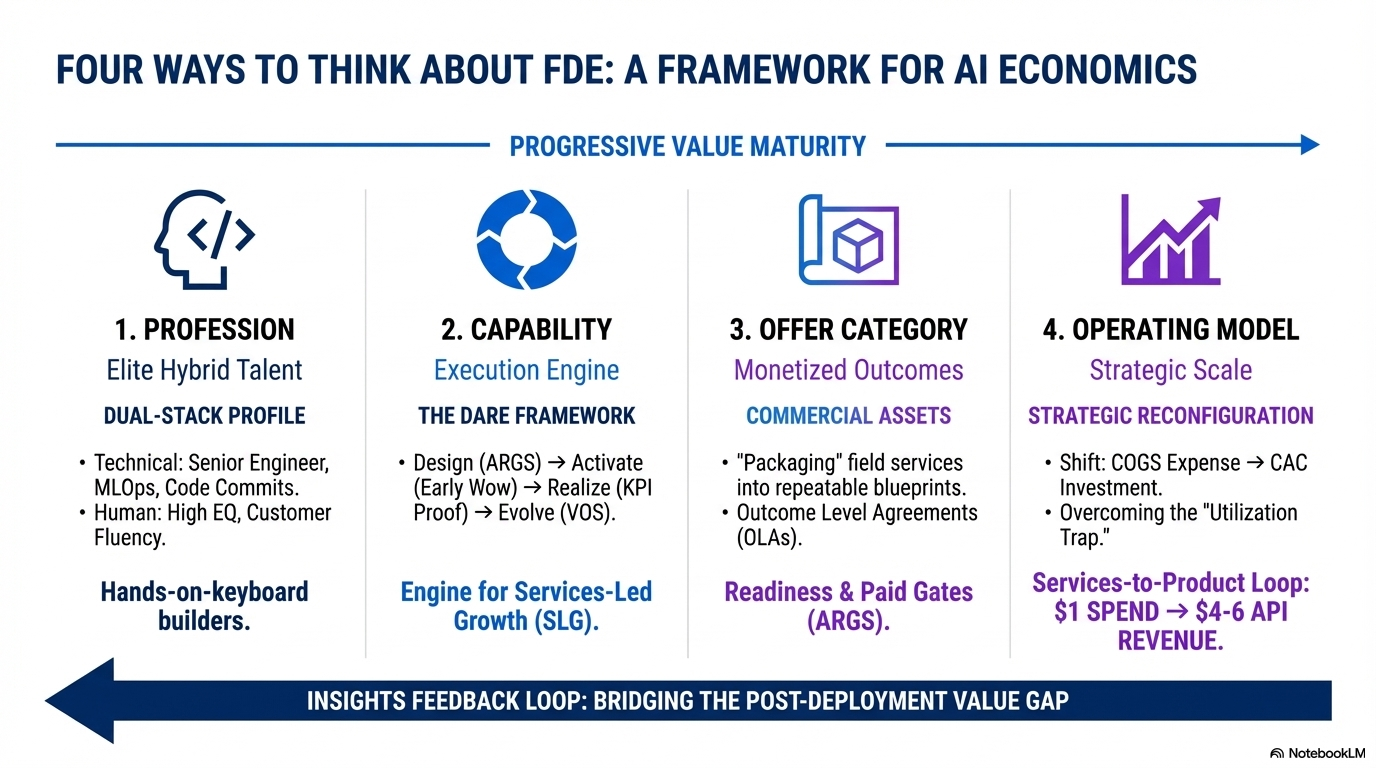
Pillar 1: Forward Deployed Engineering as a Job Role
At its core, FDE starts with a new type of talent. These aren’t traditional software engineers. And they’re not consultants either. They sit somewhere in between.
The hybrid skill set
To succeed in this role, forward deployed engineers need two equally important capabilities:
1. Technical depth:
- Writing production-grade code.
- Building data pipelines.
- Working across MLOps and model optimization.
2. Business and customer fluency:
- Translating ambiguous problems into technical solutions.
- Communicating with stakeholders.
- Acting as a trusted advisor inside the account.
You can think of them as fractional CTOs embedded within your customer’s organization.
Why talent is the biggest constraint
Finding this type of talent is difficult. These are high-performing engineers who are also comfortable working directly with customers.
To address this, many organizations are:
- Rotating top R&D engineers into the field.
- Building structured programs to develop hybrid skills.
- Treating FDE roles as high-prestige positions, not secondary support functions.
If you don’t solve the talent challenge, you won’t scale AI outcomes.
Pillar 2: Forward Deployed Engineering as an Organizational Capability
Hiring a few strong engineers isn’t enough. To make FDE work, you need to operationalize it across your organization. This requires a shift from product-led growth to a more services-led model.
Moving beyond LAER with DARE
Instead of waiting for adoption to drive value, you proactively design and deliver outcomes through the DARE framework:
- Design: You assess readiness upfront. This includes data, infrastructure, and governance. Without this step, AI initiatives stall before they begin.
- Activate: You focus on delivering a fast, visible win. Within the first 30 to 60 days, your customer should see a clear improvement tied to a real workflow.
- Realize: You continuously prove value against business KPIs. At this stage, renewal becomes a natural outcome of performance.
- Evolve: You refine models, adjust workflows, and expand impact over time. AI systems are never static.
This approach ensures you’re not just deploying AI; you’re making it work.

The service pod model
To support this, many organizations adopt a service pod structure, which brings together:
- The forward deployed engineer (builder).
- The forward deployed operator (FDO).
This creates a tight feedback loop between building and running the solution. Real-world performance data feeds directly back into development, improving outcomes faster.
Related: From LAER to DARE: Why the AI Era Demands a New Customer Engagement Model
Pillar 3: Forward Deployed Engineering as a Commercial Offer
To scale FDE, you can’t treat it as open-ended custom work. You need to package it into repeatable, monetizable offers.
From services to scalable assets
The goal is to turn one-off implementations into reusable blueprints. These blueprints make your platform harder to replace and increase long-term customer value. This is where you start trading short-term margin for long-term defensibility.
The three-phase commercial model
A structured approach to monetizing FDE typically includes:
- AI readiness and governance services (ARGS): These are paid upfront engagements that prepare the customer environment and qualify high-value opportunities.
- Outcome-Oriented AI Services (OOAS): These services focus on delivering and validating specific business results enabled by AI solutions.
- Value optimization services (VOS): Ongoing services that scale and refine outcomes, often tied to consumption or shared value models.
Why outcome-level agreements matter
Traditional SLAs focus on uptime. That’s no longer enough. With FDE, you shift toward outcome-level agreements (OLAs), in which you take accountability for business results such as accuracy rates or deflection percentages. If those outcomes aren’t met, you share the downside. This fundamentally changes the relationship with your customer. You’re no longer selling software. You’re delivering results.
Pillar 4: Forward Deployed Engineering as an Operating Model
The final shift is the most important. FDE becomes embedded into how your business operates.
Rethinking how you measure value
Traditional services organizations optimize for utilization. But in the AI era, that metric can hold you back. Some of the most valuable work an FDE does, like turning a custom solution into a reusable blueprint, doesn’t look efficient in a utilization model.
That’s why leading organizations are:
- Reclassifying FDE spend from cost of goods sold (COGS) to customer acquisition cost (CAC).
- Viewing FDE as a driver of long-term platform revenue.
In many cases, $1 invested in FDE can generate multiple dollars in downstream consumption.
The three stages of FDE maturity
To scale this model, organizations typically move through three phases:
- Artisan phase: You focus on solving high-value, complex problems for strategic customers.
- Industrial phase: You standardize what works, turning custom solutions into repeatable assets.
- Orchestration phase: You scale delivery through partners and broader ecosystems.
This progression allows you to move from bespoke work to scalable impact.
Aligning teams with a matrixed structure
To support this, organizations often adopt a matrixed command model:
- A central engineering group ensures technical quality and consistency.
- A field organization focuses on customer outcomes and priorities.
This creates a continuous loop where insights from the field feed directly into product development.
Why Forward Deployed Engineering Matters Now
If you’re investing in AI, you’re likely already seeing the gap between potential and results. Forward deployed engineering is how you close that gap. It connects your product to real-world outcomes. It aligns your revenue model with the value you deliver. And it gives you a path to scale AI in a way that actually works for your customers. More importantly, it helps you move beyond adoption and into something more meaningful: consistent, measurable impact.
Related: The Rise of Forward Deployed Engineering
Closing the Gap Between AI Potential and Business Outcomes
The shift to AI Economics isn’t just changing how technology works. It’s changing how value is created, delivered, and captured.
Forward deployed engineering sits at the center of that shift.
- When you treat it as a role, you get better implementations.
- When you treat it as a capability, you get repeatable success.
- When you treat it as an offer, you unlock new revenue models.
- When you treat it as an operating model, you transform your business.
This is how you move from experimenting with AI to building a sustainable, outcome-driven strategy.
FAQs
What is forward deployed engineering?
Forward deployed engineering is a delivery model where engineers work directly within a customer’s environment to implement, customize, and optimize technology solutions, especially AI, to ensure measurable business outcomes.
Why is forward deployed engineering important for AI?
AI systems often fail to deliver value due to poor integration with existing systems and workflows. Forward deployed engineers solve this “last mile” problem by embedding directly with customers and ensuring AI solutions work in real-world conditions.
How does forward deployed engineering impact revenue models?
FDE supports the shift from traditional per-seat pricing to outcome-based and consumption-based models. By focusing on results, organizations can align pricing with the value their AI delivers, rather than the number of users.
Smart Tip: Embrace Data-Driven Decision Making
Making smart, informed decisions is more crucial than ever. Leveraging TSIA’s in-depth insights and data-driven frameworks can help you navigate industry shifts confidently. Remember, in a world driven by artificial intelligence and digital transformation, the key to sustained success lies in making strategic decisions informed by reliable data, ensuring your role as a leader in your industry.

.png)