For years, managed services followed a familiar formula. You paid a provider to keep your systems running, resolve issues when they appeared, and manage IT complexity behind the scenes. That model no longer holds.
AI is reshaping how work gets done. Customers are no longer buying technical tasks. And the economics that once supported managed services—billing for labor, tickets, and uptime—are breaking down.
You’re now operating in a market where:
- AI can resolve issues faster than humans.
- Foundational services are fully commoditized.
- Customers expect measurable business outcomes, not operational support.
This has created a clear identity crisis. And if you don’t redefine what you sell and how you deliver it, you risk becoming irrelevant.
Key Takeaways
- The traditional managed services model is collapsing as AI eliminates labor-based value and customers demand business outcomes over technical tasks.
- Your differentiation now comes from outcomes, not operations, shifting your role from IT support provider to business resilience partner.
- Four major trends are reshaping the future of MSPs, including agentic AI, human-led strategy, value-based packaging, and product-service convergence.
Why Managed Services Is Facing an Identity Crisis
For decades, managed services operated on a simple promise: take the burden of IT off your hands for a predictable fee. This “mess for less” model worked when customers needed help managing infrastructure. But today, what you’re built to sell no longer matches what your customers want to buy.
You may still be structured around:
- Hours.
- Tickets.
- SLAs.
- Technical tasks.
But your customers are looking for:
- Business outcomes.
- Resilience.
- Agility.
- Competitive advantage.
That gap is the root of the identity crisis.
The Subscription vs. Service Confusion
A major contributor to this confusion is how many organizations misunderstand what they’re actually selling. A subscription is a pricing model. A service is a value delivery model. If you’re focused on how customers pay instead of what they achieve, you end up selling billing structures, not outcomes. And customers don’t buy billing structures. They buy results.
Related: Why MSPs Must Build a Service-Led Foundation to Reach AI-First Success
The Legacy Model Is Breaking Faster Than You Think
The economic foundation of managed services is eroding quickly.
The Tech-First Trap
Many organizations are still stuck in a reactive, “monitor and notify” model:
- Systems generate alerts.
- Tickets are created.
- Engineers resolve issues.
This model only proves value when something breaks. If everything works as expected, your customer starts questioning the cost. That’s a dangerous place to be.
Commoditization Is Already Here
Services like:
- Monitoring
- Patching
- Backups
- Antivirus
Are no longer differentiators. They’re expected. If your revenue still depends on these services, you’re competing in a race to the bottom.
The Consumption Gap Is Driving Churn
Even when your technology works, your customers may not see value. Why? Because they aren’t using what they bought. For example, a customer may invest in a robust platform but only use a fraction of its capabilities. At renewal time, they question the cost and often downgrade or leave. Closing this gap is now critical to retention.
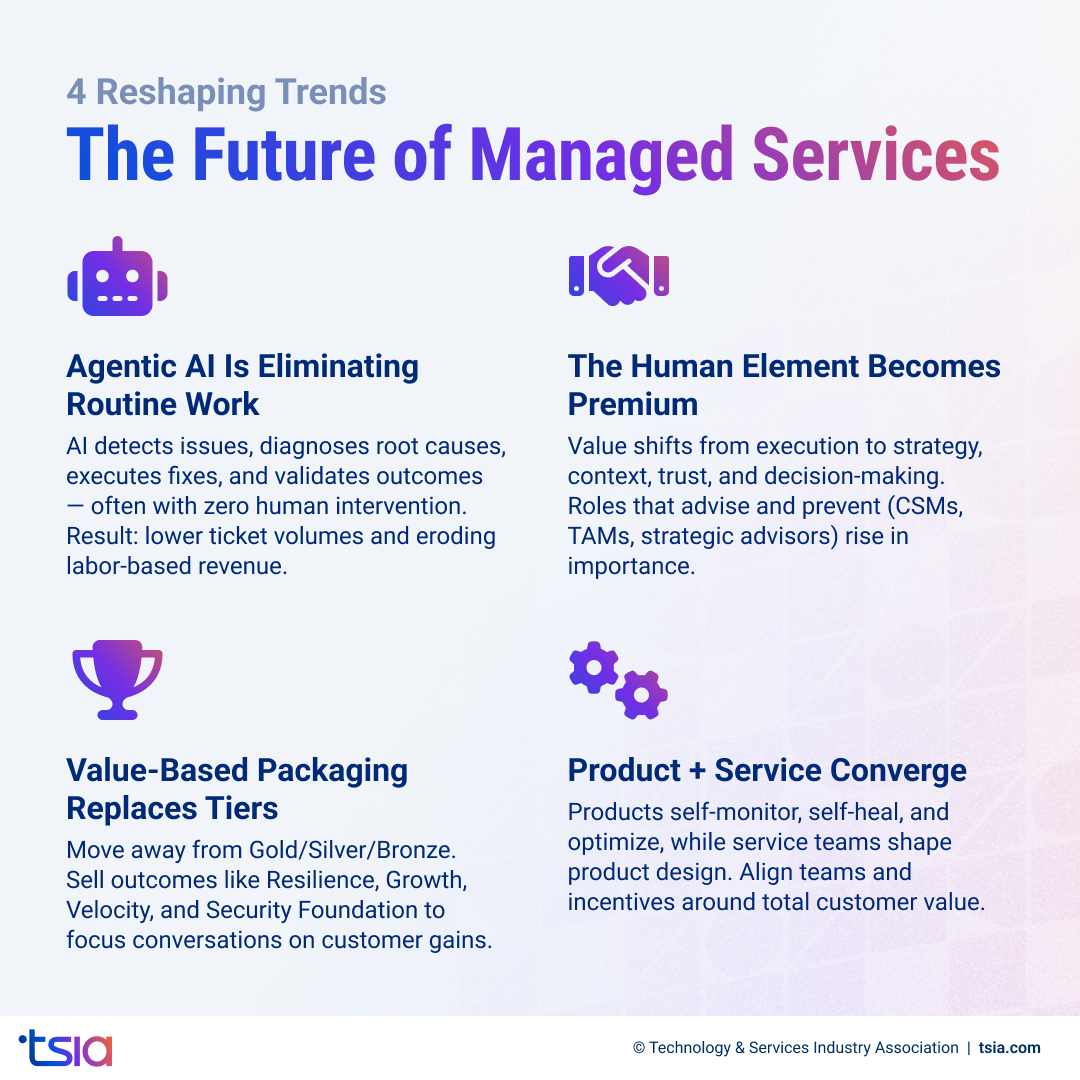
The 4 Trends Reshaping the Future of Managed Services
To move forward, you need to understand the forces redefining your business model.
1. Agentic AI Is Eliminating Routine Work
AI has moved beyond assisting humans—it’s now replacing entire workflows.
Agentic AI can:
- Detect issues
- Diagnose root causes
- Execute fixes
- Validate outcomes
All without human intervention.
This has major implications:
- Level 1 service desks are disappearing.
- Ticket volumes are declining.
- Labor-based pricing models are collapsing.
If your revenue depends on effort and AI removes effort, your revenue disappears. You can’t mark up a cost that no longer exists.
Related: Guiding MSPs Through AI-First Transformation
2. The Human Element Becomes Premium
As AI handles execution, the value of human work shifts.
You’re no longer monetizing technical tasks. You’re monetizing:
- Strategy.
- Context.
- Trust.
- Decision-making.
This is where roles like:
- Customer Success Managers
- Technical Account Managers
- Strategic Advisors
Become critical. Instead of fixing problems, your role becomes preventing them and guiding your customers toward better outcomes.
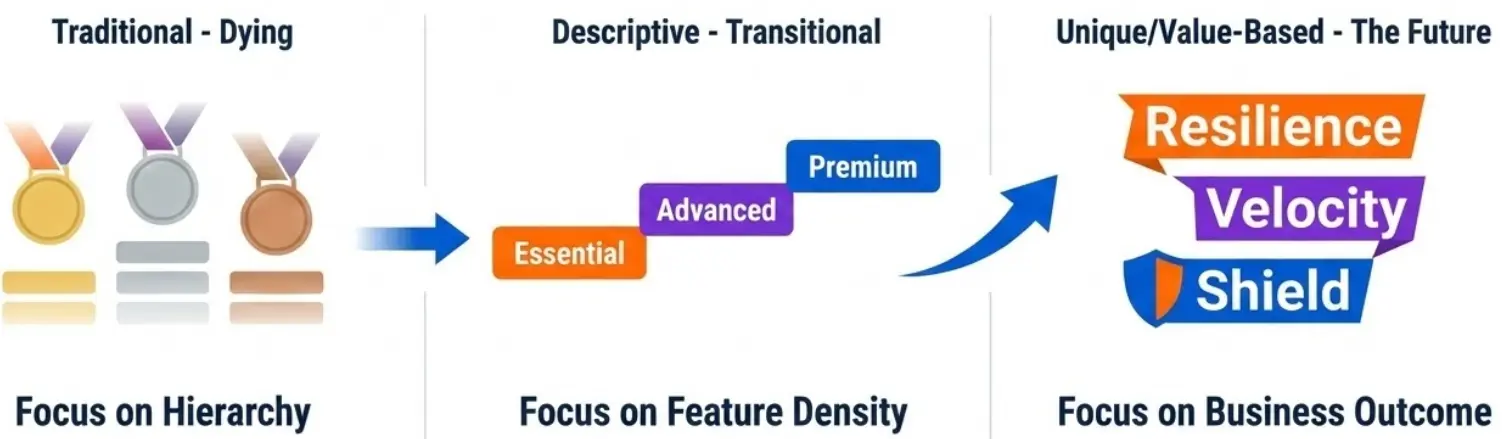
3. Value-Based Packaging Replaces Generic Tiers
If you’re still selling Gold, Silver, and Bronze packages, you’re reinforcing commoditization.
These labels:
- Offer no differentiation.
- Encourage price comparisons.
- Signal hierarchy rather than value.
Instead, leading providers are shifting to outcome-based naming, like:
- Resilience.
- Growth.
- Velocity.
- Security Foundation.
This forces a different conversation, one focused on what the customer gains rather than what they receive.
4. Product and Service Are Becoming One
The line between product and service is disappearing.
AI-powered products can now:
- Self-monitor.
- Self-heal.
- Optimize performance.
Which means the product itself delivers service.
At the same time, service teams are influencing product design to ensure outcomes are achievable.
This convergence requires:
- Unified teams.
- Aligned incentives.
- A shared focus on total customer value.
If your product and services teams are still operating in silos, you’re already behind.
What the Future Looks Like: From MSP to Business Resilience Partner
As these trends take hold, your identity will shift. You’re no longer just managing IT systems—you’re responsible for business outcomes.
From SLAs to XLAs
Traditional SLAs measure system performance. But they don’t capture user experience. That’s why leading organizations are moving to Experience Level Agreements (XLAs).
- Instead of asking: “Is the system up?”
- You’re asking: “Can your employees actually do their jobs?”
This shift aligns your metrics with real business impact.
Outcome-Based Pricing Becomes the Standard
Instead of charging for effort, you’ll charge for results:
- Risk reduction.
- Revenue growth.
- Operational efficiency.
This aligns your success with your customer’s success and creates a true partnership model.
Related: Why Managed Services Thrives in Outcome-Based Offers
AI-Native Services: Define Your Portfolio
The most valuable services moving forward will be built around AI.
These include:
- AI Readiness: Preparing data and systems for AI adoption.
- AI Governance: Ensuring AI is compliant, ethical, and secure.
- Value Optimization: Continuously improving AI performance and outcomes.
These services are harder to replicate and far more valuable than traditional offerings.
The managed services identity crisis isn’t a temporary disruption. It’s a structural shift. If you continue to operate as a tech-first, labor-based provider, you’ll be outpaced by AI and undercut by competitors who’ve already automated the basics. But if you redefine your role—focusing on outcomes, resilience, and strategic value—you position yourself for long-term growth.
- The question is no longer: “What services do you provide?”
- It’s: “What outcomes do you deliver?”
FAQs
What is causing the managed services identity crisis?
The identity crisis stems from a disconnect between what providers sell (technical tasks and labor) and what customers want (business outcomes and resilience). AI is accelerating this shift by eliminating the value of routine work.
How does AI impact managed services pricing?
AI reduces the need for human labor, which undermines traditional cost-plus pricing models. As a result, providers must shift to outcome-based pricing, in which they charge for results rather than effort.
What should MSPs focus on to stay competitive?
To remain competitive, you need to:
- Automate low-value tasks.
- Focus on strategic, human-led services.
- Close the consumption gap for customers.
- Shift to outcome-based pricing and delivery.
Smart Tip: Embrace Data-Driven Decision Making
Making smart, informed decisions is more crucial than ever. Leveraging TSIA’s in-depth insights and data-driven frameworks can help you navigate industry shifts confidently. Remember, in a world driven by artificial intelligence and digital transformation, the key to sustained success lies in making strategic decisions informed by reliable data, ensuring your role as a leader in your industry.