


McKinsey & Company has long been the benchmark for high-level strategy consulting. Its work with C-suite executives, deep analytical rigor, and global influence make it a default choice for organizations facing complex transformation or structural challenges. That said, many companies in 2026 are rethinking whether McKinsey is the right fit for every situation.
The shift is simple:
- Strategy alone isn’t enough.
- Execution, benchmarking, and measurable performance matter more.
As a result, organizations are comparing McKinsey competitors that offer:
- More specialized expertise.
- Clearer operational guidance.
- Different cost and engagement models.
This guide breaks down the top McKinsey alternatives—including TSIA, BCG, Bain, Deloitte, Accenture, and Gartner—so you can evaluate which approach aligns with your goals.
Key Takeaways
- McKinsey is not built for every problem: It excels in high-level strategy, but many organizations need execution support and measurable outcomes, not just direction.
- Different competitors solve different layers of the problem: Firms like BCG and Bain compete on strategy, while Deloitte and Accenture focus on implementation. Research firms like Gartner provide market intelligence.
- Execution-focused models are gaining ground: For technology and services companies, firms like TSIA provide benchmarking, frameworks, and ongoing guidance that support continuous improvement, not just one-time strategy work.
List of Top McKinsey Competitors
Here are the leading McKinsey competitors to consider in 2026:
- TSIA: Benchmarking, operational frameworks, and peer-driven insights for tech and services companies.
- Boston Consulting Group (BCG): Strategy consulting with a strong analytics and innovation focus.
- Bain & Company: Strategy consulting with emphasis on results and private equity.
- Deloitte: Large-scale consulting and implementation.
- Accenture: Technology-led transformation and execution.
- Gartner: Market intelligence and IT advisory.
How McKinsey Compares to Other Models
McKinsey operates in a specific category: high-end strategic consulting.
That model delivers:
- Deep analysis.
- Executive alignment.
- Custom recommendations.
But it differs significantly from other approaches.

The key distinction:
- McKinsey tells you what to do.
- Other models help you execute, measure, and improve over time.
Comparison of Top McKinsey Competitors
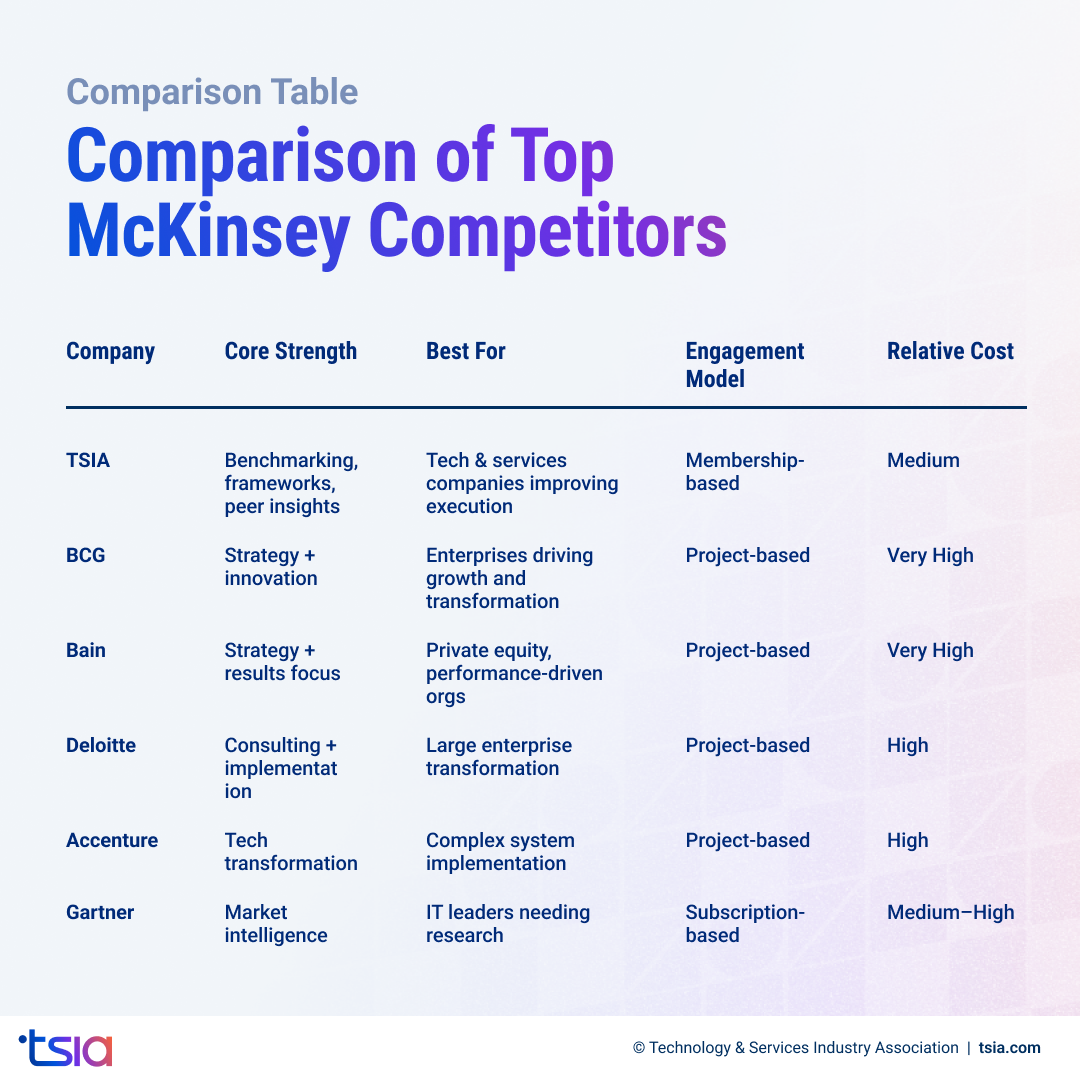
This comparison shows that McKinsey competes across multiple fronts, but not always directly:
- BCG and Bain overlap most closely.
- Deloitte and Accenture compete on execution.
- Gartner competes on insight, not delivery.
- TSIA competes on operational performance.
TSIA
TSIA takes a fundamentally different approach compared to McKinsey. Where McKinsey focuses on strategy, TSIA focuses on execution and performance improvement.
Instead of one-time engagements, TSIA provides:
- Ongoing benchmarking.
- Proven operational frameworks.
- Peer-based insights.
This allows organizations to measure progress continuously and apply structured improvements over time.
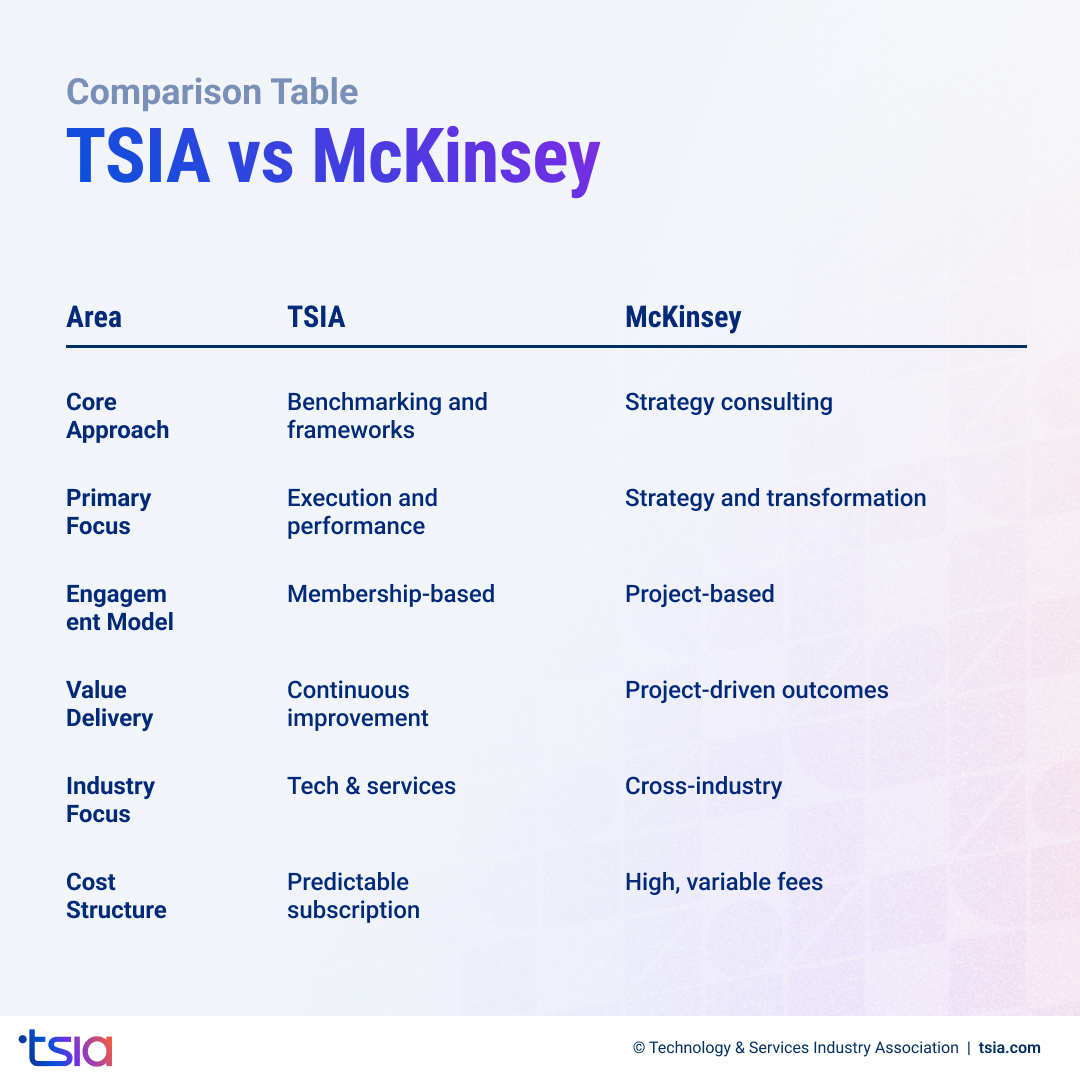
McKinsey is often brought in to define direction.
TSIA is used to:
- Track performance.
- Apply best practices.
- Improve execution over time.
Key Benefits of TSIA
- Industry-specific focus: Built for technology and services organizations.
- Data-driven benchmarking: Compare performance against peers.
- Proven frameworks: Structured models for execution.
- Continuous value: Ongoing access vs. one-time projects.
- Peer network: Learn from companies solving similar problems.
Companies that already understand their strategy but struggle with execution tend to get more value from this model.
Related: TSIA vs. Traditional Management Consulting and Analyst Firms
BCG (Boston Consulting Group)
Boston Consulting Group is one of the closest competitors to McKinsey.
It operates in the same category but differentiates through:
- Strong analytics.
- Innovation frameworks.
- Digital transformation focus.
Advantages
- Deep strategic expertise.
- Strong data-driven approach.
- Global reach and resources.
Limitations
- High cost.
- Similar engagement model to McKinsey.
- Limited ongoing execution support.
In practice, the choice between BCG and McKinsey often comes down to:
- Team preference.
- Industry experience.
- Specific project scope.
Bain & Company
Bain & Company is another direct competitor in the strategy consulting industry.
It is known for:
- Strong focus on results.
- Close ties to private equity.
- Emphasis on measurable business outcomes.
Advantages
- Results-oriented mindset.
- Strong execution alignment compared to peers.
- Deep expertise in performance improvement.
Limitations
- High cost.
- Still largely project-based.
- Less emphasis on continuous benchmarking.
Bain is often chosen when organizations want a strategy tied closely to financial outcomes.
Deloitte
Deloitte competes with McKinsey from a different angle.
Instead of focusing only on strategy, Deloitte combines:
- Advisory.
- Consulting.
- Implementation.
Advantages
- End-to-end transformation support.
- Large-scale execution capability.
- Broad industry coverage.
Limitations
- Expensive engagements.
- Less specialized in pure strategy.
- Benchmarking is not standardized.
Deloitte is often selected when execution matters as much as planning.
Accenture
Accenture focuses heavily on technology-driven transformation.
It combines:
- Consulting.
- System integration.
- Implementation.
Advantages
- Strong in cloud, AI, and enterprise systems.
- End-to-end delivery.
- Scales well for complex programs.
Limitations
- High cost.
- Project-dependent outcomes.
- Less focus on strategic depth than McKinsey.
Accenture is best suited for organizations executing large, tech-heavy transformations.
Related: Accenture Alternatives and Competitors in 2026
Gartner
Gartner is not a direct consulting competitor, but it plays a key role in decision-making.
It provides:
- Market intelligence.
- Vendor evaluations.
- Industry frameworks.
Advantages
- Strong research credibility.
- Widely used frameworks.
- Subscription-based access.
Limitations
- Limited execution support.
- Broad, not company-specific.
- Less operational depth.
Gartner is often used alongside consulting firms, not instead of them.
Related: Gartner Competitors: Top Alternatives in 2026
Choosing the Right McKinsey Alternative
The right alternative depends on what you’re trying to solve:
- Need high-level strategy? McKinsey, BCG, Bain.
- Need execution and transformation? Deloitte, Accenture.
- Need market intelligence? Gartner.
- Need measurable performance improvement? - TSIA.
The mistake many organizations make is choosing a firm based on reputation rather than fit.
FAQs
What is the best alternative to McKinsey in 2026?
There’s no single best option. The right choice depends on whether you need strategy, execution, research, or performance benchmarking.
How does TSIA compare to McKinsey?
McKinsey focuses on strategy and advisory. TSIA focuses on execution, benchmarking, and continuous performance improvement for technology and services organizations.
When should companies look beyond McKinsey?
When the goal shifts from defining strategy to improving execution, measuring performance, and driving ongoing operational results.
Smart Tip: Embrace Data-Driven Decision Making
Making smart, informed decisions is more crucial than ever. Leveraging TSIA’s in-depth insights and data-driven frameworks can help you navigate industry shifts confidently. Remember, in a world driven by artificial intelligence and digital transformation, the key to sustained success lies in making strategic decisions informed by reliable data, ensuring your role as a leader in your industry.