Accenture is one of the most recognized global consulting and professional services firms, known for its scale, breadth, and ability to execute complex transformation programs across industries. In 2025, many organizations are re-evaluating whether Accenture is the right fit for their needs. As AI adoption accelerates, organizations are having to rethink whether traditional consultancy models can still provide the measurable outcomes they once could.
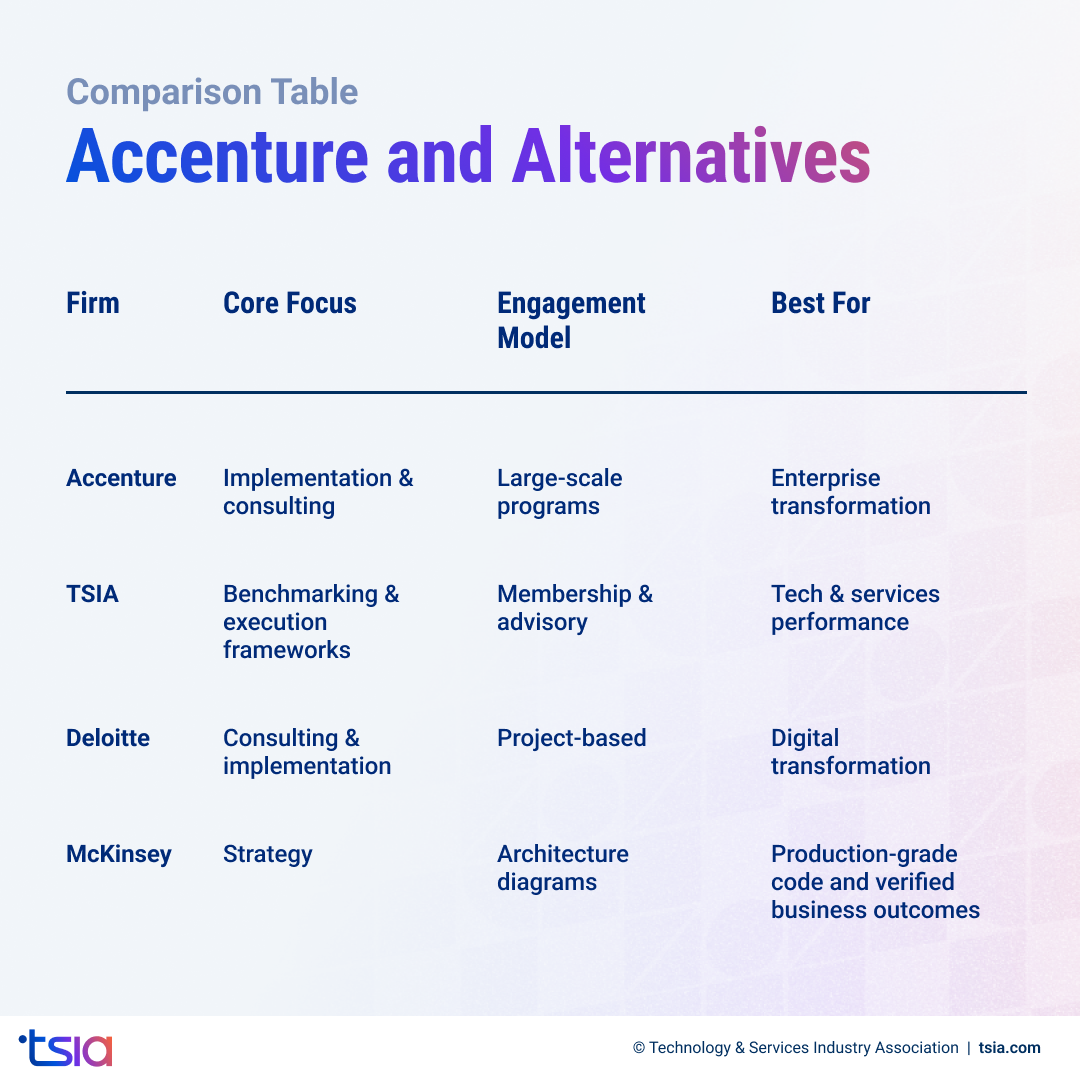
In this guide, we compare Accenture with top competitors, including TSIA, Deloitte, McKinsey, and PwC, to help provide an understanding of where each firm excels, and how they differ, as well as which options align most with your company’s goals.
Key Takeaways
- Scale vs. specialization is the trade-off: Accenture offers unmatched global delivery capabilities, but many alternatives focus more on strategy, benchmarking, and industry execution.
- Different firms operate under different value models: Accenture and Deloitte emphasize large-scale implementation, while McKinsey and BCG are focused on high-level strategy. TSIA stands out as an execution-focused model tailored to tech and services organizations.
- Execution clarity is the differentiator: AI-driven transformation has become more complex, leading organizations to prioritize partnerships that translate strategy into measurable outcomes.
List of Accenture’s Top Competitors
- TSIA: Industry-specific research, benchmarking, and execution frameworks for technology and services organizations.
- Deloitte: End-to-end consulting and implementation across digital transformation initiatives.
- McKinsey & Company: High-level strategic advisory for enterprise leadership.
- PwC: Consulting and advisory services with strong regulatory and financial expertise.
- BCG: Strategy-led consulting with growing digital and AI capabilities.
Breakdown of Each Competitor
TSIA
The Technology & Services Industry Association represents a business model that is considerably different from Accenture's. While the latter focuses on delivering large-scale transformation programs, TSIA is designed to help technology and services organizations improve performance through benchmarking, frameworks, and peer-driven insights.
TSIA’s approach focuses on helping companies understand how they perform relative to their peers and what actions are required to improve. Rather than executing the transformation on behalf of clients, TSIA provides the tools and frameworks that empower organizations to execute these essentials themselves.
Key strengths:
- Industry focus: Exclusively designed for technology and services organizations.
- Benchmark-driven insights: Helps organizations measure performance and identify gaps.
- Execution frameworks: Models like LAER and DARE help to transition strategy into action.
- Peer network: Access to real-world insights from similar enterprises.
These are key insights that make TSIA essential for companies seeking measurable operational improvements, particularly in areas such as customer success and AI adoption.
Related: From LAER to DARE: Why the AI Era Demands a New Customer Engagement Model
Deloitte
Deloitte is one of Accenture's closest competitors in terms of scale and breadth of services. Much like Accenture, Deloitte gives end-to-end consulting services, combining strategy and operational support.
Strengths
- Broad capabilities across consulting and financial advisory services.
- Strong implementation expertise.
- Integrated approach across business and technology.
Weaknesses
- Complex engagements.
- Costly processes.
- Less specialization in the performance of technology services.
Deloitte is considered a strong alternative for organizations seeking large-scale transformation, with integrated advisory services, especially for regulatory and financial considerations.
McKinsey & Company
McKinsey is in an entirely different category from Accenture and focused on high-level strategy rather than implementation. It’s best known for working directly with leadership to define strategies that transform your business and solve its complex problems.
Strengths
- Strategic, executive-level expertise.
- A strong, analytical, data-driven approach.
- C-suite leadership brings high credibility.
Weaknesses
- Limited implementation capabilities.
- High-cost engagements.
- Project-based engagements.
McKinsey is the optimal choice for companies seeking clarity on their strategic direction, rather than those seeking full-scale support.
PwC
PricewaterhouseCoopers is well-known for combining consultancy with strong audit, tax, and risk advisory capabilities, making it a compelling and unique alternative to Accenture. With consultancy services integrating with finance and regulatory expertise, PwC is one of the leading names in the finance sector.
Strengths
- Strong focus on regulatory compliance.
- Integrated consulting and financial services.
- Broad enterprise transformation experience.
Weaknesses
- Less tech-specific execution.
- Lacking in AI depth.
PwC is undoubtedly a strong fit for organizations looking to navigate regulated industries or thrive in environments with complex compliance requirements.
Boston Consulting Group (BCG)
BCG is considered another of the ‘Big Three’ strategy consulting firms, but the company is known for its focus on innovation and strategy, and attempts at transformation. In recent times, the company has expanded its expertise in AI and digital platforms via its BCG X division.
Strengths:
- Strong focus on innovation.
- Growing capabilities in AI and digital transformation.
- High-impact advisory work.
Weaknesses
- Less emphasis on large-scale implementation.
- Engagements can sometimes be costly.
BCG is ideal for businesses and organizations seeking innovative leadership and the potential for strategic transformation. This is especially pertinent in the field of emerging technologies.
Related: Gartner Competitors: Top Alternatives in 2026
Accenture vs. Alternatives: Delivery Model Differences
One of the most important distinctions between these firms is how they deliver value.
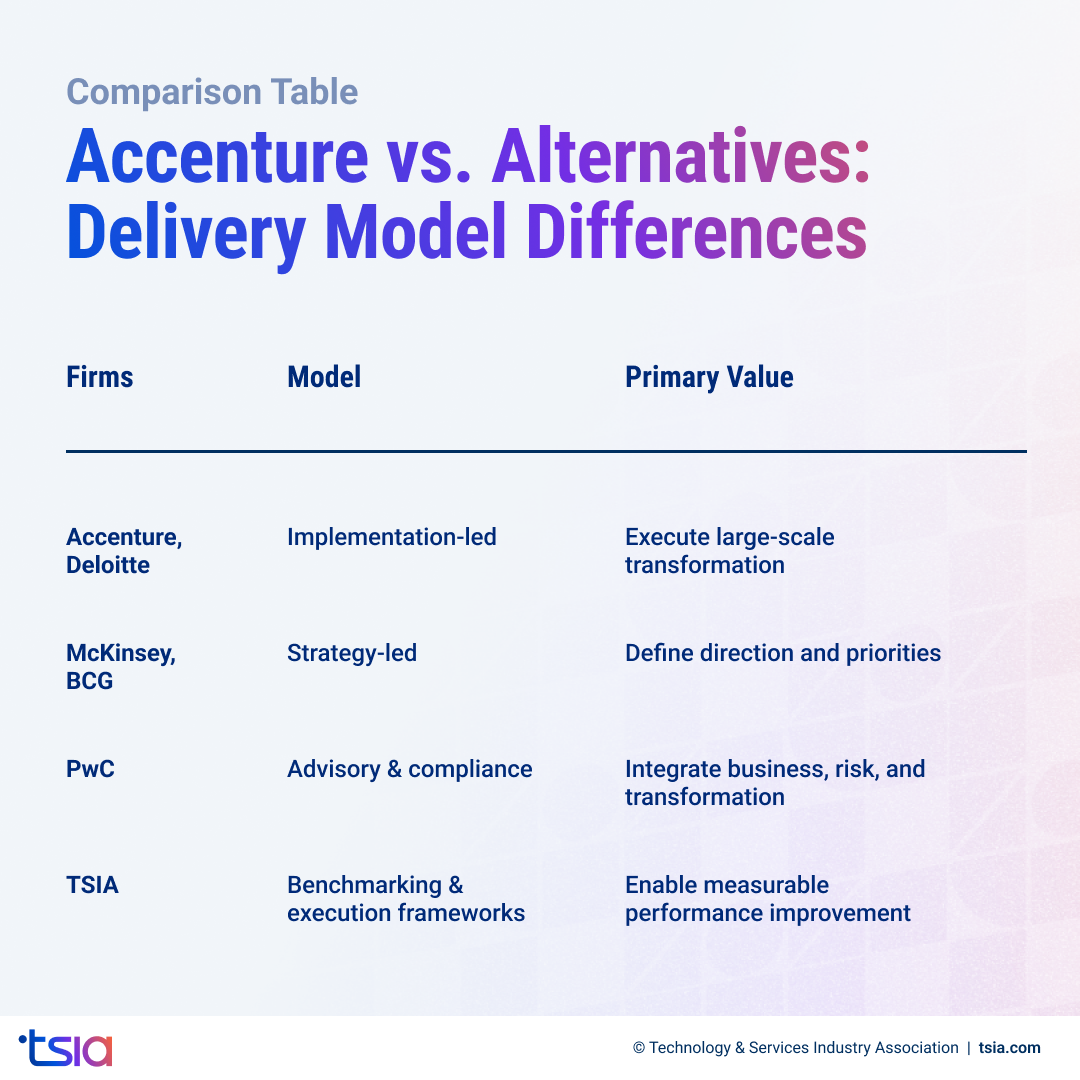
As the corporate world moves toward AI-driven transformation, connecting strategy with measurable outcomes is crucial to long-term success and future development.
Choosing the Right Accenture Alternative
Making sure you choose the right alternative to Accenture is vital for ensuring your company thrives. Your decision will depend on what your business goals are and what you are looking to achieve. For instance, if you are looking for a large-scale implementation, Accenture or Deloitte are the ideal choice. Executive-level strategy is perfectly suited to McKinsey and BCG.
If you want a compliance-driven transformation, PwC is certainly the standout choice. But ultimately, if your goal is to improve operational performance, TSIA can give you a targeted approach to meet measurable benchmarks. What’s important here is understanding whether your business requires execution, strategy, or performance optimization. Each choice is optimized for a different area and offers a different type of value.
Related: Forrester Competitors: Best Alternatives To Consider in 2026
Rethinking Consulting in the AI Era
AI is reshaping how businesses are run and is set to have a strong impact on the future. As this happens, the traditional model for consultation is continually evolving. Large-scale implementation alone is no longer enough. Businesses are increasingly looking to translate strategy into measurable outcomes that can drive long-term growth and success.
Accenture is essential for enterprise transformation, but alternative models are growing in prominence and importance, and becoming more relevant as complexity continues to evolve. Choosing the right partner for your organization requires a clear understanding of what each business offers and how its value aligns with your company’s needs, goals, and expectations.
FAQs
Who are the main competitors of Accenture?
There are several competitors your organization might choose instead of Accenture, including Deloitte, McKinsey & Company, BCG, PwC, and TSIA. Each provides a different value to your business.
What is the best alternative to Accenture?
There isn’t a single best alternative, and the right choice for you will largely depend on where your organization needs improvement and whether your focus is on performance benchmarking, large-scale implementation, or execution frameworks.
How is TSIA different from Accenture?
While Accenture focuses on delivering large transformation programs, TSIA focuses on enabling organizations to execute directives more effectively rather than executing them on their behalf.
Smart Tip: Embrace Data-Driven Decision Making
Making smart, informed decisions is more crucial than ever. Leveraging TSIA’s in-depth insights and data-driven frameworks can help you navigate industry shifts confidently. Remember, in a world driven by artificial intelligence and digital transformation, the key to sustained success lies in making strategic decisions informed by reliable data, ensuring your role as a leader in your industry.