For years, your business likely grew by selling access—software seats, licenses, or billable hours. The more people use your product, the more revenue you generate. But AI is breaking that model.
Today, the better your technology performs, the less your customer needs to rely on people, seats, or time. That creates a serious problem: your product can succeed while your revenue declines. This is the AI Value Paradox, and it’s forcing a fundamental shift in how you design, price, and deliver your offerings.
Offering Management 2.0 is the response. It’s a new way of thinking about how you monetize value, shifting your focus from selling access to selling measurable outcomes. In this blog, you’ll learn what that shift means for you and how to start making it.
Key Takeaways
- Your current pricing model is at risk: AI reduces the need for seats and billable hours, which directly threatens traditional revenue streams.
- Outcome-based models are becoming the new standard: Leading companies are moving up the AI Pricing Ladder and charging for results, not usage.
- You need to redesign how your business operates: Success requires changes across your people, processes, and technology to consistently prove and deliver value.
Why Your Current Model Is Breaking
For decades, the economics of the technology industry were straightforward: complexity drove revenue.
You sold:
- Software seats.
- Usage-based access.
- Time and expertise.
But AI flips that equation.
When AI automates work:
- Fewer employees are needed.
- Fewer licenses are required.
- Less time is spent delivering outcomes.
That means your traditional pricing model starts working against you. This is what TSIA defines as the AI Value Paradox: when delivering more value results in less revenue under legacy models. And this isn’t theoretical. The market is already reacting.
Companies that fail to adapt their revenue models are seeing declining valuations as investors recognize this structural risk. So the question becomes: how do you capture value in a world where effort no longer drives revenue?
What “Good” Looks Like in the AI Era
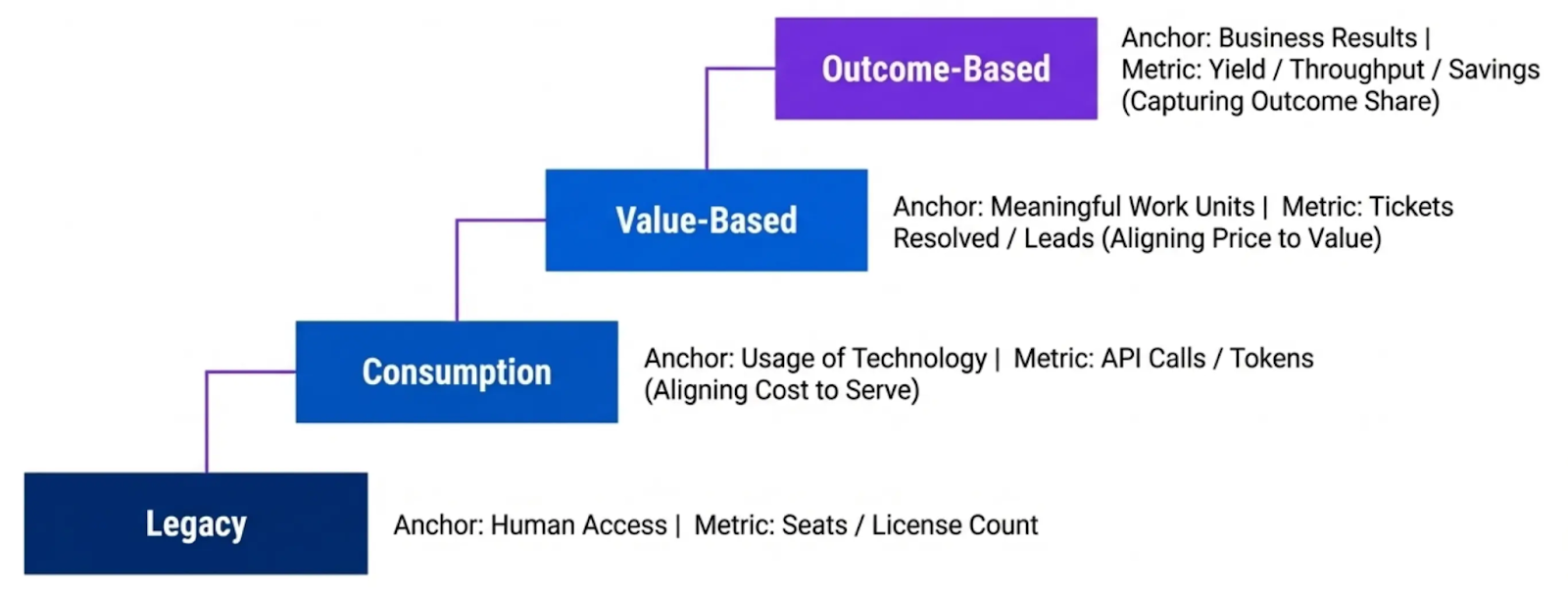
Leading organizations aren’t trying to fix legacy pricing—they’re replacing it. They’re moving up what TSIA calls the AI Pricing Ladder, shifting from selling access to selling outcomes.
Here’s how that progression works:
1. Legacy (Access-Based)
- Revenue tied to seats or licenses.
- Value is measured by access.
2. Consumption-Based
- Revenue tied to usage.
- Value measured by activity.
3. Value-Based
- Revenue tied to work completed.
- Value measured by outputs (e.g., tickets resolved).
4. Outcome-Based
- Revenue tied to business results.
- Value measured by impact (e.g., cost savings, revenue growth).
At the top of this ladder, you’re no longer selling software or services—you’re selling results. And companies that get this right are scaling fast. AI-native players are already proving that outcome-based pricing can drive rapid growth by aligning revenue directly with customer success.
Rethinking the Customer Lifecycle: From LAER to DARE
If you want to sell outcomes, you can’t rely on a lifecycle designed for product adoption. The traditional model—Land, Adopt, Expand, Renew (LAER)—focuses on usage and retention. But in the AI era, success is about delivering measurable value.
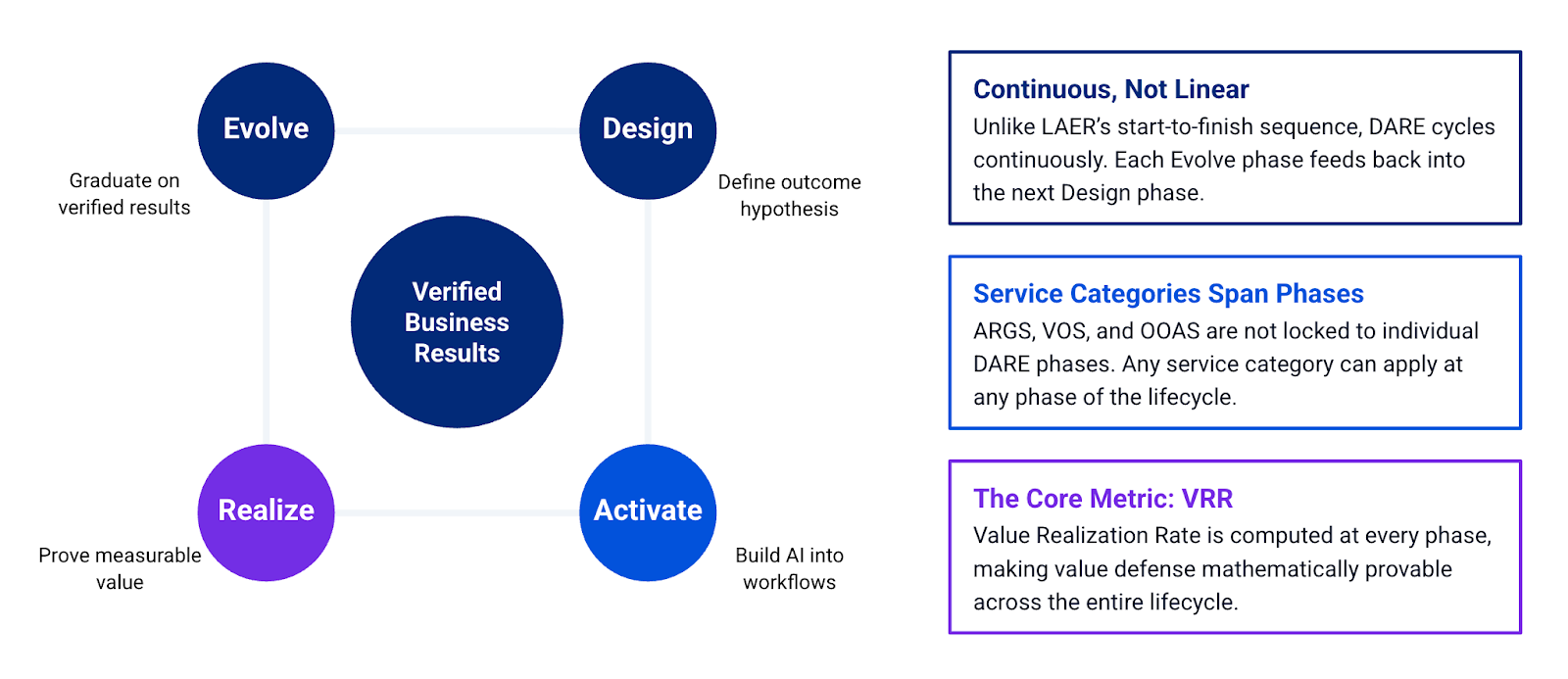
That’s why leading organizations are shifting to the DARE model:
- Design: You define the expected outcome and align on value upfront.
- Activate: You deploy AI and services to begin delivering that outcome.
- Realize: You measure and prove the value being created.
- Evolve: You continuously optimize performance and expand outcomes.
This shift matters because it puts value realization, not adoption, at the center of your business.
Related: From LAER to DARE: Why the AI Era Demands a New Customer Engagement Model
What You Need To Change To Make This Work
Transitioning to Offering Management 2.0 isn’t just a pricing update—it’s an operational transformation. You’ll need to rethink how your organization is structured and how it delivers value.
1. People: Redefining Roles Around Value
Your leadership team will need to evolve:
- CFO: Moves from financial oversight to architecting the revenue model.
- Head of Services: Leads engineering-driven delivery instead of time-based consulting.
- Product Leaders: Focus on outcome design instead of feature velocity.
You’ll also need to break down silos.
Leading companies are building a Value Engineering Office (VEO) to:
- Define value metrics.
- Track outcomes.
- Align teams around delivery.
This becomes your central control point for proving value.
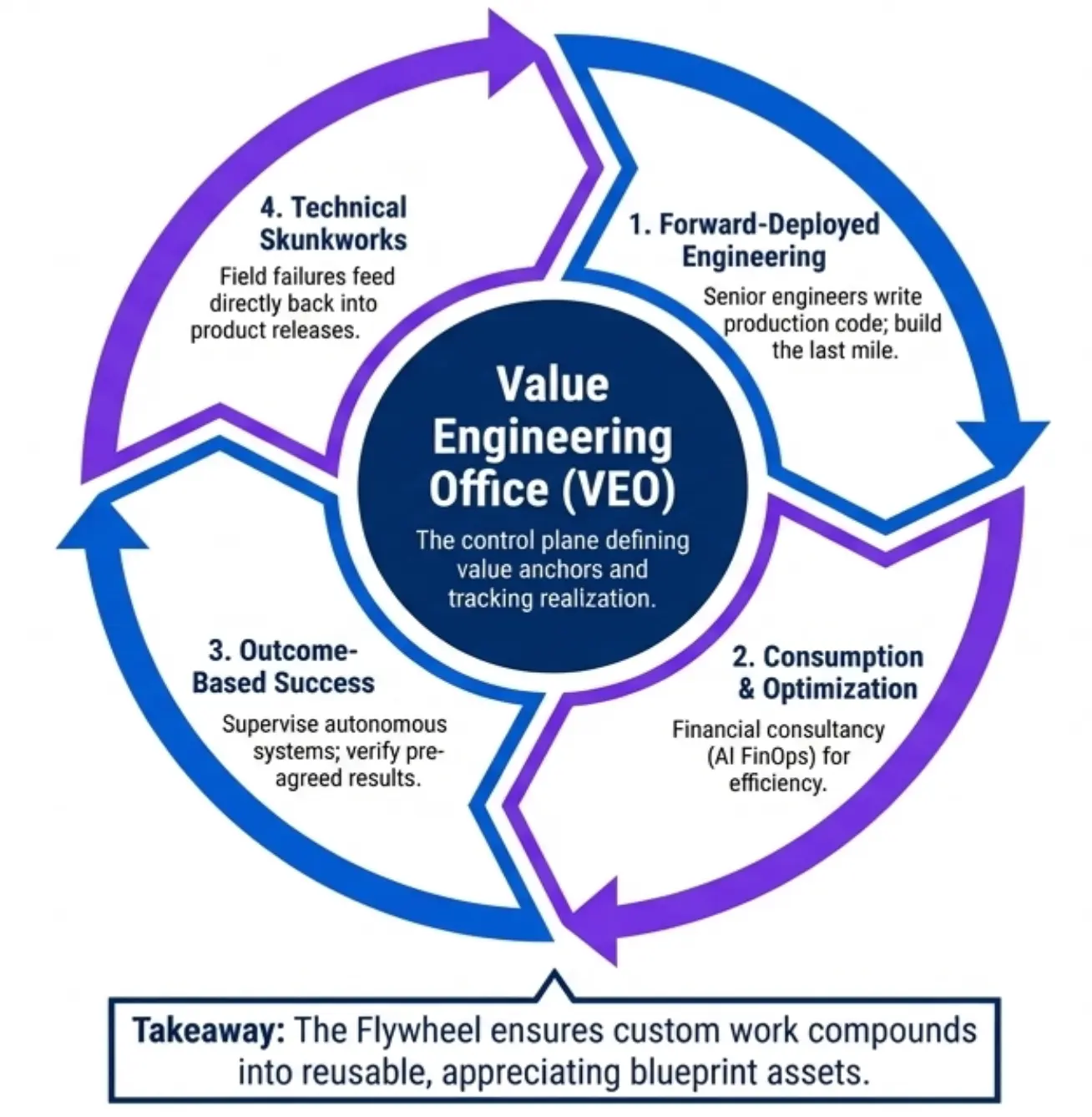
2. Process: Building a Services Engineering Flywheel
Traditional consulting models rely on one-off projects. That doesn’t scale in an AI-driven world.
Instead, you need a services engineering flywheel where:
- Custom work becomes reusable assets.
- Field insights feed back into product development.
- Delivery improves continuously over time.
Forward-deployed engineers (FDEs) play a critical role here, building the “last mile” solutions that make AI work in real-world environments.
To reduce risk, leading organizations also introduce structured gates:
- AI Readiness & Governance Services (ARGS): Ensure customers are ready before deployment.
- Value Optimization Services: Continuously improve performance and prevent model drift.
- Outcome-Oriented AI Services (OOAS): Use conversion triggers to auto-execute production contracts.
This ensures you’re not just delivering AI—you’re delivering outcomes consistently.
3. Technology: Proving Value at Scale
You can’t sell outcomes if you can’t prove them. That’s why Offering Management 2.0 depends on a telemetry-to-contract pipeline.
This system connects:
- AI activity.
- Operational data.
- Financial outcomes.
So you can directly tie actions to measurable results.
To support this, you’ll need:
- A unified data ontology that integrates CRM, financials, and telemetry.
- Offer blueprints that combine code, configuration, and pricing logic.
- Real-time reporting that validates outcomes.
Without this foundation, outcome-based pricing simply doesn’t work.
How You Measure Success in Offering Management 2.0
As your model changes, your metrics need to change too. Two key metrics stand out.
Value Realization Rate (VRR)
This becomes your most important metric. It measures how much of the promised value you actually deliver. If your VRR is low, your model breaks. If it’s high, you can scale outcome-based pricing with confidence.
The 10-10-10 Rule
This helps you maintain financial discipline:
- ≤10% non-monetized services.
- ≥10% revenue from paid success.
- Resource acquisition costs are within 10% of competitors.
For CFOs managing the shift to outcome-based contracts, this rule also includes a critical "risk reserve." To safely pool risk, no more than 10% of your outcome-based revenue should be allocated to engagements that fall below a defined confidence threshold.
By treating outcome contracts collectively rather than as isolated bets, you can use revenue from high-confidence, high-margin deployments to cross-subsidize riskier, more complex engagements. These benchmarks ensure your transformation is both scalable and sustainable.
Related: The 10-10-10 Rule for SaaS CFOs
You’re Not Just Changing Pricing—You’re Changing How You Win
Offering Management 2.0 isn’t a small adjustment. It’s a shift in how your entire business creates and captures value.
You’re moving from:
- Selling potential → selling proof.
- Measuring usage → measuring outcomes.
- Delivering projects → delivering continuous value.
And the risk of not making this shift is clear. If you stay tied to seat-based or effort-based models, your revenue will decline as your products get better.
The organizations that succeed will be the ones that:
- Redesign their offerings around outcomes.
- Build the systems to prove value.
- Align their entire business around delivering results.
The path forward is defined. The only question is how quickly you move.
Related: Retooling Your Services Portfolio for the Era of AI Economics™
FAQs
What is Offering Management 2.0?
Offering Management 2.0 is a modern approach to designing, pricing, and delivering technology offerings based on measurable business outcomes rather than access, usage, or effort.
Why are traditional pricing models failing in the AI era?
AI reduces the need for human labor, software seats, and time-based work. As a result, pricing models based on these factors generate less revenue as technology becomes more effective.
What role do forward-deployed engineers play in this model?
Forward-deployed engineers help bridge the gap between AI capabilities and real-world implementation. They build customized solutions that ensure AI delivers measurable outcomes in complex customer environments.
Smart Tip: Embrace Data-Driven Decision Making
Making smart, informed decisions is more crucial than ever. Leveraging TSIA’s in-depth insights and data-driven frameworks can help you navigate industry shifts confidently. Remember, in a world driven by artificial intelligence and digital transformation, the key to sustained success lies in making strategic decisions informed by reliable data, ensuring your role as a leader in your industry.