


AI is changing how technology companies grow. It’s also changing who is responsible for making that growth stick.
As vendors race to embed AI across products and services, they’re discovering a hard truth: AI-driven offerings don’t scale themselves. Adoption, integration, ongoing optimization, and measurable outcomes still require human-led execution. And increasingly, that execution depends on partners.
Channel partners have always extended reach. In the AI era, they do far more than sell. Partners help customers operationalize AI, navigate data and integration complexity, train teams, and turn early deployments into lasting business value. In other words, partners are now critical to adoption, retention, and expansion, not just revenue at the point of sale.
The problem is that most partner strategies haven’t caught up. Enablement still centers on product knowledge. Incentives still reward transactions. Performance metrics still look backward instead of across the customer lifecycle. As AI raises the bar for post-sale execution, these outdated partner models are becoming a constraint on growth.
To unlock partner-led growth in the AI era, vendors must modernize how partners are enabled, measured, and rewarded. They are shifting from transactional programs to lifecycle-driven ecosystems built for recurring revenue and services-led value.
Key Takeaways
- AI has fundamentally changed the role of channel partners: In the AI era, partners are no longer just a route to market. They are essential to adoption, integration, optimization, and long-term customer outcomes across the entire lifecycle.
- Outdated partner programs are now a growth constraint: Enablement built around product knowledge, transaction-based incentives, and metrics focused on bookings leaves partners unprepared (and unmotivated) to deliver post-sale value in AI-driven business models.
- Partner profitability is shifting from resale to services: As AI introduces new layers of operational complexity, the primary source of partner value and margin is moving toward high-impact services that help customers operationalize AI and achieve measurable outcomes.
The Partner Performance Triangle: A Systemic Problem
Underperformance is systemic. We’ve identified three structural barriers that prevent partners from succeeding in recurring revenue and AI-driven environments:
- The “Don’t Know” Problem: Partners lack clarity on expectations. Vendors emphasize adoption, expansion, and renewals verbally, but measure only revenue and bookings—which creates confusion around what truly matters.
- The “Can’t Do” Problem: Partners lack the skills, processes, and enablement to execute. Traditional training prepares partners to sell but not to drive post-sale outcomes, leaving them certified but unequipped.
- The “Won’t Do” Problem: Even capable partners won’t act without aligned incentives. Legacy discount and rebate structures reward transactional behavior rather than the lifecycle activities (adoption, expansion, and renewal) needed for recurring revenue success.
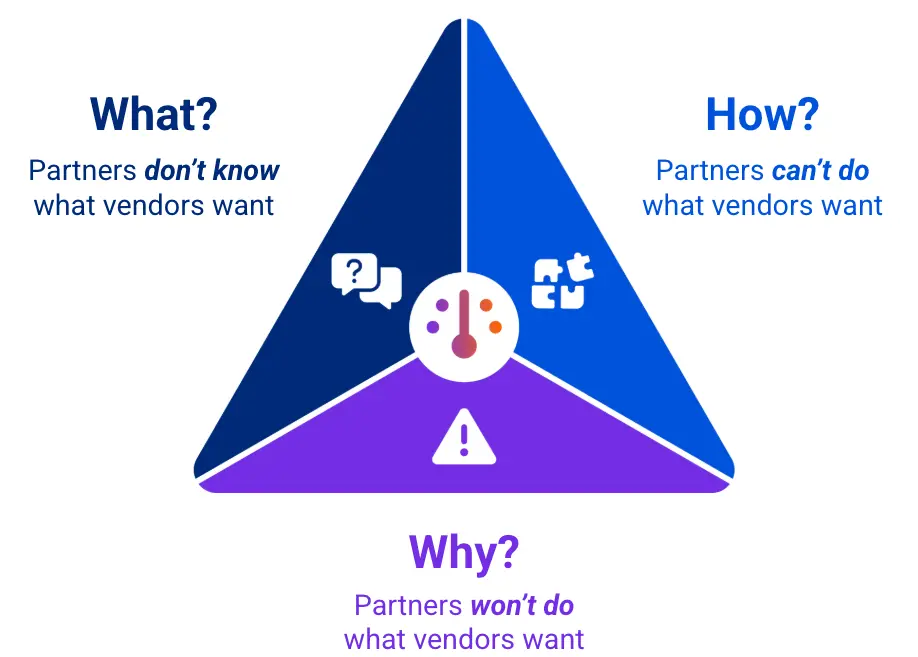
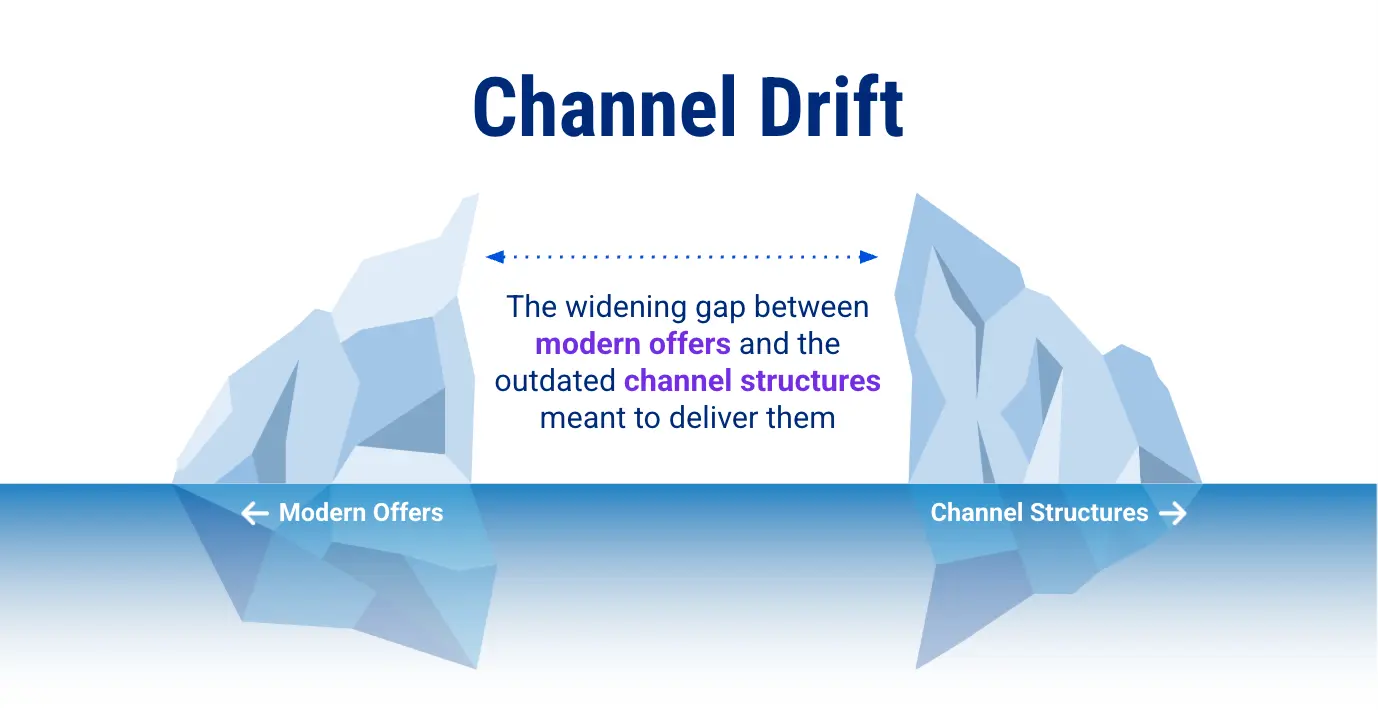
These challenges combine to create Channel Drift: a widening gap between modern, AI-enabled offerings and partner structures built for a different era. Vendors must modernize partner frameworks or risk persistent underperformance.
Related: The Partner Success Measurement Gap
Three Trends Redefining Partner Strategy in the AI Era
While AI introduces complexity that strains outdated partner models, it also provides the tools to modernize them. Three emerging trends reveal how AI is reshaping partner strategy and opening a new era of partner-led growth.
AI as an Accelerator for Partner-Led Growth
The first major trend is AI's ability to dramatically scale partner performance without requiring vendors to expand internal resources proportionally. Under pressure to "do more with less," companies are turning to AI to enable more partners, improve partner effectiveness, and drive better customer outcomes, all while keeping headcount relatively flat.
Leading vendors are deploying AI across the partner lifecycle. AI personalizes training based on partner skill gaps and learning patterns. It enhances sales collaboration by surfacing relevant content and next-best actions during active deals. It improves customer success motions by flagging at-risk accounts and recommending interventions. It automates expansion workflows by identifying usage patterns that signal upsell opportunities. It predicts churn by analyzing customer behavior and partner engagement quality.
The impact is measurable. AI-powered partner training is a strong predictor of partner-led XaaS revenue growth. Vendors using AI for training localization and customer success support report double-digit increases in partner-sold revenue compared to companies without those capabilities. AI-assisted upsell and cross-sell tools are improving retention rates while reducing the operational cost of managing large partner ecosystems.
Companies that integrate AI into their partner operations will accelerate partner-led growth at a pace that traditional, human-driven methods simply cannot match. AI is becoming the most critical accelerator for partner ecosystems.
The Rise of Predictive Partner Intelligence
The second major trend is the evolution from measuring what happened to forecasting what will happen. As vendors adopt more leading indicators across the customer lifecycle, partner scoring is evolving into partner forecasting.
Traditional partner scorecards focus on lagging indicators: last quarter's bookings, year-over-year growth, certifications completed. These metrics tell you where a partner has been, not where they're headed. By the time underperformance shows up in revenue numbers, you've already lost months of potential intervention time.
In the near future, partner performance will be guided by dynamic forecasting engines that combine structured and unstructured data. AI-driven models will blend inputs like certifications earned, implementation quality scores, customer onboarding speed, usage pattern trends, expansion activity, and renewal behaviors. They'll also incorporate external signals such as hiring trends at partner organizations, funding events, leadership changes, or layoffs that might affect capacity.
Instead of waiting for revenue results to confirm success or failure, vendors will be able to anticipate partner trajectory months in advance. A partner slipping from green to yellow health could trigger proactive support long before lagging metrics like sales revenue reveal the problem. Conversely, a rising partner who consistently drives early customer adoption and helps customers achieve initial business outcomes could be identified as a high-potential growth engine and prioritized for strategic investment.
This shift fundamentally changes how vendors engage their partner ecosystems. You move from reactive responses to strategic resource allocation. You invest in partners based on their likely future contribution, not just their historical performance. You identify risks and opportunities while there's still time to influence outcomes.
The vendors who gain the most from AI-driven forecasting models will be those who start by clarifying what they can measure now and identifying the leading indicators that signal future performance. Predictive partner intelligence will become the new navigation system for partner-led growth.
AI Complexity and the Future of Partner Services
AI is not simplifying enterprise technology; it’s shifting where complexity lives.
While AI reduces effort at the surface level, it introduces new layers of operational complexity beneath it. Data is fragmented across systems. Integration requires careful orchestration. Security and compliance risks increase. Employees need training to work effectively alongside AI. Existing workflows must be redesigned to capture AI’s value, and change management becomes critical to successful adoption.
This is what we call the AI Complexity Avalanche. As AI adoption accelerates, complexity compounds, and customers increasingly need help navigating it.
That complexity is reshaping how partners create value. As AI-driven offerings expand, the primary source of partner profitability is shifting away from resale and toward services that resolve complexity and accelerate outcomes.
The question is: how will partners make money in the AI era?
The answer is services. Partners generate profitability by delivering high-margin services that operationalize AI: preparing and integrating data, training customer teams, optimizing AI models for real-world use cases, and providing ongoing support to ensure AI investments continue delivering value over time.
For vendors, this represents a critical inflection point. Those that recognize AI-driven services as the foundation of partner profitability and realign their partner strategies accordingly, will unlock a new era of partner-led growth. Those that continue treating partners primarily as a sales channel will struggle to capture the full potential of their ecosystems.
AI complexity isn’t a problem to eliminate. It’s an opportunity to build a services-led partner ecosystem designed for the realities of the AI era.
Related: The Next Frontier of Partner-Led Growth
What Vendors Must Do Now: Four Actions
Understanding the challenges and trends is valuable, but action is what drives results. Vendors that want to modernize their partner ecosystems and capitalize on AI-driven growth need to take four, strategic steps. Each directly addresses the systemic challenges we've outlined.
1. Clarify Post-Sales Partner Expectations
Start by defining what you actually expect partners to do after the sale closes. This addresses the "don't know" problem head-on. If your partners are unclear about their role in adoption, expansion, and renewal, it's because your organization hasn't made those expectations explicit and measurable.
Align your performance metrics to the behaviors that drive land, adopt, expand, and renew. Track onboarding completion rates, time-to-first-value, usage adoption curves, expansion pipeline generation, and renewal rates by partner. When you measure what matters in a recurring revenue model, partners will respond by focusing on those activities. Metrics communicate priorities more effectively than any enablement document.
2. Build the Readiness Partners Need To Deliver Outcomes
Solve the "can't do" problem by fundamentally redesigning partner training and enablement. Move beyond product knowledge and sales techniques. Provide partners with the capabilities to deliver customer success motions, including effective onboarding, proactive health monitoring, expansion identification, and renewal management.
This requires defining what success looks like in your business and identifying which partner actions drive that success. Remember, only 41% of vendors have done this work. If you're not in that group, start there. You can't enable partners to achieve outcomes you haven't defined. Once success is apparent, build training programs, playbooks, and tools that develop the capabilities required to deliver it.
3. Redesign Incentives Around Lifecycle Value
Address the "won't do" problem by creating partner-friendly offers and aligning incentives with the LAER model. Partners need financial motivation to execute recurring revenue motions, and that means rewarding behaviors across the full customer lifecycle, not just at the point of sale.
Consider how your incentive structure supports partner profitability at each stage. Does your offer create opportunities for partners to deliver profitable services during onboarding? Are expansion activities financially rewarded? Do partners benefit when customers renew successfully? If the answer to any of these questions is no, you've identified where motivation will break down.
Partner-friendly offers are those designed to support partner-led delivery. They leave room for partners to add value through services, customization, and ongoing support. When you enable partner profitability, you naturally align partner motivation with customer success.
4. Support Partner-Branded, High-Margin Services
Help partners build the service capabilities that will drive their profitability in the AI era. This is where the AI Complexity Avalanche creates opportunity. Customers need help with data preparation, system integration, employee training, change management, and ongoing optimization. Partners are positioned to deliver these services, but many need support developing the offers, methodologies, and go-to-market strategies to capture that demand.
Vendors that actively enable partner services, through co-development programs, certification pathways, marketing support, and reference architectures, will strengthen partner motivation and unlock growth that pure product resale can't deliver. You're not just building a sales channel. You're building a services ecosystem.
Related: The State of Channel Partnerships 2026
The Path Forward for Partner-Led Growth
AI is accelerating partner-led growth, but only for vendors that modernize their ecosystem. Aligning metrics, incentives, and enablement to the full customer lifecycle ensures partners can scale AI adoption, deliver recurring revenue, and drive customer success. Vendors that act decisively will convert their partner ecosystem into a sustainable growth engine. Those who wait risk managing underperforming partners in a world moving faster than ever.
The channel remains one of technology’s most valuable assets. In the AI era, its value doesn’t diminish; it multiplies. Modernize your partner strategy today to seize the opportunity.
FAQs
How is AI changing channel partner strategies in 2026?
AI is shifting channel partner strategies away from transaction-focused sales models toward lifecycle-driven engagement. In 2026, successful partner programs prioritize adoption, expansion, and renewal, supported by enablement, metrics, and incentives aligned to post-sale execution rather than bookings alone.
Why are traditional partner programs struggling in the AI era?
Most partner programs were designed for simpler products and linear sales motions. AI-driven offerings introduce ongoing operational complexity and require partners to deliver services that support adoption and outcomes, capabilities that legacy enablement, incentive structures, and performance metrics were not built to support.
What is driving partner profitability in the AI era?
Partner profitability is increasingly driven by services rather than resale. As AI introduces new layers of complexity, partners create value by delivering high-impact services, such as data preparation, system integration, training, optimization, and ongoing support, that help customers operationalize AI and achieve measurable business outcomes.
Smart Tip: Embrace Data-Driven Decision Making
Making smart, informed decisions is more crucial than ever. Leveraging TSIA’s in-depth insights and data-driven frameworks can help you navigate industry shifts confidently. Remember, in a world driven by artificial intelligence and digital transformation, the key to sustained success lies in making strategic decisions informed by reliable data, ensuring your role as a leader in your industry.

.png)