

AI isn’t just changing how technology works. It’s changing how technology gets priced, delivered, and valued. If you’re a technology or services leader, you’re already feeling the tension. AI promises scale, automation, and efficiency—but it also quietly dismantles the economics that have powered your business for decades. Seat-based pricing weakens as AI agents replace human users. Traditional professional services struggle to scale. And “AI-enabled” add-ons no longer satisfy customers who expect measurable outcomes, not tools.
This is the moment the technology services industry enters the AI Services Revolution. The State of Technology Services 2026 report reveals a hard truth: AI doesn’t eliminate services—it makes them mandatory. Delivering outcomes in an AI-driven world requires deeper integration, higher-touch expertise, new pricing models, and entirely new operating structures. The companies that recognize this are rewriting the rules of profitability. The ones that don’t risk becoming invisible.
Key Takeaways
- AI breaks seat-based pricing and forces a shift to value and outcomes. If your revenue depends on human users, AI will eventually cannibalize it.
- Services are no longer an attachment—they are the delivery engine of AI value. The “last mile” makes professional and managed services central to outcomes.
- Winning in AI Economics™ requires organizational and pricing transformation, not feature upgrades. This is a business model reset, not a product refresh.
AI Economics™: Why the Old Playbook No Longer Works
For the past two decades, technology economics followed a predictable pattern. You sold access, and customers paid per seat. Growth came from adding users. Services existed mainly to help customers adopt the product, not to define value. AI shatters that model.
Autonomous AI agents are designed to do work, not just support people doing work. As AI becomes more capable, the need for human users declines. And when pricing is tied to users, your customers’ success becomes a revenue problem for you. This creates what the report defines as the cannibalization dilemma: The better your AI performs, the more it erodes your core revenue model.
That’s why AI Economics isn’t about embedding generative AI into existing products and services. It’s about redefining how value is created, delivered, and monetized—starting with services.
Related: How AI Economics™ Is Disrupting the Biggest Names in Tech
The Market Is Splitting—and Services Are the Fault Line
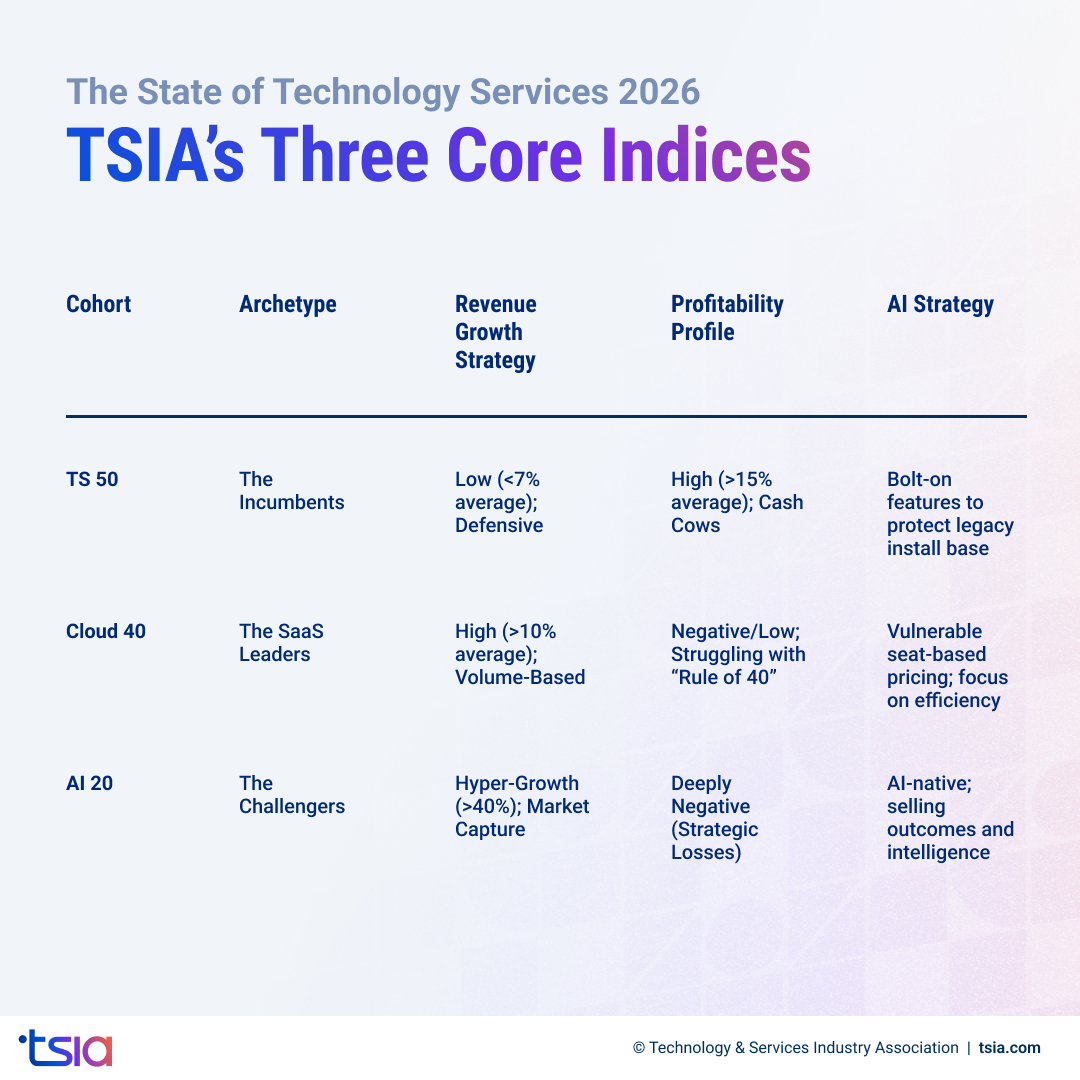
TSIA research shows the technology market is dividing into three distinct groups, each responding differently to AI disruption.
Incumbents: Defensive and Exposed
Mature technology providers are profitable but slow-moving. Most are attempting to “bolt on” AI features while protecting legacy pricing models. This defensive posture leaves them vulnerable because it treats AI as a feature—not a new economic engine.
SaaS Leaders: Growth Without Profit
Many cloud-era leaders are stuck between high burn rates and fragile seat-based pricing. AI threatens both. Efficiency gains can’t offset structural revenue pressure forever.
AI-Native Challengers: Selling Outcomes
The fastest-growing companies aren’t selling tools at all. They’re selling results—often at a loss today to build the infrastructure for tomorrow’s AI economy. Firms like Palantir demonstrate what happens when outcome delivery and services scale together.
The difference isn’t technology. It’s economics, and services are the mechanism. The following table compares TSIA’s three core indices: the TS 50, the Cloud 40, and the AI 20.
The Last Mile Makes Services Non-Optional
Early enthusiasm for generative AI suggested that enterprises could adopt AI through APIs and self-service models. In reality, most organizations hit the same wall: the last mile.
Your customers don’t operate in clean, modern environments. They run on legacy systems, fragmented data, strict governance, compliance mandates, and decades of technical debt. Raw AI models can’t navigate that complexity on their own. This is where services return—not as cost centers, but as value enablers.
Professional and managed services now handle:
- Data integration and cleanup.
- Model tuning and governance.
- Security and compliance.
- Ongoing optimization as models drift.
If you don’t deliver these services, someone else will, and they’ll own the outcome and the customer relationship.
Related: The AI Last Mile: How AptEdge Is Redefining Enterprise Support
Trend 1: Offers Are Moving From Products to Outcomes
AI accelerates the shift from selling tools to selling results. In the past, customers bought software and carried the risk of making it work. If the adoption failed, the vendor was still paid. That effort-based model collapses under AI.
Outcome-oriented offers flip the risk equation. Instead of selling access to AI, you sell what the AI accomplishes—resolved tickets, prevented outages, optimized supply chains. Pricing aligns to results, not effort.
This also reframes deployment. “Go-live” becomes day zero. The real value comes from operating, maintaining, and improving AI over time. Services that manage model drift, data decay, and optimization become part of the offer—not optional extras.
Related: Outcome-Oriented AI Services
Trend 2: Sales Is Becoming Consultative Engineering
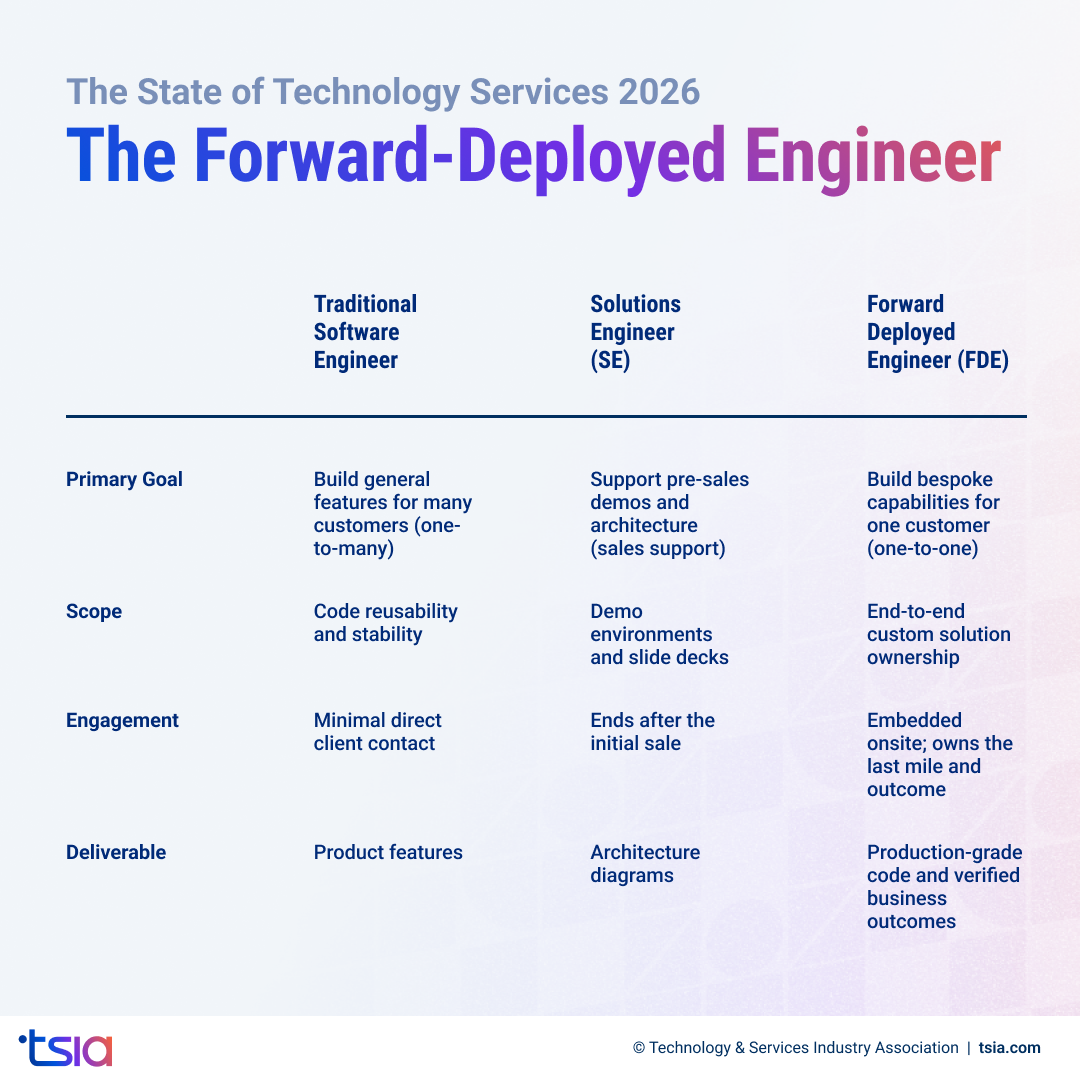
As outcomes replace features, selling changes too. Traditional sales engineering focuses on demos and architecture diagrams. That’s not enough when customers expect engineered results. Enter the forward-deployed engineer (FDE).
FDEs blend software engineering, consulting, and product expertise. They embed with customers to design and deliver AI outcomes inside real-world constraints. Companies like OpenAI and Salesforce are already adopting this model. For you, this means shifting from feature-selling to capability-selling—proving you can deliver outcomes, not just ship software.
The table below contrasts the FDE with traditional roles, highlighting why this evolution is critical for the AI era.
Trend 3: Pricing Is Climbing the AI Ladder
Seat-based pricing collapses in an AI world because AI reduces the number of seats. The transition won’t happen overnight, but the direction is unmistakable. Pricing is moving away from per-user models toward value-based consumption, and ultimately, to full, outcome-based pricing.
Value-based consumption bridges pricing to the complexity and impact of the task, not the number of users. This aligns revenue with value while managing financial risk. If pricing doesn’t evolve, AI success will shrink revenue rather than grow it.
Trend 4: Services Are Becoming Proactive, Intelligent, and Always On
AI is reshaping every service line:
- Support shifts from reactive to predictive, preventing issues before customers notice them. Companies like Palo Alto Networks already automate a majority of internal support interactions.
- Managed services evolve into guardians of AI ROI, continuously optimizing models and infrastructure.
- Customer success moves from usage tracking and task management to value realization, following a Design → Activate → Realize → Evolve (DARE) model.
- Field services become data-driven and augmented, reducing downtime and increasing revenue opportunities.
- Education services transition to AI-driven learning stacks. Providers like Databricks use AI to personalize learning and accelerate adoption at scale.
Across all functions, services shift from reacting to orchestrating outcomes.
Trend 5: Organizations Must Be Rewired for Value
You can’t deliver AI outcomes with siloed teams.
Leading organizations are introducing:
- Value Engineering Offices (VEOs) to define outcomes, metrics, and accountability.
- Cross-functional service pods aligned to industries or products.
- Centers of Excellence to scale AI, data, and resource management.
This structure ensures that the value promised in sales is engineered, delivered, and proven through services.
What’s Holding Companies Back
Despite the urgency, five barriers are slowing progress:
- Broken operational foundations that AI can’t automate.
- Poor data integrity—internally and for customers.
- Financial resistance to variable, outcome-based revenue.
- Shortages of AI-literate talent and FDEs.
- Lack of rigor in designing scalable service offers.
AI Economics requires fixing the foundation before scaling the future.
Technology Services in 2026: Compete or Concede
Technology services are entering a period of separation. You can protect legacy pricing, treat AI as a feature, and hope efficiency buys time. Or you can redesign your services, pricing, and organization around outcomes—and win in the Services Era.
AI doesn’t reward hesitation. It rewards those who sell results and deliver them relentlessly.
FAQs
How is AI changing technology services in 2026?
AI is shifting technology services from efficiency-driven, reactive support models to outcome-driven, proactive delivery. In 2026, services will play a central role in integrating AI into complex enterprise environments, managing data quality, preventing model drift, and proving business impact. As a result, professional and managed services are no longer add-ons—they are the primary mechanism for delivering AI value.
Why are technology companies moving away from seat-based pricing because of AI?
Seat-based pricing becomes unsustainable when AI automates work that previously required human users. As AI agents reduce the need for seats, revenue tied to user counts declines. To remain profitable, technology companies are adopting value-based consumption and outcome-based pricing models that align revenue with the complexity, impact, and results AI delivers rather than the number of users accessing the software.
What role do professional and managed services play in AI-driven outcomes?
Professional and managed services solve the “last mile” problem of AI adoption by integrating AI models into legacy systems, cleaning and governing data, and continuously optimizing performance. These services ensure AI delivers measurable business outcomes over time, making them essential for customer success, renewal, and long-term AI profitability in technology services organizations.
Smart Tip: Embrace Data-Driven Decision Making
Making smart, informed decisions is more crucial than ever. Leveraging TSIA’s in-depth insights and data-driven frameworks can help you navigate industry shifts confidently. Remember, in a world driven by artificial intelligence and digital transformation, the key to sustained success lies in making strategic decisions informed by reliable data, ensuring your role as a leader in your industry.

.png)