


AI is advancing quickly, reshaping how support and service organizations operate and how customers measure performance. As information moves faster than ever, expectations have shifted just as fast. Customers now expect immediate responses, personalized service, and consistent experiences across every interaction.
Yet many organizations are still waiting for the “perfect” moment to begin. That hesitation is becoming a costly risk. Momentum in AI adoption doesn’t come from long-term planning alone—it comes from visible wins and operational proof.
As Mike Flannagan, Corporate Vice President of Global Customer Success at Microsoft explains, the organizations seeing real results aren’t waiting for flawless strategies. They’re running focused 6–12-week sprints that deliver measurable impact quickly.
Key Takeaways
- Speed beats perfection in AI adoption. Waiting for the “right time” guarantees you fall behind. Real momentum comes from starting fast, learning in motion, and iterating with purpose.
- Your first AI use case must move a KPI that leadership cares about. If it doesn’t impact a metric tied to budget, growth, cost reduction, or customer satisfaction, it won’t earn sustained investment.
- Adoption accelerates when AI becomes the default—not an option. Executive sponsorship, frontline champions, and the removal of legacy workflows are what turn pilots into real operational change.
The Speed of Change Has Fundamentally Shifted
The way information spreads has transformed dramatically—from the printing press to social media. Today, customer experiences are shared globally in seconds. As a result, customer expectations now mirror the speed of digital conversation.
When issues arise, customers don’t wait. They post, share, and escalate immediately. That means your brand reputation is shaped by how quickly and clearly you respond.
Support teams are no longer measured in days or weeks. Responsiveness now happens in minutes or hours. AI is the mechanism that enables service organizations to meet that speed at scale consistently.
Related: The AI Services Era: Why Services Are Now Your Greatest Advantage
Why Support Leaders Can’t Wait for “Perfect AI Readiness”
In today’s environment, hesitation is a strategic risk. Waiting for perfect AI readiness delays learning, limits competitive positioning, and slows performance improvement.
As Flannagan shared, if organizations wait until everything feels complete, competitors will already be demonstrating measurable results. The takeaway is simple: progress comes from action, not perfection.
Rather than endlessly refining plans, successful teams launch early, learn quickly, and refine continuously.
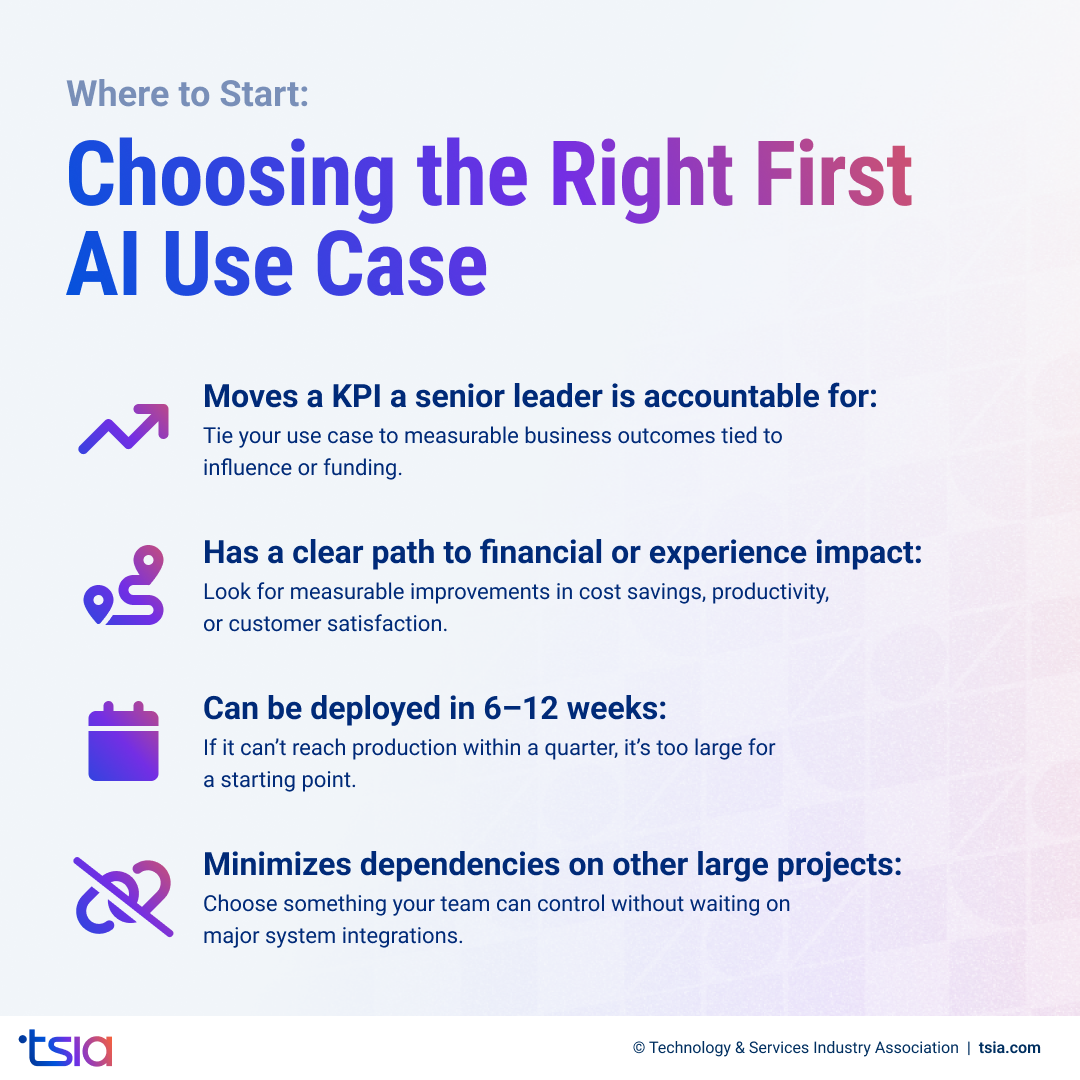
Where To Start: Choosing the Right, First AI Use Case
Support leaders face no shortage of AI ideas—but prioritization is critical. Your first project sets the tone for adoption and future investment.
Use these four filters to identify the right starting point:
- Moves a KPI a senior leader is accountable for: Tie your use case to measurable business outcomes tied to influence or funding.
- Has a clear path to financial or experience impact: Look for measurable improvements in cost savings, productivity, or customer satisfaction.
- Can be deployed in 6–12 weeks: If it can’t reach production within a quarter, it’s too large for a starting point.
- Minimizes dependencies on other large projects: Choose something your team can control without waiting on major system integrations.
Secure Executive Sponsorship Early
Every successful AI initiative needs an executive sponsor who can:
- Influence budget decisions.
- Support expansion.
- Communicate results to senior leadership.
As Flannagan summarizes, every prioritized business case must solve a real problem for someone who can sustain the momentum beyond the first sprint.
Related: A Framework for Digital-First Support
Build Momentum Through Quick Wins, Not Large-Scale Transformation
Traditional transformation programs often take years to show results. AI requires a different operating rhythm—one based on short, focused execution cycles.
A successful sprint follows a clear pattern:
- Delivers a fast improvement.
- Quantifies the benefit.
- Communicates the result clearly.
- Reinvests and scales.
Microsoft Support used this approach across five AI use cases. While not all succeeded, the combined effort delivered:
- A CSAT improvement from 4.76 to 4.82
- $455 million in savings
The lesson is not that every project will succeed—it’s that momentum compounds when learning continues sprint by sprint.
Related: 20 Emerging AI Use Cases for Generating Revenue
The Hardest Part of AI Adoption Isn’t Technology—It’s People
Technology behaves predictably. People don’t. AI initiatives stall when frontline teams don’t understand, trust, or adopt new workflows. That’s why change management must be built into every project from the start.
Successful leaders:
- Identify early champions.
- Empower frontline managers.
- Proactively address job security and productivity concerns.
- Treat change as a continuous process—not a one-time event.
Without adoption, even the best models fail to deliver measurable results.
Remove Optionality To Accelerate Adoption
People instinctively default to what they know. Optionality becomes one of the most significant barriers to change.
To drive widespread adoption, AI workflows must become the primary path—not just an alternative. That doesn’t mean forcing unsupported change. It means designing transitions so the new workflow is:
- Logical.
- Accessible.
- Supported with training and feedback.
As Flannagan noted, if teams are allowed to work the same way they always have, most will do exactly that.
Measure Business Impact and Communicate Results Relentlessly
AI programs gain credibility through measurable outcomes, not anecdotes.
Track results that show how AI affects:
- Resolution time.
- Cost-to-serve.
- Workforce productivity.
- Customer satisfaction.
- Retention.
Equally important is how those results are communicated. Translate outcomes into clear, executive-ready stories that show before-and-after impact. That visibility fuels reinvestment and ongoing scale.
How To Accelerate AI Adoption With 6–12-Week Sprints
There is no perfect moment to begin your AI journey—and waiting for one only delays the progress your organization needs to make right now. The teams seeing real results aren’t operating from flawless roadmaps. They’re moving with focus, speed, and discipline.
Acceleration starts with a single, well-chosen use case tied to a KPI your leadership team cares about. From there, momentum is built through a clearly defined sprint—one that delivers operational proof in weeks, not years.
Each sprint becomes the foundation for the next. What starts as a single win compounds into a repeatable operating motion for AI adoption across your support and service organization. The companies winning with AI aren’t waiting for certainty. They’re creating it by staying focused on one sprint at a time.
Frequently Asked Questions
How do we choose the proper first AI use case?
Start with a use case that directly moves a KPI that your leadership team has measured. If it doesn’t impact budget, growth, cost, or customer satisfaction, it won’t sustain momentum. It must also be feasible to launch within a 6–12-week sprint.
What if our first AI sprint doesn’t deliver significant results?
Early success isn’t about perfection—it’s about proof. Even partial wins create learning, operational insight, and credibility for the next sprint—progress compounds when you keep moving.
How do we overcome resistance to AI adoption on the front line?
Identify early champions, design workflows with them, and remove optionality from legacy processes. When AI becomes the default, supported with training and guardrails, adoption accelerates naturally.
Smart Tip: Embrace Data-Driven Decision Making
Making smart, informed decisions is more crucial than ever. Leveraging TSIA’s in-depth insights and data-driven frameworks can help you navigate industry shifts confidently. Remember, in a world driven by artificial intelligence and digital transformation, the key to sustained success lies in making strategic decisions informed by reliable data, ensuring your role as a leader in your industry.