




Imagine walking into a grocery store after a long day, just hoping to grab something quick for dinner. Every sign simply says “food,” and everything looks appealing—but milk is next to canned soup, produce is beside pet treats, and the tomato sauce sits next to anchovy paste. What should be a five-minute trip becomes chaos.
Now imagine a store that knows you. It recognizes your habits and understands that it’s Thursday night—curry night. The milk, vegetables, and spices are already waiting for you at checkout.
According to Mari Cross, Chief Customer Officer at Infor, that’s the difference between selling technology that looks good on paper and delivering solutions that feel designed for your customer’s world.
“Your customers are not asking you to be everything to everyone. They’re asking you to be theirs, everything to them.” said Mari Cross, Chief Customer Officer at Infor.
Even when companies believe their flexible, all-purpose platforms are helping customers, they often create more confusion than clarity. Instead of streamlined workflows and faster outcomes, customers face endless customization, budget overruns, and slow adoption. The result is what Cross calls the Value Void: the growing gap between outcomes customers are promised and the results they actually see.
While 75% of organizations expect at least a 20% productivity improvement, Infor found that only 30% were realizing those results, referencing McKinsey benchmarks. AI is beginning to change that dynamic—predicting customer needs, automating workflows, and personalizing solutions at scale.
Key Takeaways
- One-size-fits-all platforms widen the Value Void instead of closing it.
- Focusing on micro-verticals enables faster time-to-value and stronger adoption.
- AI makes personalization scalable, helping you deliver tailored outcomes without adding more staff.
The Value Void—and Why Your Customers Are Losing Patience
Every technology company makes the same promises: a better experience, faster results, and higher productivity. But reality often tells a different story. There’s a widening gap between what platforms can do and what customers actually get.
According to industry data, 75% of customers expect a 20% or greater productivity boost from their technology investments over the next three years. Yet, only about 30% ever achieve those results. Even with onboarding, tutorials, and adoption programs, most are still left to figure technology out on their own.
This is what’s known as the Value Void, the gap between potential and performance. It’s not a product problem; it’s an execution problem. Too many vendors rely on broad, one-size-fits-all enablement that forces customers to do the heavy lifting.
Customer expectations have shifted. They no longer define success by how many users log in or how many features are adopted. They want precision over possibility and personalization over programs. They expect technology built for the realities of their business, not generic tools they have to mold to fit.
Your customers don’t want to be empowered to do more work—they want you to take the work off their plate.
Horizontal Platforms Are Dying—Customers Want Precision
For years, technology vendors sold the promise of scale through broad, one-size-fits-all platforms—systems meant to work for every customer, across every industry, in any use case. In practice, that approach delivers the opposite: slow results, messy implementations, and solutions that feel disconnected from the customer’s world.
Horizontal platforms are no longer enough. Your customers want solutions that understand their business and deliver outcomes without added complexity. That’s why Infor took a different path, focusing on precision instead of generalization.
Rather than a single massive platform, Infor built three industry-specific platforms, each tailored to the unique needs of its sector. Within them are more than 2,000 micro-vertical processes—ready to support everything from dairy producers to brewers to bakers.
“What used to feel impossible just a few years ago is now possible with AI,” says Mari Cross, Chief Customer Officer at Infor. “It allows us to understand and serve our customers on a whole new level.”
The takeaway is simple: generalism no longer signals flexibility—it signals misalignment. It leads to lost deals, delayed renewals, and customers who can’t see themselves in your product.
Your customers aren’t asking you to serve everyone. They’re asking for precision—solutions that fit their world and deliver value without extra effort.
The Micro-Vertical Mindset
A micro-vertical isn’t a new buzzword or a deeper layer of product segmentation. It’s a mindset shift—from selling broad capabilities to solving real operational challenges within a specific industry segment.
Instead of thinking in terms of “retail” or “manufacturing,” a micro-vertical approach zeroes in on the exact workflows, metrics, and decisions that drive success in that niche.
Take the food and beverage industry as an example. Three companies might use the same platform, but how they define value looks completely different:
- A dairy producer focuses on optimizing yield to make more cheese from the same amount of milk.
- A brewer manages fermentation timing and batch consistency to protect quality.
- A baker fights supply chain volatility and tight freshness windows to keep shelves stocked.
They all make food, but each defines success differently.
The micro-vertical mindset isn’t about adding features or layers of complexity; it’s about focus. It builds repeatable workflows, shared language, and KPI frameworks that align directly with what drives business outcomes. The software doesn’t force customers to adapt—it adapts to them.
Related: How Infor Has Unlocked Value with Hyper-Verticalization
Why AI Makes Micro-Vertical Personalization Possible Now
Not long ago, tailoring software to a micro-vertical—customizing workflows, KPIs, and decision-making for each niche—was nearly impossible. It required teams of specialists, endless content creation, and expensive custom projects.
AI changed that. What once took months and hundreds of people can now happen automatically for every customer. Think of AI as an evolution in capability.
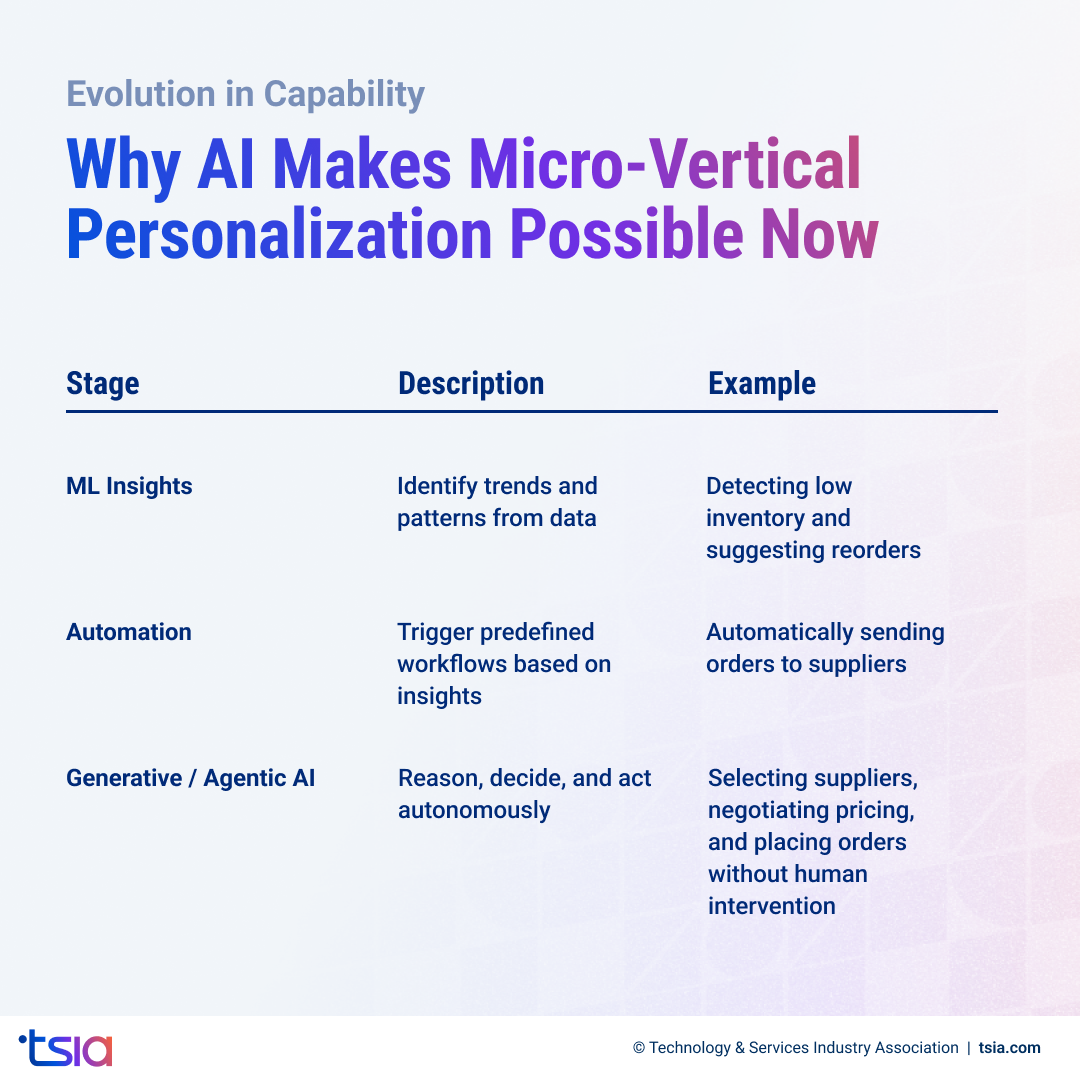
This evolution marks a shift from guidance → automation → autonomous execution.
In the micro-vertical model, AI doesn’t replace human expertise—it scales it. It turns context into action, transforming a static platform into a responsive system that understands your customer’s unique business and moves at their speed.
Related: Faster Outcomes: Accelerate Value and Scale Smart with Micro-Verticals
Value Mapping: From Software to Outcomes in Real Time
Bridging the gap between software and tangible business outcomes takes more than adoption programs. It requires a value playbook built directly into the product—and that’s precisely what value mapping provides.
Value mapping connects three critical elements in real time:
- KPIs → workflows → product capabilities: Every key metric ties directly to a workflow, feature, or automation within the platform.
- Co-created adoption roadmaps: Vendors and customers build them together inside the product, so every step tracks measurable outcomes.
- Business-impact prioritization: Implementation focuses on what drives the most value—not on feature volume, or technical complexity.
When this alignment clicks, the conversation shifts from “What features are live?” to “What value are we getting?”
For example, imagine a CFO at a brewery aiming to raise margins from 42% to 48%. The answer isn’t a list of new features—it’s a clear, data-backed connection between outcomes and capabilities:
- The ingredient optimization engine reduces hop waste.
- Batch yield analytics improves efficiency by 3–5%.
- Foam and spillage tracking captures lost volume and revenue.
This is how adoption becomes inevitable—when the path from software to ROI is visible, measurable, and shared.
Case Study: Milcà (Luxury Cheese Producer)
Milcà, a luxury cheese producer, processes over 240,000 liters of milk each year. But every batch was different—protein and butterfat levels varied, and each cow had its own ratios. Without real-time tracking, manual analysis took hours, delays were frequent, and yields suffered.
After modernizing with Infor’s cloud suite and implementing AI-driven dairy optimization, Milcà completely transformed its operations:
- Deviations are flagged seven times faster.
- 10 hours of manual work are saved each week—the equivalent of 65 working days per year.
- Implementation is completed in months, not years.
The results were immediate: yield stabilized, waste decreased, and production became more sustainable.
This is the power of combining micro-vertical precision with AI automation—delivering measurable, rapid results that are built entirely around the customer’s unique needs.
The Three-Step Micro-Vertical Playbook
Building a micro-vertical mindset isn’t a product overhaul—it’s an organizational shift. The goal isn’t to broaden your focus but to sharpen it. Start small, build on evidence, and let AI handle the heavy lifting.
Step 1: Choose Your Key Micro-Verticals
Don’t try to do everything at once. Start by identifying two micro-verticals where your product already delivers measurable value. Use data to guide you—product usage metrics, KPI performance, and “reverse demos,” where you sit with customers, observe their workflows, and uncover hidden patterns.
Within those patterns, you’ll find 5–10 repeatable workflows that become your micro-vertical gold mine—the foundation for scalable, outcome-driven solutions.
Step 2: Measure What Actually Matters
Your customers don’t celebrate logins or license counts, they celebrate results. Focus on the KPIs that matter at the board level: yield, assembly uptime, production efficiency, or cycle time.
Map each KPI directly to the workflows, automations, and AI actions that influence it. Tracking AI’s impact means measuring real, quantifiable outcomes—not vanity metrics.
Step 3: Enable Teams With AI and Micro-Vertical Context
Once your KPIs are defined, integrate them across your organization. Every function should align around the same micro-vertical priorities:
- Sales uses preconfigured demos tailored to each micro-vertical.
- Customer success tracks progress based on KPI movement, not feature adoption.
- Support routes inquiries by micro-vertical expertise.
- Education leverages AI-driven, persona-based learning pathways.
This alignment makes execution repeatable, measurable, and fast—the key to turning focus into impact.
Related: When AI Becomes the Strategy, Not the Tool
Overcoming the Common Objections
Even when the business case is obvious, many leaders hesitate to operationalize a micro-vertical model. The resistance usually sounds familiar—and each concern has a straightforward answer.

A micro-vertical model doesn’t add layers of work. It removes ambiguity. It aligns your product, your teams, and your customers around the exact definition of success.
The challenge isn’t product capability—it’s organizational mindset. For years, companies competed on feature volume, flexibility, and the ability to “mix and match” modules. That’s no longer the winning formula.
Today, the competitive edge is accuracy.
Your customers aren’t asking for broad platforms or endless options. They want precise solutions that deliver value without extra effort. The companies that provide that specificity earn loyalty. The ones that don’t are falling behind.
In this new era, the burden doesn’t sit with the customer to figure things out. It sits with the vendor to bring clarity, context, and outcomes from day one.
FAQs
How should we choose our first micro-verticals?
Start with two segments where your product already delivers repeatable workflows and real outcomes. Use usage data, KPI patterns, and customer observations to identify where value is already happening.
How do we demonstrate ROI quickly?
Tie the implementation to 2–3 KPIs that matter at the executive level. When you anchor the work to measurable business outcomes—not adoption metrics—you show impact fast.
Do we need net-new product features to support micro-verticals?
No. You need clearer packaging, defined workflows, aligned KPIs, and AI-supported enablement. Most of the capability already exists—the focus and framing are what unlock value.
Smart Tip: Embrace Data-Driven Decision Making
Making smart, informed decisions is more crucial than ever. Leveraging TSIA’s in-depth insights and data-driven frameworks can help you navigate industry shifts confidently. Remember, in a world driven by artificial intelligence and digital transformation, the key to sustained success lies in making strategic decisions informed by reliable data, ensuring your role as a leader in your industry.

.png)





.png)
.png)
.png)
